
died 2nd century·Feast June 19
Ss. Gervasius and Protasius
Twin martyr brothers of Milan
Overview
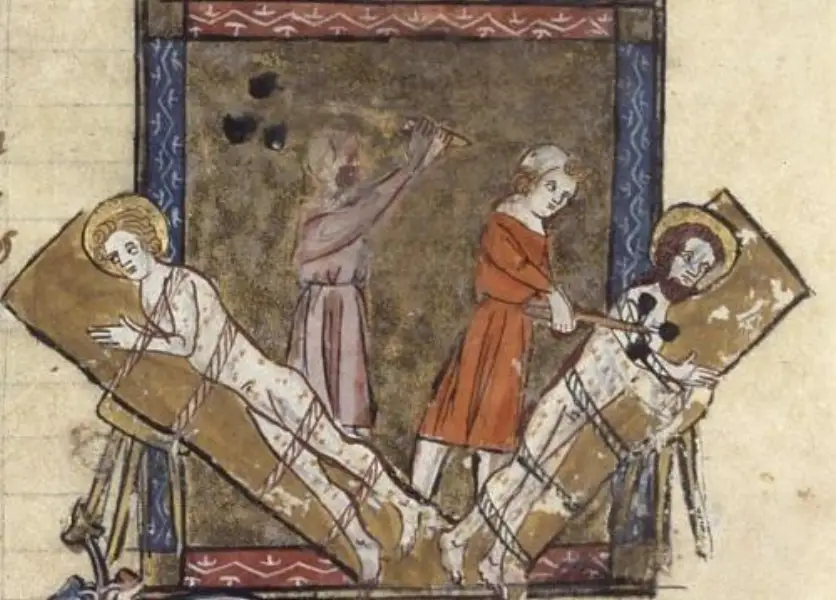
Gervasius and Protasius, known also as Gervase and Protase, are venerated as Christian martyrs who probably suffered in the second century at Milan. According to their acta, the pair were twins born to parents who were themselves martyrs: Vitalis of Milan, their father, held consular rank and suffered death at Ravenna, perhaps in Nero's persecution, while their mother Valeria gave her life for the faith in Milan. The brothers themselves, remembered in art with large hands, died when Anubinus or Astasius presided and Caius governed the see of Milan; they endured the scourge and then the sword. Most scholars set their death in the reign of Marcus Aurelius. Their relics lay forgotten until 386, when Ambrose, prompted by a dream, unearthed them in the cemetery church of Saints Nabor and Felix and translated them to his new basilica at Milan amid reported miracles that strengthened his stand against the Arian empress Justina. Patrons of Milan and of haymakers, and invoked for the discovery of thieves, they are honored on June 19 in the Latin Rite and October 14 in the East, and in art they carry the scourge, club, and sword.
The Complete Life
Sons of Martyrs
The acta of Gervasius and Protasius, simple in style and difficult to date, present the brothers as the twin sons of parents who had already given everything for the faith. Their father was Vitalis of Milan, a man of consular rank who was put to death for his Christianity at Ravenna, in circumstances the tradition connects with the persecution of Nero. Their mother, Valeria, completed the family's witness by dying for her faith at Milan itself. The sons thus grew up, on the testimony of their legend, as children of the confessors, marked from the first by the inheritance of their blood. They were imprisoned for their own profession of Christ and were visited in prison by Nazarius, another of the revered figures of the Milanese church. Later imagination fixed on a curious physical detail preserved in the tradition: the brothers are said to have had large hands, a trait that passed into their iconography. Whatever the acta's historical value, they preserve the memory of a household in which martyrdom was not an isolated catastrophe but the family's defining vocation.
§ Martyrdom
Scourged and Beheaded
The tradition records that scourging came first for the brothers, and beheading after, in the days when Anubinus or Astasius held the presidency and Caius sat on Milan's episcopal throne. The date of their passion has long been debated. Some authors place it under the Emperor Diocletian at the beginning of the fourth century, but others object that on that timing one must ask how, barely a generation before Ambrose, the martyrs' gravesite and even their names could have slipped from memory, as the discovery account asserts. The more probable setting, adopted by modern scholars, is the reign of Emperor Marcus Aurelius, between 161 and 180, when the church of Milan suffered its own trials. In the Eastern churches their feast on October 14 preserves the traditional day of their death. For Milan the brothers remained, after their death, buried and unnamed, until the fourth-century discovery that returned them to the city's memory.
§ Martyrdom
The Discovery of 386
In 386 Ambrose had built a magnificent basilica at Milan, the church now known as Sant'Ambrogio, and the people asked that its consecration match the solemn ceremony used in Rome. Ambrose answered that he would, provided relics befitting the altars could be secured, and in a dream he was shown where such remains could be found. Excavations were ordered outside the walls, in the cemetery church of Saints Nabor and Felix, then the primary patrons of Milan, and there the relics of Gervasius and Protasius came to light. Ambrose himself described the event in a letter, reporting the manifestations of power that accompanied the work and the two bodies of marvelous stature, their bones whole, with much blood. He had the relics moved first to the Basilica of Fausta, now the church of Saints Vitalis and Agricola, and the next day into his own basilica, an arrival accompanied in the sources by many miracles. The occasion carried political weight, strengthening Ambrose in his contest with the Arian empress Justina, and the whole episode was written up for his sister Marcellina.
§ Ambrose and Gervasius and Protasius
Witnesses of the Milanese Church
Like all the martyrs of the first centuries, Gervasius and Protasius were never canonized by any later process; their cult rests on their passion and on the immediate recognition the Church gave to it. Augustine, not yet baptized, claimed to have witnessed the events of 386 and recorded them in his Confessions, in the City of God, and in a sermon for the saints' feast; Paulinus likewise told of them in his life of Ambrose. The Latin Rite keeps their feast on June 19, the anniversary of the translation of the relics, while the Eastern Orthodox Church and the Eastern Rites of the Catholic Church honor them on October 14, the traditional day of their death. Their names were inserted very early into the Litany of the Saints. Ambrose, who died in 397, was buried in his basilica at his own wish by the side of the two martyrs he had recovered, and in 835 the three saints' remains were gathered into a porphyry tomb by Angilbert II, who then governed the Milanese church.
§ Ambrose and Gervasius and Protasius
Churches, Tapestries, and Harvest Weather
The cult of the brothers spread at once after Ambrose's discovery. Churches rose in their honor at Pavia, Nola, and other Italian towns, and in Gaul, around the year 400, at Mans, Rouen, and Soissons. Pope Innocent I dedicated a church to them in Rome, to whose title the name of their father Vitalis was later added, giving the Basilica of San Vitale. In art they appear from the sixth-century mosaics of San Vitale in Ravenna to Philippe de Champaigne's painting, now in the Louvre, from the Parisian church of Saint-Gervais-Saint-Protais; Antwerp's cathedral still displays the great tapestry series of their life donated in 1509. A tradition, rejected by Milan itself, claimed that after Barbarossa's destruction of the city his chancellor Rainald of Dassel carried the relics to Breisach in Germany, whence some reached Soissons. German farmers venerated them as weather saints, with a harvest proverb threatening forty days of rain if it rained on Gervasius's day. In Kerala, the Syrian Catholics know them as Kandeeshangal, a name once given to the Persian missionaries Mar Sabor and Mar Proth; a decree of the Synod of Diamper redirected those dedications to the Roman martyrs, whose intercession is still believed to obtain the grace of twins for childless couples.
§ Veneration
Timeline
- 161
Probably martyred at Milan under Emperor Marcus Aurelius (161–180), scourged and then beheaded.
§ Martyrdom
- 386
Ambrose discovered the brothers' relics by dream-guided excavation and translated them to his new basilica in Milan amid reported miracles.
§ Ambrose and Gervasius and Protasius
- 397
Ambrose died and was laid to rest, as he had asked, beside the two martyrs in his own basilica.
§ Ambrose and Gervasius and Protasius
- 400
Churches were dedicated to the saints in Gaul, at Mans, Rouen, and Soissons, around the year 400.
§ Veneration
- 402
In Rome Pope Innocent I consecrated a church in their honor, which later took the name of their father Vitalis, becoming the Basilica of San Vitale.
§ Veneration
- 835
The relics of all three saints were enclosed in a porphyry sarcophagus by Milan's bishop Angilbert II.
§ Veneration
- 1509
A famous series of tapestries of the life of the saints was donated to the Cathedral of Antwerp.
§ Veneration
- Jan 1864
The porphyry sarcophagus of Angilbert II was found again in Milan in January 1864.
§ Veneration
In Their Own Words
I found the fitting signs, and on bringing in some on whom hands were to be laid, the power of the holy martyrs became so manifest, that even whilst I was still silent, one was seized and thrown prostrate at the holy burial-place. We found two men of marvelous stature, such as those of ancient days. All the bones were perfect, and there was much blood.
Wenn's regnet auf Gervasius / es vierzig Tage regnen muss
The Record
- Patron of
- Milan·Breisach·haymakers·invoked for the discovery of thieves
- Symbols
- the scourge·the club·the sword
- Canonization
- Pre-congregation; venerated as martyrs from antiquity, honored especially for the discovery of their relics by St. Ambrose in 386.
Prayer
Bibliography
Show 7 sources
- Mershman, Francis. "Sts. Gervasius and Protasius." The Catholic Encyclopedia. Vol. 6. New York: Robert Appleton Company, 1909.
- Stracke, Richard (20 October 2015). "Gervasius and Protasius: The Iconography". Christian Iconography.
- "Acta Sanctorum" June, IV, 680 and 29.
- Ambrose, ed. & tr. by John Hugo Wolfgang Gideon Liebeschuetz, Ambrose of Milan: Political Letters and Speeches, Liverpool University Press, 2005.
- Williams, D. H. (1995). Ambrose of Milan and the End of the Arian-Nicene Conflicts. Oxford: Clarendon Press.
- Weigert, Laura (1995). "Reconstructing Medieval Pictorial Narrative: Louis Joubert's Tapestry Restoration Project". Art Journal 54.2: 67-72.
- Herbermann, Charles, ed. (1913). "Sts. Gervasius and Protasius". Catholic Encyclopedia. New York: Robert Appleton Company.
Profile text adapted from the Wikipedia article, licensed CC BY-SA 4.0.
Pray with this saint every day
Save Ss. Gervasius and Protasius to your favorites, read the full profile, and get feast-day reminders in the Saints app.
Get the Saints AppFree on the App Store for iPhone and iPad