
died c. 120·Feast June 10
St. Getulius
Martyr of Sabina, husband of Symphorosa
Overview
Getulius was a Christian martyr who died around 120 and is venerated together with his companions Amantius, Cerealus, and Primitivus. According to his legend he was a native of Gabii in Sabina and an officer in the Roman army who gave up his commission when he became a Christian, withdrawing to his estates near Tivoli. Sent to arrest him, the imperial legate Cerealus and the officer Primitivus were themselves converted by his witness, while Amantius was his own brother. The account of his passion relates that the four men were bound to a stake and set on fire, emerged from the flames unharmed, and were then clubbed and beheaded. Getulius is honored as the husband of St. Symphorosa and the father of seven sons who were likewise martyred, each by a different death. His remains came to be honored at several places: on the Via Salaria at a site later called the Corte di San Getulio near Montopoli di Sabina, at the abbey of Farfa from 867, and at the church of Sant'Angelo in Pescheria in Rome, where his relics are purported to rest in the principal altar.
The Complete Life
An Officer of Gabii
Getulius is remembered as a native of Gabii, in the Sabine territory east of Rome, in the first years of the second century. His very name carries a far horizon: it means 'of the Gaetuli', a people of North Africa, and suggests a family line that had reached Latium from the southern shore of the Mediterranean. He pursued the career open to a man of his standing and became an officer in the Roman army. His life changed direction when he accepted the Christian faith. Still a young religion in the eyes of the empire, Christianity demanded a loyalty that the army's oath could not easily accommodate, and Getulius chose it without reservation: he resigned his commission, left his military post, and retired to his own estates near Tivoli to live as a Christian layman. There, in the country he had chosen, his household became a center of the faith, and his wife Symphorosa shared his convictions. It was from this quiet retirement that he would be summoned back into imperial hands.
§ Legends and burial
The Faith That Drew His Persecutors
The legend of Getulius is built around a striking irony: the men dispatched to arrest him were captured by him instead. When the imperial legate Caerealis was sent to take the retired officer into custody, he found in his prisoner a man whose serenity and conviction overmatched the authority he represented, and he returned a Christian rather than a jailer. The empire tried again. The officer Primitivus was dispatched on the same errand, and the same thing occurred: instead of dragging Getulius to punishment, he too was converted to the faith he had come to suppress. Joining them was Amantius, Getulius's own brother, who shared his confession. In this way the group of martyrs venerated under Getulius's name came together: four men bound not by a military command but by baptism. The story reflects a constant theme of the early persecutions, in which the courage of the accused proved more persuasive than any argument, and the instruments of the state, sent to extinguish a congregation, swelled it instead.
§ Legends and burial
Fire, Club, and Sword
According to the account of his passion, the four confessors were condemned together and made to die as a single witness. They were tied to a stake and the wood beneath them was set alight, the customary stage of execution meant to break the condemned by terror and pain. The fire, however, did not harm them; the legend insists that they stood in the flames and were not consumed. Denied the spectacle of suffering, the executioners turned to blunter instruments: the four men were brutally clubbed, and finally beheaded. Some traditions locate the killing on the Via Salaria, the old salt road leading out of Rome, and the Martyrology of Ado fixes the site with precision at a farm called Capriolis on that road, about thirteen miles from the city above the Tiber on the Sabine side, a place known in the Middle Ages as the Corte di San Getulio, in what is today Montopoli di Sabina, because a church was later raised there that kept some of the martyr's relics. Getulius is called the father of the Seven Martyrs, his sons by Symphorosa, each of whom, by their own legend, perished by a different wound: Crescens was pierced in the throat, Julian in the breast, Nemesius in the heart, Primitivus struck at the navel, Justinus run through from behind, Stracteus stabbed in the side, and Eugenius cut in two from head to foot.
§ Legends and burial
Burial on the Family Estate
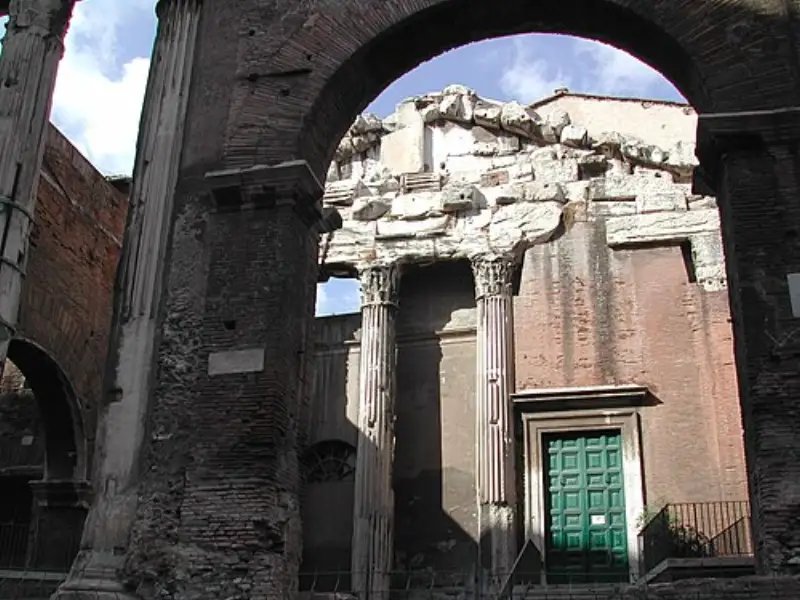
After the execution, the legend assigns to Symphorosa the office of a Christian widow: she gathered the bodies of her husband and his companions and buried them in an arenarium, a sand quarry or cemetery vault, on her own estate. The act, performed at evident risk, made the family property a martyr's shrine, and from it all later translations of the relics derive. The remembrance of the place was precise enough that the ninth-century Martyrology of Ado could describe the site, on the Via Salaria above the Tiber toward Sabina, and the memory endured into the Middle Ages, when the Corte di San Getulio near Montopoli di Sabina marked the spot and a church there originally held part of his remains. In 867 the bond between the martyr and that ground was solemnly acknowledged when Abbot Peter of Farfa moved the relics from the site to his abbey nearby in a ceremonial translation, while the tradition also maintained that Getulius's relics lay in Rome itself, in the church of Sant'Angelo in Pescheria.
§ Legends and burial
A Cult of the Earliest Church
Getulius belongs to the company of martyrs who were never canonized by any process, since his confession of Christ and death for it were themselves recognized as sanctity from the beginning. He is venerated in the Roman Catholic Church and the Orthodox Church, and his feast is kept on June 10. The diffusion of his relics charts the devotion he received: at Rome they are purported to rest in the principal altar of Sant'Angelo in Pescheria, where his purported wife Symphorosa and their seven sons had been brought by Pope Stephen II in 752, and where a sarcophagus uncovered in 1610 bore an inscription recording that translation. During the pontificate of Pius IV the relics were placed in an urn of glass. In 1584 Pope Gregory XIII gave part of them to the Jesuits, and portions reached Jesuit colleges in India and Spain on June 25, 1572. To prevent further distribution, the governor of Rome, Mariano Perbenedetti, enclosed the remainder at Sant'Angelo in a marble sarcophagus on September 26, 1587, the same tomb that also holds relics of Cyrus and John.
§ Veneration
Shrines from Sabina to Panama
The memory of Getulius is attached to a chain of places reaching far beyond the Sabine countryside where he died. A church of San Getulio once stood at Teramo in the Abruzzi, bearing his name. At the site on the Via Salaria where tradition placed his passion, a church that originally kept some of his relics gave the locality its medieval designation as the Corte di San Getulio, now part of Montopoli di Sabina, and the abbey of Farfa, which received relics in 867, carried his cult among the great religious houses of central Italy. In Rome, the church of Sant'Angelo in Pescheria holds the principal shrine, where the martyr's remains are purported to rest in the high altar alongside those of the saints Cyrus and John in a marble sarcophagus sealed in 1587. The Jesuit missions carried his cult across the world with the fragments of his relics: to colleges in India and Spain in the sixteenth century, and ultimately to Panama City, where part of his relics are purported to be enshrined in an altar of the Metropolitan Cathedral Basilica of Santa María la Antigua, linking the martyr of the Via Salaria to the church of the Americas.
§ Veneration
Timeline
- 120
Martyred with Amantius, Cerealus, and Primitivus; burned without harm at a stake, then clubbed and beheaded.
§ Legends and burial
- 752
Pope Stephen II transferred the relics of St. Symphorosa and her seven sons to the Church of Sant'Angelo in Pescheria at Rome.
§ Veneration
- 867
Abbot Peter of Farfa translated relics of Getulius to his abbey with solemn rite.
§ Legends and burial
- 25 Jun 1572
Relic fragments reached Jesuit houses of study in India and Spain.
§ Veneration
- 1584
Pope Gregory XIII donated part of his relics to the Jesuits, enshrined in a chapel near the Villa d'Este.
§ Veneration
- 26 Sep 1587
Mariano Perbenedetti, governor of Rome, enclosed the remaining relics at Sant'Angelo in a marble sarcophagus.
§ Veneration
- 1610
A sarcophagus was found at Sant'Angelo in Pescheria bearing an inscription naming Symphorosa, her husband, and her sons.
§ Veneration
In Their Own Words
Consumati sunt beati Martyres Gethulii in fundo Capriolis, viam Salariam, ab urbe Romam, plus minus miliario decimotertio, supra flumium Tiberim, in partem Savinensium.
Hic requiescunt corpora SS. Martyrum Simforosae, viri sui Zotici (Getulii) et Filiorum ejus a Stephano Papa translata.
The Record
- Canonization
- Pre-congregation; venerated as a martyr and saint from the earliest tradition of the Roman Church.
Prayer
Bibliography
Show 4 sources
- "St. Getulius". Catholic Online.
- "CATHOLIC ENCYCLOPEDIA: Saint Symphorosa".
- "San Getulio" (in Italian).
- "El Papa consagra altar de la primera catedral en tierra firme de América". vaticannews.va (in Spanish). Retrieved 2025-05-08.
Profile text adapted from the Wikipedia article, licensed CC BY-SA 4.0.
Pray with this saint every day
Save St. Getulius to your favorites, read the full profile, and get feast-day reminders in the Saints app.
Get the Saints AppFree on the App Store for iPhone and iPad