
died October 9, 680·Feast October 9
St. Ghislain
Anchorite of Hainaut and founder of the bear's den
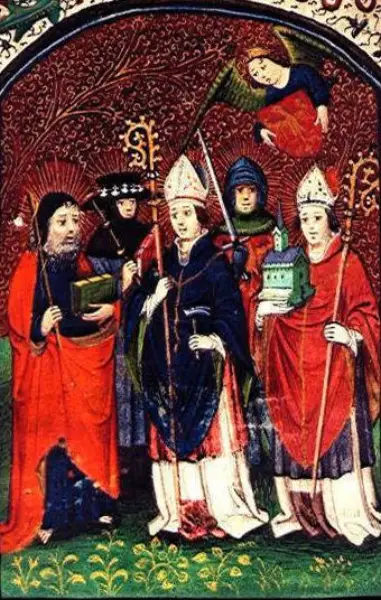
Overview
Ghislain was a confessor and anchorite in what is now Belgium, a man probably of Germanic origin who lived in Hainaut in the generation of Amandus, of Waltrude, of Aldegonde, and of Amalberga of Maubeuge. Two disciples, Lambert and Berler, shared his labor: together they opened a clearing in the wilderness near Castrilocus — today's Mons — and later settled at a place called Ursidongus, the bear's den, where he built an oratory dedicated to Saints Peter and Paul. Aubert of Avranches, summoned to sound the intentions of this nearly unknown hermit, came away an ally and granted him effective protection, and during a visit to Cambrai Ghislain received the estates of Celles and Hornu as a gift. His counsel drew Waltrude to found a monastery at his former refuge, and his friendship shaped the religious vocations of Aldegonde, Amalberga, and Aldetrude, knitting Maubeuge and his own foundation into a single spiritual family. He died at Ursidongus on 9 October 680, and the monastery he had founded took his name — becoming the town of Saint-Ghislain. His relics traveled through the centuries by way of Grandlieu and Le Cateau-Cambrésis before returning home in 1647, and his feast is kept on 9 October.
The Complete Life
A Clearing at Castrilocus
Ghislain's beginnings are wrapped in the obscurity proper to anchorites: he was probably of Germanic origin, and no record names his birthplace or his youth. What emerges first from the sources is a hermit already at work in the province of Hainaut, laboring in the same years as Amandus, the great bishop-missionary who died in 679, and alongside the holy women of the Maubeuge circle — Waltrude, Aldegonde, and Amalberga. Two disciples, Lambert and Berler, were at his side when he opened a clearing in the forest not far from Castrilocus, the settlement that grew into Mons, and took up his first dwelling there. Later he moved to a place called Ursidongus — a name meaning bear's den, though the animal in question belonged to legend rather than to natural history. On that ground he raised an oratory, or small chapel, dedicated to the Apostles Peter and Paul, the seed from which his monastery and eventually a whole town would grow. It was a characteristic foundation of seventh-century Christianity: not a cathedral or a school, but two or three men in a clearing, a chapel of wood, and the daily office prayed where the wolves had howled. From such outposts, the faith of the Merovingian countryside was won.
§ Life
Counsel to Saints and Foundations
Ghislain's influence soon reached beyond his clearing. Aubert of Avranches, the bishop, summoned the almost unknown hermit into his presence to examine his intentions — a prudent inquiry into any unrecognized ascetic — but what he found convinced him, and he afterward granted Ghislain efficient and lasting protection. During a stay at Cambrai, the hermit sojourned at the villa of Roisin and was given, as a free gift, the estates of Celles and Hornu, endowments that secured the material future of his foundation. His counsel proved even more consequential for the women's houses of the region. He entered into close relations with Waltrude and persuaded her to build a monastery at Castrilocus, his own former place of refuge, extending the monastic map of Hainaut. It is probable that he shaped the religious vocations of Aldegonde, Abbess of Maubeuge, of Amalberga, and of Aldetrude — Aldegonde's sister and Waltrude's daughters respectively. When Aldegonde saw a vision at Maubeuge of the death of Amandus, Bishop of Tongeren, Ghislain came to her at Mairieu, her villa close to Maubeuge, and told her that the vision in truth announced her own approaching death. The understanding between the hermit and the abbess bound Maubeuge and Ursidongus into one spiritual family, and Waltrude rewarded her counselor with part of the villa of Frameries and the oratory of Saint-Quentin within the villa of Quaregnon.
§ Life
Death at the Bear's Den
Ghislain ended his days where he had built, dying at Ursidongus on 9 October 680. He did not live to see the consequences of his work, which outlasted him by many centuries: the monastery he had founded took his own name, and around it grew the town of Saint-Ghislain, one of the few municipalities of Belgium that carries a saint's name outright. His burial there made the place a center of devotion from the beginning, and the history of his relics became the history of the community that guarded them. The remains were first disinterred around 929, a sign of the growing formality of his cult. Around the close of the tenth century or the opening of the eleventh, they were transferred to Grandlieu, near Quaregnon, perhaps for safekeeping in the disorders of the age; in 1025 Gerard of Florennes, Bishop of Cambrai, removed them again to Le Cateau-Cambrésis, and the bishops of Cambrai visited them several times through the Middle Ages. Only in 1647 did they come home, removed at last to the town of Saint-Ghislain itself, where the anchorite rested among his own people. Few founders have been so literally identified with their foundation: the man, the monastery, and the town share a single name.
§ Veneration
An Immemorial Cult
Ghislain belongs to the company of saints who were never formally canonized, because they were venerated before the machinery of canonization existed. His sanctity was ratified in the only way the early medieval Church knew: by the devotion of the people among whom he had lived and died, by the pilgrimage to his grave, and by the churches and monasteries that arose on the memory of his name. The Roman Catholic Church and the Eastern Orthodox Church alike keep his memory, and his feast is celebrated on 9 October, the anniversary of his death at Ursidongus. The continuity of the cult is itself the clearest evidence for the man: a hermit of the seventh century whose relics were sought out in the tenth, carried in state across Hainaut and Cambrésis, and restored to his own town in the seventeenth, cannot have been anything but a figure deeply fixed in local faith. The town that bears his name, the Golden Chariot procession at Mons in which his reliquary has been escorted, and the churches that keep his feast all bear witness that the anchorite of the bear's den passed into the permanent company of the saints of the Low Countries, honored without interruption for thirteen centuries.
§ Veneration
The Bear, the Children, and the Town
Ghislain's memory survives in three distinct forms: a town, a devotion, and a legend. The town is Saint-Ghislain itself, which grew from his monastery and still carries him as its patron; even Brussels keeps a Rue Saint-Ghislain in his honor. The devotion is his peculiar patronage on behalf of children: his intercession is sought to protect them from convulsions and epilepsy, and the old St. Martin church at Saint-Ghislain once held an altar in his honor to which children suffering from epilepsy were brought in hope of a cure — a practice documented as far as the modern medical literature on epilepsy recalls it. The legend is the most charming of the three. In popular tradition, a bear pursued in the chase by King Dagobert I fled to Ghislain for refuge and was received; the grateful animal later showed the hermit the place where he should establish his monastery. The tale explains both the saint's familiar iconography — his familiar image shows him with a bear, or a bear's cub, at his side — and the ancient name of his settlement, Ursidongus, the bear's den. Whatever the historians make of it, the story preserves the shape of Ghislain's life: a man in whom even the wild things of the forest, and the hunters who chased them, found peace.
§ Veneration
Timeline
- 679
The death of Amandus, Bishop of Tongeren, was revealed in a vision to Aldegonde at Maubeuge; Ghislain told her it announced her own approaching death.
§ Life
- 9 Oct 680
Died at Ursidongus, where the monastery he founded took his name.
§ Life
- 929
His relics were first disinterred, around this date.
§ Veneration
- 1025
Gerard of Florennes, Bishop of Cambrai, removed the relics to Le Cateau-Cambrésis.
§ Veneration
- 1647
The relics were brought back to the town of Saint-Ghislain, of which he is patron.
§ Veneration
The Record
- Patron of
- Invoked against convulsions and epilepsy in children
- Symbols
- Bear or bear's cub beside him
- Canonization
- Pre-congregation saint, venerated from antiquity in the Roman Catholic and Eastern Orthodox Churches.
Prayer
Bibliography
Show 5 sources
- Van der Essen, Léon. "St. Ghislain." The Catholic Encyclopedia Vol. 6. New York: Robert Appleton Company, 1909.
- Lebrun, Yvan; Fabbro, Franco (2008). Language and Epilepsy. Germany: Wiley. p. 24. ISBN 9780470698594.
- "A Few Words About Bears". New York Illustrated Journal. New York: S. French. 1854. p. 175.
- Abrams, Harry N (1996). Horta: Art Nouveau to Modernism. Ludion Press. ISBN 0-8109-6333-7.
- Herbermann, Charles, ed. (1913). "St. Ghislain". Catholic Encyclopedia. New York: Robert Appleton Company.
Profile text adapted from the Wikipedia article, licensed CC BY-SA 4.0.
Pray with this saint every day
Save St. Ghislain to your favorites, read the full profile, and get feast-day reminders in the Saints app.
Get the Saints AppFree on the App Store for iPhone and iPad