
died 1245·Feast April 1
St. Gilbert de Moravia
Bishop of Caithness and founder of Dornoch Cathedral
Overview
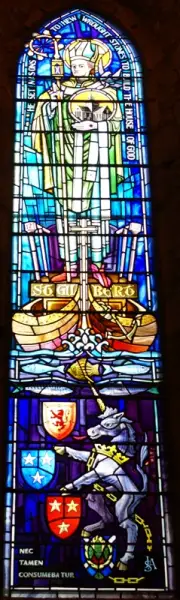
Gilbert de Moravia, remembered as Saint Gilbert of Dornoch or Gilbert of Caithness, died in 1245 and stands as the most celebrated bishop that Caithness ever had. He probably sprang from the Gaelicised Flemish family who held the lordship of Duffus, and his own father was Muiredach, son of Alexander de Moravia. After long service as archdeacon of Moray, he was chosen bishop around 1223, in the presence of King Alexander II, and within a year he is securely attested in the see. His episcopate moved the bishop's seat from Halkirk in the far north down to Dornoch in the south, nearer royal protection after the murder of his predecessor, Adam of Melrose. There Gilbert built the cathedral whose stained glass still depicts him. He founded hospices for the poor, earned a reputation as a fine preacher, laboured to bring civility to a turbulent diocese, and rendered the Psalms and the Gospels into Gaelic. He died at his palace of Scrabster; Dornoch received his body for burial, and oaths were still sworn upon his relics as late as 1545.
The Complete Life
A Son of Moray
Gilbert's origins lie in Moray, the province his surname preserves, and his family story binds together the Gaelic and Flemish strands of medieval northern Scotland. His father was Muiredach, the son of Alexander de Moravia, and the name Gilbert itself may be a Francization of the Gaelic Gille Brigte should the family have been of purely Gaelic stock. Yet another possibility is that he belonged to the semi-Gaelicised line of Flemish descent who were Lords of Duffus, a family whose lands stretched across Duffus and Strabok and whose standing rose still higher during Gilbert's own episcopate, when his possible cousin William de Moravia became the first Earl of Sutherland. He had at least three brothers: an elder brother named John, a younger brother named Simon, and another younger brother, Richard, who fell in battle against Scandinavians and whose effigy-sarcophagus came to rest in the cathedral at Dornoch. The exact year of his birth is unknown, and the sources say nothing of his childhood or education. What is certain is that a man of this border family, poised between cultures, rose through the Church to become the most famous bishop Caithness would ever have.
§ Life
Archdeacon and Bishop-Elect
Before he ever wore a bishop's ring, Gilbert served for a long period as Archdeacon of the Bishopric of Moray, an office that would have immersed him in the administration and pastoral care of his home province. His election to the troubled see of Caithness probably took place in the year 1223, and the circumstances were striking: the choice was made, so far as can be known, in the very presence of King Alexander II of Scotland and his army. That military setting was no accident. Gilbert's predecessor, Adam of Melrose, had been murdered, and the crown had a direct interest in placing a capable and loyal man at the head of a diocese that had become dangerous for its pastors. By the summer of 1224 Gilbert is certainly documented as bishop. He thus took charge of a church still reeling from violence, one whose own traditions record how sharply the northern world of Caithness could turn upon its bishops. From the first, his episcopate would be shaped by the need to reconcile a fractious region, to stand near the protection of the king, and to give the far north of Scotland a stable and civilised Christian order.
§ Life
Moving the See to Dornoch
The defining act of Gilbert's episcopate was a decision about place. King Alexander, reckoning that after the murder of Bishop Adam the bishop's seat should stand closer to royal protection, sanctioned moving the bishop's throne out of Halkirk at the diocese's northern extremity and installing it at Dornoch in the south. There Gilbert raised the cathedral that remains his monument, the building whose later stained glass would portray him and where his own body would lie. In 1239 he translated the body of his murdered predecessor, Adam of Melrose, into that new cathedral, honouring the man whose death had reshaped the diocese. Yet Gilbert did not govern the north from a safe distance. Through most of his years as bishop he made his home amid that unruly north itself, maintaining a palace at Scrabster, within reach of the people and factions who most needed a bishop's presence. His achievements gathered around this double labour of building and staying: the cathedral rose at Dornoch, and hospices for the poor were established in the diocese. His preaching won him renown, and he laboured steadily to civilise a region that had known little of it.
§ Life
Preacher and Translator
Among the bishops of medieval Scotland, Gilbert's mark was made as much in words as in stones. Contemporaries counted him a fine preacher, a man whose sermons could hold and move the mixed Gaelic- and Scots-speaking population of his enormous diocese. More lastingly, he turned the Scriptures themselves into the language of his people: he translated the Psalms and the New Testament Gospels into Gaelic, an undertaking of real scholarly and pastoral daring in thirteenth-century Scotland, centuries before translation of the Bible into vernacular tongues became common anywhere in Europe. For a bishop to give his flock the Psalter and the Gospels in their own speech was to trust them with the Word of God directly, and it marks Gilbert as a pastor who thought first of the souls actually committed to his care. Alongside this literary labour stood works of bodily mercy: the hospices he established offered shelter to the poor of Caithness, a practical expression of the Gospel he was busy translating. Folklore remembered him as a holy man of power too, recounting his victory over a monstrous dragon, or salamander, that ravaged the countryside, a legend gathered in Sutherlandshire in the late nineteenth century.
§ Achievements and death
Death at Scrabster
Gilbert ended his life where he had chosen to labour, in the north. He died in 1245 at his palace of Scrabster, and tradition fixes the day as 1 April, the date that afterwards became his feast. He had governed the see of Caithness for some two decades, years that had seen the bishop's throne moved from Halkirk to Dornoch, a cathedral raised upon the new site, the body of his murdered predecessor honourably translated, and the Scriptures opened to his people in Gaelic. His body was carried to Dornoch and buried there, in the shadow of the cathedral he had founded, so that bishop and building became inseparable in the memory of the diocese. There was no violent end and no dramatic last journey, only the close of a long and steady episcopate in the palace of a northern town. The simplicity of that ending contrasts with the turbulence that had marked the beginning of his tenure, when a murdered predecessor and a royal army had framed his election. He had lived long enough to see disorder give way to order in Caithness, and to leave behind him a church materially and spiritually furnished for the generations that followed.
§ Achievements and death
The Last Scottish Saint in the Calendar
Gilbert's afterlife in the devotion of Scotland was long and concrete. His relics at Dornoch were venerated until the Reformation, and the testimony to their credibility is unusually practical: oaths were sworn upon them at least until the year 1545, which means that ordinary people still treated his remains as instruments of truth and holiness nearly three centuries after his death. He holds a distinctive place in the sanctoral history of his nation, for no Scottish saint after him was ever entered in the Calendar of Saints, and whether any formal act of canonization ever took place remains unknown. His cult seems to have grown from the gratitude of the diocese he served rather than from papal process. Folklore kept his memory vivid in Sutherland, where nineteenth-century collectors recorded the tale of the dragon or salamander he was said to have overcome, and where he was remembered under the curious surname Carthophilax. Above all his cathedral stands as his lasting monument: Dornoch Cathedral, founded by his enterprise, received his bones, sheltered his relics, and still displays his image in glass, keeping green the name of the builder-bishop of the thirteenth century.
§ Achievements and death
Timeline
- 1223
Probably elected Bishop of Caithness in the presence of King Alexander II of Scotland and his army.
§ Life
- 1224
Certainly serving as Bishop of Caithness by the summer of this year.
§ Life
- 1239
Brought the body of Bishop Adam of Melrose to the new cathedral at Dornoch.
§ Life
- 1 Apr 1245
Died at his palace in Scrabster, traditionally on 1 April, and was buried at Dornoch.
§ Achievements and death
- 1545
Oaths were still being sworn upon his relics at Dornoch in this year.
§ Achievements and death
The Record
- Major works
- Dornoch Cathedral·Hospices for the poor·Gaelic translation of the Psalms·Gaelic translation of the New Testament Gospels
- Patron of
- Diocese of Dornoch
- Symbols
- Bishop's vestments·Dornoch Cathedral
- Canonization
- Venerated as a saint without any recorded formal canonization; the last Scottish saint entered in the Calendar of Saints.
Prayer
Bibliography
Show 4 sources
- People of Medieval Scotland – Gilbert Murray, Bishop of Caithness (d.1245), retrieved 10 April 2021
- Farmer, David Hugh (1997). The Oxford Dictionary of Saints (4th ed.). Oxford: Oxford University Press. pp. 208–209. ISBN 0-19-280058-2.
- Mowat, John (1920). "Books and Printing in Caithness". The Glasgow Bibliographical Society. 6: 84.
- Dempster, Miss. "Folk-Lore of Sutherlandshire". Folk-Lore Journal. Volume 6, 1888. pp. 156–9.
Profile text adapted from the Wikipedia article, licensed CC BY-SA 4.0.
Pray with this saint every day
Save St. Gilbert de Moravia to your favorites, read the full profile, and get feast-day reminders in the Saints app.
Get the Saints AppFree on the App Store for iPhone and iPad