
c. 448 – c. 525·Feast June 8
St. Gildard
Bishop of Rouen and brother-saint of Medard
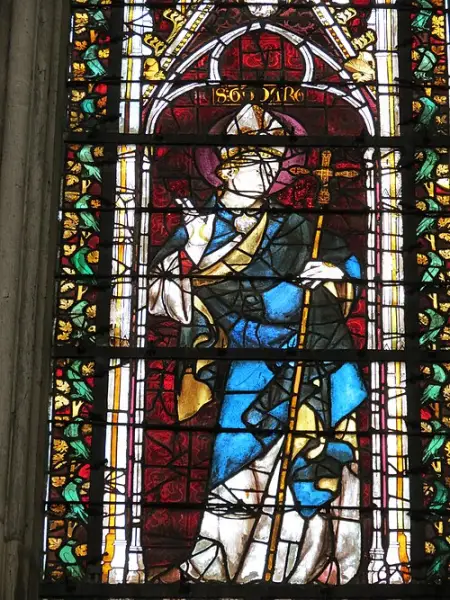
Overview
Gildard — Latinized as Gildardus or Gildaredus, and in some traditions Godard — was Bishop of Rouen from 488 until his death around 525, and the Roman Catholic Church numbers him among her saints; the missal of the Sarum Rite styles him a confessor. Born around 448, he governed the Norman see through the decades in which the Franks under Clovis I turned from paganism to Catholic Christianity, and in 511 he took part in the First Council of Orléans, the great assembly convoked by Clovis to order the life of the Gallican Church. Earlier versions of the Roman Martyrology make him the twin brother of Medard of Noyon — born, consecrated, and dying on the same day — but the chronology resists the legend: Gildard sat at Orléans in 511, while Medard was consecrated a bishop only in 530. Whatever the truth of the kinship, the association with Medard became the engine of Gildard's cult. Buried first at St. Mary's Church in Rouen, a church that later took his name, his body was carried off during the Norman incursions and laid in the Abbey of St. Medard at Soissons, where it remains, reunited with the brother whose fame had given him his own.
The Complete Life
The Question of the Twin
Gildard was born around 448, into a Gaul still shaking off the Roman order, but the record of his origins is thin, and the most famous fact about his early life belongs to legend rather than documentation. Earlier versions of the Roman Martyrology declare that he was the twin brother of Medard — that the pair were born the same day, consecrated the same day, and died the same day. It is a touching symmetry, and it shaped centuries of devotion, but the chronology will not bear it. Gildard attended the First Council of Orléans in 511, an assembly convoked by Clovis I; Medard, by contrast, was consecrated a bishop only in 530, five years after Gildard's death. Two men cannot die in the same year when one of them receives office after the other is already buried. The scholars who have studied the case treat the brotherhood as pious construction, and the historian Felice Lifshitz has shown that the association with Medard was, in any case, the making of Gildard's cult: before the belief in the two brothers took hold, no cult of Gildard was promoted at all. What the record does establish plainly is the man's career: by 488 he was Bishop of Rouen, and he held that see for the rest of his long life.
§ Life
Shepherd of Rouen
Gildard's public life was the episcopate of Rouen, which he assumed in 488 and exercised until his death around 525 — nearly four decades of governance in one of the principal sees of Neustria. Alban Butler, summarizing the tradition, records that the government of the Rouen see was marked, in his telling, by great zeal across a span of fifteen years, a statement that sits uneasily with the full length of his tenure but preserves the memory of energetic leadership. The one dated act of his episcopate that survives is among the most significant things a Gaulish bishop could do in his generation: in 511 he attended the First Council of Orléans, the assembly summoned by Clovis I after the Frankish king's conversion to Catholic Christianity. There the bishops of the new Catholic kingdom ordered the discipline of the Church and the relations of Church and crown for the Merovingian age. Gildard's name appears in the conciliar record — preserved under the variant spellings Geldaredus, Gildaredus, Gildardus, and Gelidandus — which is why the tradition remembers him, rightly, as a confessor: a bishop who served the faith by governance and orthodoxy rather than by martyrdom. Rouen commemorated him together with his supposed brother, and the pairing proved more durable than the chronology that contradicted it.
§ Life
Death and First Burial
Gildard died at Rouen around the year 525, closing an episcopate that had spanned the turning of Gaul from Roman province to Frankish kingdom. His body was buried in the church of St. Mary in the city — a foundation whose identity was later transformed by his presence there, for in time it came to bear his own name. There he rested for centuries as the bishop of the place, though the record suggests his grave attracted little wide-reaching devotion: according to Felice Lifshitz, his relics lay in the church of Notre Dame in suburban Rouen without attracting any attention, and no cult of Gildard was promoted before the belief in his kinship with Medard emerged. The peace of that first grave was broken by the Vikings. Butler relates that the body was carried off amid the Norman incursions, the great upheavals of the ninth century that emptied the churches of Neustria, and was carried inland to the Abbey of St. Medard in Soissons. It was a displacement that determined everything about his afterlife in history: the bishop of Rouen would spend the rest of his venerable existence, so to speak, at Soissons, in the abbey named for the brother with whom legend had twinned him.
§ Life
A Confessor of the Pre-Congregation Era
Gildard was never canonized in the formal sense; he belongs to the Pre-Congregation saints, whose veneration was settled by the practice of the Church long before centralized processes existed. The Roman Catholic Church has honored him from the early medieval period as a confessor — the technical title for a saint who confessed Christ by a holy life rather than by martyr's blood — and the missal of the Sarum Rite, the liturgical use of medieval England, expressly refers to him by that name. His feast is kept on June 8, and in Rouen he is commemorated together with Medard, his supposed brother, so that the pairing contradicted by the calendar of history was preserved by the calendar of the saints. His major shrine is the Abbey of St. Medard at Soissons, where his body rests. The pattern of his recognition is instructive: Lifshitz observes that only in Soissons, among the monks who claimed his relics, did Gildard receive literary traditions for the first time, and there his cult was actively fostered. In other words, his sanctity was received from the early Church and then actively cultivated — an old bishop of Rouen whose memory flourished in a Picard abbey because the monks there wanted their patron's brother beside him.
§ Cult
The Brothers Reunited and the Churches That Keep Their Names
The afterlife of Gildard's relics is a small drama of medieval politics. When the monks of St. Medard at Soissons discovered the supposed sibling link between their patron and the bishop of Rouen, they argued successfully before Charles the Bald that the brothers should be reunited in death — and so the Norman incursions, which had brought the body to Soissons, were given a pious rationale. Rouen's populace resented losing their saint. They offered a barter that reveals how relic economies worked: the monks of St. Medard might leave them the head of Gildard, and in exchange Rouen would give the head of Romanus of Rouen, one of its bishops, or the entire body of Remigius of Rouen, the city's third archbishop. The negotiation fixed Gildard's fame in place, and his cult, once promoted at Soissons, spread to parish churches. In France, the church of Saint-Médard-et-Saint-Gildard at Crépon in Calvados dates from the twelfth to fourteenth centuries, and its counterpart at Fel in the Orne from the twelfth. In England, the parish church of St Medard and St Gildard at Little Bytham in Lincolnshire reaches back to the Anglo-Saxon period — a rare double dedication that carried the two brothers, real or legendary, into the religious geography of another island.
§ Churches named for Medard and Gildard
Timeline
- 448
Born around this date.
§ Life
- 488
Became Bishop of Rouen, an office he would hold for the rest of his life.
§ Life
- 511
Attended the First Council of Orléans, convoked by Clovis I.
§ Life
- 525
Died at Rouen around this date, after decades as bishop.
§ Life
- 530
Medard, traditionally held to be his twin, was consecrated a bishop — five years after Gildard's death, undoing the twin legend.
§ Life
The Record
- Canonization
- Pre-Congregation saint, venerated as a confessor in the Roman Catholic Church from the early middle ages.
Prayer
Bibliography
Show 6 sources
- The Sarum Missal: In English. Church Press Company, 1868, p. 372.
- De Clercq, C. Concilia Galliae, A. 511–695. Turnhout: Brepols, 1963, pp. 13–19.
- Smith, William; Wace, Henry (1880). A Dictionary of Christian Biography, Literature, Sects and Doctrines. J. Murray, p. 669.
- Butler, Alban (1821). The Lives of the Fathers, Martyrs, and Other Principal Saints, p. 127.
- Lifshitz, Felice (1990). "Eight Men In: Rouennais Traditions of Archiepiscopal Sanctity". Haskins Society Journal Studies in Medieval History. Continuum, pp. 63–82. ISBN 978-1-85285-059-3.
- Lifshitz, Felice (1995). The Norman Conquest of Pious Neustria: Historiographic Discourse and Saintly Relics, 684–1090. PIMS, p. 117. ISBN 978-0-88844-122-5.
Profile text adapted from the Wikipedia article, licensed CC BY-SA 4.0.
Pray with this saint every day
Save St. Gildard to your favorites, read the full profile, and get feast-day reminders in the Saints app.
Get the Saints AppFree on the App Store for iPhone and iPad