
c. 500 – c. 570·Feast January 29
St. Gildas
British monk and author of the Ruin of Britain
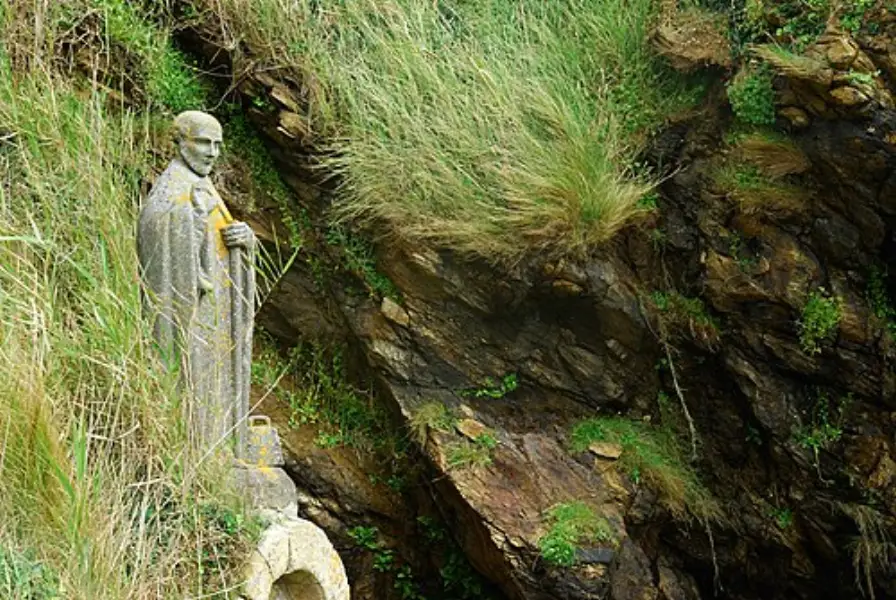
Overview
Gildas, called Sapiens, the Wise, and in Middle Welsh sources Gildas fab Caw, was a sixth-century British monk whose polemic De Excidio et Conquestu Britanniae, On the Ruin and Conquest of Britain, makes him the most important near-contemporary witness to sub-Roman Britain. He was born, by his own account, in the same year as the Battle of Mount Badon, at a place called Arecluta; scholars still dispute whether that lies on the River Clyde in the north or, as many now argue, in what was Roman Britain in the south, perhaps at Chester or at Arclid in Cheshire. Educated at the College of Saint Illtud in Glamorgan, he forsook a royal heritage for monastic life, was ordained in Ireland, and preached through Britain and Ireland, founding churches and monasteries. Summoned by the high king Ainmericus to restore the faith in Ireland, he built and taught across the island, visited Rome and Ravenna, and finally settled as a hermit on the Isle of Houat off Brittany. There disciples found him, and the monastery of Saint-Gildas-de-Rhuys rose around him. He died at Rhuys around 570, and his relics remain there.
The Complete Life
A Birthplace Still Disputed
Where Gildas entered the world has been argued for centuries. Both recensions of his Life concur in placing his birth at a spot named Arecluta, whose name, its author explains, came from a river called the Clut that watered most of the surrounding country. For a long time historians read this as the River Clyde and placed his birth in what is now Scotland, in the old Brythonic north. Modern scholars have grown doubtful: his writings, they observe, show little familiarity with the geography of Strathclyde but a surer grasp of southern Britain, and his command of classical Latin authors looks like an education acquired within the old bounds of Roman Britain. The historian E. A. Thompson proposed Chester as a candidate, while the linguist Andrew Breeze has argued for Arclid, near Sandbach in Cheshire, whose name plausibly descends from Arecluta. Gildas himself offers one firm anchor: he states in his own writing that his birth fell in the year of the British victory at Mount Badon, the great British victory over the Saxons. Because scholars date that battle differently, his birth has been placed around the middle of the fifth century by some, and around the year 500 by David Dumville.
§ Birthplace
From Royal Blood to the Cloister
The tradition preserved at Rhuys gives Gildas royal blood in the far north: his father, Caunus, reigned over Alt Clud in the Hen Ogledd, that Brythonic-speaking region of northern Britain, and of his five brothers one, Cuillum, took up the throne while the rest embraced monastic life. As a child he was sent to the College of Saint Illtud in Glamorgan, the great monastic school of the Celtic west, where his companions were Samson of Dol and Paul Aurelian, and where his master cherished him and instructed him with unusual zeal. Educated as he was in the liberal arts and in divine scripture, Gildas made a decisive choice: he elected to study only holy doctrine, renouncing his noble birth in favour of the religious life. After completing his formation under Illtud he crossed to Ireland, where he was ordained a priest, and then returned to his native north to labour as a missionary among the pagan people, winning many to Christianity. His fame for holiness and learning soon reached beyond his own country, and when Ainmericus, high king of Ireland, asked him to restore order to a church whose Christian faith had failed utterly; the king's summons was obeyed without delay.
§ Biographies
Missionary of Britain and Ireland
Gildas's missionary career, as the first Life recounts it, spanned the whole Celtic world. Obeying the high king's summons, he journeyed the length of the island, winning its people back to the faith, raising churches, and planting monasteries in a land whose Christianity had sunk into paganism. From Ireland his path led south to Rome and to Ravenna, where tradition credits him with many miracles, including the slaying of a dragon in Rome itself. He meant to return to Britain, but instead settled on the Isle of Houat off the coast of Brittany, embracing the solitary and austere life of a hermit. Solitude, however, could not contain a teacher of his reputation: pupils sought him out and begged for instruction, and out of their petition grew the monastery of Saint-Gildas-de-Rhuys, the house with which his name has been joined ever since. It was there, according to the account of his life, that he wrote his great work, reproving the rulers of the Britons and calling them to abandon their sins and embrace true Christian faith. Among the many corners of the Celtic world touched by his preaching, one tradition remembers that he taught Nonnita, the mother of Saint David, while she carried the future apostle of Wales.
§ Biographies
The Ruin of Britain
De Excidio et Conquestu Britanniae is at once a history and a sermon, and its author made no pretence of neutral chronicle. It is the only substantial source for the history of sub-Roman Britain written by a near-contemporary, a fact that has made it indispensable despite its polemical temper. The work falls into three parts. The first explains the author's purpose and outlines Britain's fortunes from its conquest in the age of the Principate down to the author's own time, including the episode of the Groans of the Britons, the islanders' last plea for military help from the departed Roman army; he rebukes his fellow Britons for their sins while paying tribute to heroes such as Ambrosius Aurelianus, the first man his pen names as head of the Saxon resistance, and he records the victory at Mount Badon without naming its commander, whom later texts would call Arthur. The second part condemns five British kings by name, Constantine, Aurelius Conanus, Vortiporius, Cuneglasus, and Maelgwn, the only contemporary evidence about them; the third attacks the clergy of his time with the same vigour. To these is joined the hymn known as the Lorica, or Breastplate, attributed to his pen as a plea for rescue from evil and rich in Hiberno-Latin.
§ De Excidio et Conquestu Britanniae
Death at Rhuys
Gildas is thought to have ended his days at the monastery he founded at Saint-Gildas-de-Rhuys in Brittany, and there he was buried. The year of his death, traditionally given as about 570, comes from the Annales Cambriae, though the scholar François Kerlouégan regards that date as, at best, traditional; like nearly every date in his life, it rests on foundations both ancient and uncertain. The legend continued to grow around his grave. A second biography, composed by Caradoc of Llancarfan, a friend of Geoffrey of Monmouth, wove the monk into the world of Arthurian romance, telling how Arthur killed Gildas's brother Hueil, how the saint reconciled the king to Guinevere after her abduction by Melvas, and how he was linked to Glastonbury Abbey, though modern scholars judge this account entirely fictional in intent. Behind the legends stands the historical reality of a monk whose written voice, stern and biblical, outlasted every king he condemned. His body remained venerated at Rhuys, the house of his last years, while his memory spread through Brittany, Wales, Cornwall, and the wider Church, honoured on 29 January in the calendars of East and West alike.
§ Veneration
Relics, Reliquaries, and a Lasting Name
The relics of Gildas have had a restless history that mirrors the centuries themselves. Venerated in the abbey he founded at Rhuys until the tenth century, they were then removed to Berry; in the eighteenth century they were said to have been moved to the cathedral at Vannes and hidden during the French Revolution. They came through that upheaval intact and have since been brought back to Saint-Gildas-de-Rhuys, where pilgrims may view them at certain seasons in a dedicated treasury in the village. The saint's body, apart from the portions incorporated into reliquaries, lies behind the altar of the church there. The treasures include a reliquary head holding parts of his skull, an arm reliquary with bone pieces surmounted by a blessing hand, and a reliquary femur and knee, all covered in gold and silver, together with the embroidered mitre he is said to have worn. Gildas is patron of several Breton churches and monasteries, and beyond them of Welsh historians and bell founders, trades that honour the author and the Celtic bell of his iconography. Welsh tradition adds a family, naming sons Gwynnog, Noethon, and Tydech and a daughter Dolgar, while David Dumville makes him the teacher of Finnian of Moville, and so a forefather of Columba's Iona.
§ Veneration
Timeline
- 500
David Dumville places his birth around this year, though other scholars date it to the middle of the fifth century.
§ Hagiography
- 540
Composed his polemic De Excidio et Conquestu Britanniae, a work usually dated to the 540s, at the age of forty-four.
§ De Excidio et Conquestu Britanniae
- 566
Summoned by Ainmericus, high king of Ireland, and travelled the island restoring the church, converting inhabitants, and founding monasteries.
§ Biographies
- 570
Died at Rhuys in Brittany, according to the traditional date drawn from the Annales Cambriae, and was buried there.
§ Veneration
In Their Own Words
Its plains are spacious, its hills are pleasantly situated, adapted for superior tillage, and its mountains are admirably calculated for the alternate pasturage of cattle, where flowers of various colours, trodden by the feet of man, give it the appearance of a lovely picture.
Meanwhile the hooked weapons of their enemies were not idle, and our wretched countrymen were dragged from the wall and dashed against the ground.
A multitude of whelps came forth from the lair of this barbaric lioness, in three cyuls, as they call them, that is, in their ships of war.
The Record
- Major works
- De Excidio et Conquestu Britanniae·The Lorica (Breastplate), a hymn attributed to him·Monastery of Saint-Gildas-de-Rhuys
- Patron of
- Welsh historians·Bell founders
- Symbols
- Monk holding a Celtic bell·Writing in a book
- Canonization
- Pre-congregation; venerated from earliest times in Brittany, Wales, and Cornwall, with his feast kept on 29 January.
Prayer
Bibliography
Show 7 sources
- Breeze, Andrew (2008). "Where was Gildas born?". Northern History. XLV (2): 347–349.
- Dark, Ken (2000). Britain and the End of the Roman Empire. Stroud, UK: Tempus Publishing. ISBN 978 0 7524 2532 0.
- Dumville, David N. (1984). "The Chronology of De Excidio Britanniae, Book 1". In Dumville, David; Lapidge, Michael (eds.). Gildas: New Approaches. Martlesham: Boydell Press. ISBN 978-0-85115-403-9.
- Higham, N. J. (1994). English Conquest: Gildas and Britain in the fifth century. Manchester: Manchester University Press. ISBN 978-0-7190-4080-1.
- Kerlouégan, François (2007). "Gildas [St Gildas] (fl. 5th–6th cent.)". Oxford Dictionary of National Biography. Oxford University Press. doi:10.1093/ref:odnb/10718.
- Sullivan, Thomas D. (1978). De excidio of Gildas: its authenticity and date. New York: Brill. ISBN 978-90-04-05793-7.
- Williams, Ann (1991). "Gildas author fl. mid-sixth century". In Williams, Ann; Smyth, Alfred P.; Kirby, D. P. (eds.). A Biographical Dictionary of Dark Age Britain. Seaby. ISBN 978-1-85264-047-7.
Profile text adapted from the Wikipedia article, licensed CC BY-SA 4.0.
Pray with this saint every day
Save St. Gildas to your favorites, read the full profile, and get feast-day reminders in the Saints app.
Get the Saints AppFree on the App Store for iPhone and iPad