
c. 650 – c. 710·Feast September 1
St. Giles
Hermit of the hind and one of the Fourteen Holy Helpers
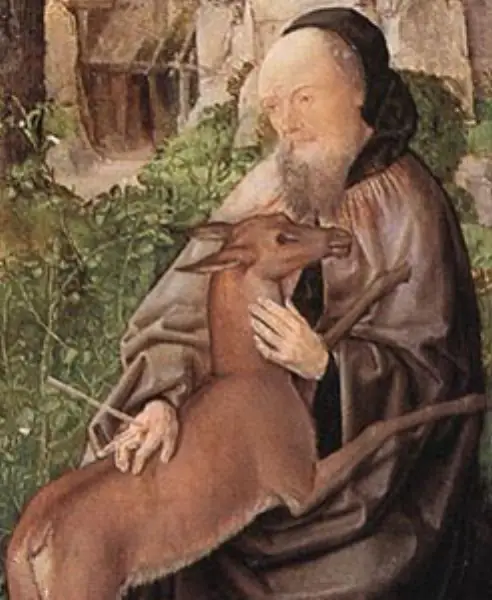
Overview
Giles the Hermit — Aegidius in Latin, Gilles in French, Egidio in Italian, Gil in Spanish — was a Greek Christian ascetic who lived in what is now France around the years 650 to 710. Legend makes him the son of King Theodore and Queen Pelagia of Athens, but his recorded life belongs to the Far West: after retreats hard by the Rhône's mouth and the River Gard in Septimania, he buried himself in the deep woods near Nîmes and passed many years there in utter solitude, his only companion a red deer said in some stories to have sustained him on her milk. His retreat ended when the king's hunters, chasing the deer, wounded Giles with an arrow meant for the animal — a wound that would make the disabled his special care thereafter. The king, held in legend to be the Visigoth Wamba, honored the hermit's humility and built him a monastery at Saint-Gilles-du-Gard, and Giles gave it the Benedictine rule. There he died early in the eighth century, about sixty years old, renowned above all for holiness and wonder-working. His cult became one of the most widely diffused in medieval Europe; he is numbered among the Fourteen Holy Helpers — its only non-martyr — and the town of Saint-Gilles-du-Gard, a stop on the Camino de Santiago, still bears his name.
The Complete Life
A Greek Prince of Athens
The Giles of legend begins as a figure of the Christian East. He was, by the consistent testimony of his hagiography, a Greek, born around 650 at Athens, in the Roman province of Achaea of the Eastern Roman Empire — and the Legenda Aurea embroiders the circumstance into royalty, naming him the son of King Theodore and Queen Pelagia of Athens. Of his childhood and education the sources say nothing more; the biographical thread picks up only when the young man leaves his homeland for the West, a pattern familiar from other saints of the great Greek diaspora of ascetics who carried Eastern monasticism into Gaul and Italy during the troubled seventh century. Beneath the legend, modern scholarship discerns a possible historical anchor far earlier and humbler: among the witnesses of a document of the year 514, when Caesarius of Arles sent a messenger named Messianus to Pope Symmachus, appears an abbot named Aegidius — and this abbot may well be the man underlying the legend of Saint Giles. The chronology of the legend and the chronology of the document cannot both be right, and the hagiography of Giles is by common admission mostly legendary; but the two figures, east and west, hermit and abbot, together mark the outline of a cult older than its stories.
§ Historicity
Into the Forest Near Nîmes
The legend traces Giles's westward path through a sequence of retreats. Though born in Athens, he lived first near the mouth of the Rhône and then by the River Gard in Septimania, in the Visigothic Kingdom — the Mediterranean fringe of what is now southern France, where the Legenda Aurea links him with Arles. But these dwellings were way stations. At the last he buried himself in the wildwood near Nîmes, and for many years he lived there in the deepest solitude. His one companion was a beloved deer, a red hind who in some versions of the story sustained him on her milk — an image with deep pagan echoes that Christianity adopted and tamed. Giles ate a Christian vegetarian diet, eating nothing but plant food — wild herbs and roots, a discipline that set his hermitage apart as a place where no blood was shed and no creature feared him. It was a life built on the inverse of ambition: the further from the cultivated world he went, the closer, his admirers believed, he stood to God. The forest clearing by the Gard became a sanctuary in both senses, and it was precisely its hiddenness that made its discovery, when it came, a turning point not only for Giles but for the whole region that would grow up around his memory.
§ Legend
The Arrow, the King, and the Monastery
Giles's solitude ended the day the king's hunters pursued his deer to its refuge. An arrow loosed at the fleeing animal missed and wounded the saint instead, who hid the injury and bore it silently — an act of hiddenness so characteristic that the wound itself became his emblem, and the reason a hermit of the forest became the patron of the physically disabled. The king of the legend is named as Wamba, an anachronistic Visigoth, though scholars judge that the story's first form surely made him a Frank, given the historical setting. Whoever he was, he esteemed the hermit greatly for the humility with which he turned away every honor — all, that is, except the keeping of some disciples, the single concession Giles would make to the world that had found him. Out of that encounter came the foundation that fixed his name upon the map: the king built him a monastery in his valley, the future Saint-Gilles-du-Gard, and Giles placed it under the Benedictine rule, binding his Greek eremitical spirit to the ordered common life of Western monasticism. The hermitage became an abbey; the abbey drew pilgrims; and the pilgrims drew a town. Giles had refused everything except disciples, and the disciples proved enough to change the face of Languedoc.
§ Legend
Abbot at Saint-Gilles
Giles spent his last years as the reluctant abbot of the monastery that bore his name, living under the rule he had accepted for his followers and dying there in the early part of the eighth century, around 710, at about sixty years of age, and leaving this world renowned above all for holiness and wonder-working, according to the legend that preserves his ending. The hagiographers could not leave even his death unadorned: the tenth-century Vita sancti Aegidii tells how Giles, offering Mass for the pardon of Emperor Charlemagne's sins, saw an angel lay upon the altar a letter setting out a sin so terrible that Charlemagne had never dared confess it — the origin of the celebrated hidden sin of Charlemagne, repeated in Latin and French texts including the Legenda Aurea. The story flatters no chronology, since it places the hermit of c. 650–710 in the company of a emperor born around 742; it is legend, and it contradicts the well-established dates of Charlemagne's life. But it testifies to how completely Giles had become, within two centuries of his death, the intercessor Europe reached for when ordinary confession seemed impossible. A later work, the Liber miraculorum sancti Aegidii, sustained the pilgrim stream to his abbey for generations more.
§ Legend
One of the Fourteen Holy Helpers
Giles was canonized in the only manner the early medieval Church knew: by the unforced growth of a cult, ratified in time by universal acceptance. He is venerated today in the Catholic Church, the Eastern Orthodox Church, and the Anglican Communion, and the Church of England keeps a commemoration of Giles of Provence on 1 September, his feast day. His cult became one of the most widely diffused in the Middle Ages — he was among the most popular saints of that age — spreading through France and Spain, through Germany, Poland, Hungary, and Slovakia, and through Great Britain besides, attested by churches and monasteries, by manuscripts in prose and verse, and above all by the immense crowds of pilgrims who pressed toward his shrine. In art he is shown with his symbols: the hind that shared his solitude, the arrow that wounded him, his crosier, his hermitage. He holds a singular place among the Fourteen Holy Helpers, the company of saints invoked against plague and calamity: Giles is the only non-martyr among them, and the group was initially invoked for protection against the Black Death. Closer to his own clearing, he remained the special advocate of the suffering — invoked against convulsions, depression, and childhood fears, particularly across Normandy, from Bernay to Saint-Germain-Village.
§ Veneration
From the Gard to Edinburgh and Tripoli
Few medieval saints left a wider geographic imprint. Around his abbey grew the town of St-Gilles-du-Gard, which stayed the heart of his cult — a devotion particularly rooted in Languedoc, even once a rival relic of the saint surfaced at Toulouse — and the abbey became a stop on the Camino de Santiago. In 1562, with the wars of religion burning, his relics were carried off by night to Toulouse, out of the Huguenots' reach, and pilgrimages sank; once most of them were returned to the abbey in 1862, and the old tomb was rediscovered and publicized there in 1865, the pilgrims came again. Nineteen other cities bear his name, and cities holding his relics reach from Antwerp, Brugge, and Tournai to Cologne, Bamberg, Rome, Bologna, and Prague. He is patron of Edinburgh, where St. Giles' High Kirk dominates the capital's skyline, and of Elgin, Graz, Nuremberg, Osnabrück, Sankt Gilgen, Brunswick, Wollaberg, Saint-Gilles in Brussels, Sint-Gillis-Waas, and Poprad. The Roman church of Sant'Egidio in Trastevere, dedicated to him in 1630, has housed since 1968 the lay Community of Sant'Egidio, one of the modern Church's best-known works of peace and charity. Even the Middle East carries his name: Raymond of St Gilles lent it to the castle of St Gilles, Qala'at Sanjil, at Tripoli in Lebanon.
§ Veneration
Timeline
- 650
Born around this date at Athens, in the Eastern Roman province of Achaea.
§ Legend
- 710
Died at about sixty years of age in his monastery of Saint-Gilles-du-Gard, renowned for sanctity and miracles.
§ Legend
- 878
Two forged papal bulls were produced, purporting to have been issued by Pope John VIII and recording royal and papal favors to his monastery.
§ Historicity
- 910
By around this date the abbey had been rededicated to Saint Giles, the earliest point at which its dedication to him is attested.
§ Historicity
- 1562
His relics were carried in secret to Toulouse, shielded from the Huguenots, and pilgrimages declined.
§ Veneration
- 1630
The church of Sant'Egidio in Trastevere, Rome, was dedicated to him.
§ Veneration
- 1862
Most of his relics reached the abbey of Saint-Gilles-du-Gard once more in that year.
§ Veneration
- 1865
The publicized rediscovery of his former tomb at the abbey helped pilgrimages recommence.
§ Veneration
- 1968
The lay Community of Sant'Egidio took up residence in the Roman church dedicated to him.
§ Veneration
The Record
- Patron of
- beggars·blacksmiths·breast cancer·breast feeding·cancer patients·disabled people·Edinburgh·epilepsy·noctiphobics·forests·hermits·horses·lepers·mental illness·outcasts·poor people·rams·spur makers·sterility
- Symbols
- Arrow·Crosier·Hermitage·Hind
- Canonization
- Pre-Congregation saint, venerated in the Catholic, Eastern Orthodox, and Anglican traditions.
Prayer
Bibliography
Show 7 sources
- Pycke, J. "(2) Gilles". Dictionnaire d'histoire et de géographie ecclésiastiques, Vol. 20 (1984): cols. 1352–1355.
- Cross, F. L.; Livingstone, E. A., eds. (2009). "Giles, St". The Oxford Dictionary of the Christian Church (3rd rev. ed.). Oxford University Press.
- Rennie, Kriston R. "The Normative Character of Monastic Exemption in the Early Medieval Latin West". Medieval Worlds 6 (2017): 61–77.
- Roberts, Holly Harlayne (2004). Vegetarian Christian Saints: Mystics, Ascetics & Monks. New York: Anjeli Press. ISBN 978-0-9754844-0-1.
- Girault, Pierre-Gilles (2002). "Observations sur le culte de saint Gilles dans le Midi". Hagiographie et culte des saints en France méridionale (XIIIe-XVe siècle). Cahiers de Fanjeaux 37, pp. 431–54. ISBN 2-7089-3440-6.
- Murphy, John F.X. "St. Giles." The Catholic Encyclopedia. Vol. 6. New York: Robert Appleton Company, 1909.
- Gangewere, R. J. "The West Portal of Saint-Gilles-du-Gard". Carnegie Museums of Pittsburgh, September/October 2003.
Profile text adapted from the Wikipedia article, licensed CC BY-SA 4.0.
Pray with this saint every day
Save St. Giles to your favorites, read the full profile, and get feast-day reminders in the Saints app.
Get the Saints AppFree on the App Store for iPhone and iPad