
1598-1634
St. Giordano Ansalone
Dominican Priest and Martyr
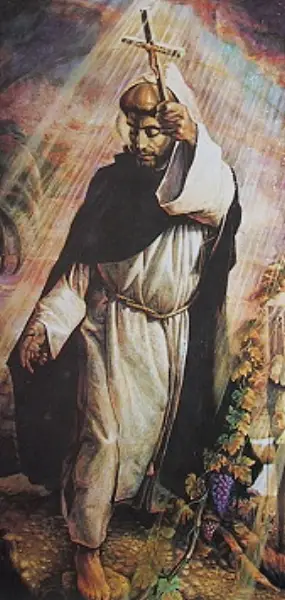
Overview
Giordano di San Stefano Ansalone was born in 1598 at Santo Stefano Quisquina, a hill town of Sicily. Having joined the Dominicans and completed Salamanca studies, in 1625 he sailed out with a large company bound for the Philippine missions. During a stop in Mexico on the outward voyage he composed Latin lives of Dominican saints, modeled on a similar work by Hernando del Castillo. Assigned in Manila as chaplain to a hospital serving Chinese and Japanese patients, he learned both their languages — a preparation that soon found its purpose. In 1631 he volunteered for Japan and arrived just as the great persecution was breaking out in 1632. Traveling the country disguised as a bonze, a Buddhist monk, he ministered secretly and administered the sacraments to the hidden faithful. He was arrested on 4 August 1634 and tortured over seven days. Forced to watch, he saw his Dominican companion Thomas of St. Hyacinth beheaded together with sixty-nine other Christians. Days later, at Nagasaki, Giordano himself was executed by being hung head-downward from a plank, his head buried in the ground, until he died. At Manila he abandoned an unfinished treatise on the religion of China.
The Complete Life
Early Life
Giordano di San Stefano Ansalone was born in 1598 at Santo Stefano Quisquina, a hill town in the Sicilian interior, and took his religious name from it when he entered the Dominican Order. His studies were completed at Salamanca, the intellectual capital of the Spanish Dominicans, which for a Sicilian friar meant that he was already being formed for the overseas provinces of the order rather than for a career at home. He is remembered as a man of learning as well as piety: on his way east he wrote, and on arrival in Manila he taught. The combination was characteristic of the Dominican Province of the Most Holy Rosary, which for a century had been sending its best men from Spain and Italy to the Philippines and on to the forbidden missions of Japan and China. Sicily in his generation was a poor country exporting clergy, and the Dominicans of the island had for years been supplying the province that ran the Philippines from Manila; a bright Sicilian novice could expect, without particular heroism, to be sent halfway around the world.
§ Introduction
Conversion and Vocation
In 1625 Ansalone sailed with a large company of missionaries for the Philippine Islands, the standard route running through Mexico. Detained there on the outward voyage, he spent the time writing a series of lives of Dominican saints in Latin, modeled on the earlier work of Hernando del Castillo — an apprentice piece that shows both his learning and his assumption that the order's dead were the best instruction for its living. Reaching Manila, he was assigned as chaplain to the hospital for Chinese and Japanese there, and in that ward he learned both languages. In 1631 he offered himself for Japan, then the most dangerous assignment the order possessed, and arrived at the outbreak of the great persecution of 1632. Volunteering for Japan in 1631 was in a different category from being sent: by then the Japanese mission had been illegal for seventeen years, its priests were being executed on arrival, and the order needed men who understood that the assignment was, in the ordinary course, a death sentence.
§ Life
Mission and Ministry
Japan after 1614 had no legal Catholic life at all: the mission had been banned, its clergy expelled or executed, and the remaining faithful driven underground. Ansalone entered the country disguised as a bonze, a Buddhist monk, and traveled the land in that dress, saying Mass in secret, hearing confessions, and administering whatever rites the hidden Christians needed. It was work that depended on the Chinese and Japanese he had learned in the Manila hospital ward. He carried on for roughly three years, moving constantly, dependent on the courage of the families who sheltered him, and at Manila he left behind the manuscript of an unfinished treatise on Chinese religion, the other half of his mind still at work on the missions' intellectual problems. The disguise was necessary because any European found in the country was presumed to be a priest, and the bonze's robe, with a shaven head and the manners of a monk, was the one costume that let a foreigner move through villages without immediate report to the authorities.
§ Life
Spirituality and Teaching
Ansalone's writing is slight in bulk — Latin lives of Dominican saints and an abandoned treatise on Chinese religion — but it indicates the shape of his mind: a friar who understood mission as continuation, the present generation of the order's martyrs simply the latest chapter in a story that ran back to Dominic. That understanding was tested directly. During his torture he was forced to watch the beheading of Thomas of St. Hyacinth, his Dominican companion, together with sixty-nine other Christians, an arrangement calculated to make him apostatize at the sight; the sources record that he did not, and that his own death followed. A spirituality built on the order's martyrology held, in the event, against the thing it had been built for. The seventeenth-century Dominican understanding of sanctity was heavily martyrological in exactly this way, and a friar who had spent his detained months in Mexico writing the lives of the order's saints had internalized the curriculum before he was asked to pass its final examination.
§ Life
Trial and Final Years
Ansalone was taken on 4 August 1634 and tortured over seven days, the interrogators working to break him and to extract the names of the Christians who had hidden him. He was then made to witness the execution of Thomas of St. Hyacinth with sixty-nine others. On 18 November 1634 he was put to death at Nagasaki, suspended from a plank head-downward, his head in the earth, the tsurushi-like suspension by which the regime made death slow. He was thirty-six. The date of his arrest and the length of his torture are unusually well fixed in the record, which is one reason his case became a standard citation in accounts of the Japanese persecution. The regime's method in these years was deliberate: the Dominican friars were kept alive after their flocks had been killed, in the hope that the sight would break them, and the sources note that the spectacle was staged for that purpose.
§ Life
Canonization
Ansalone was beatified by Pope John Paul II on 18 February 1981, at Manila, together with the other martyrs of Japan killed in the great persecution of the seventeenth century, and canonized by the same pope on 18 October 1987 among the sixteen Martyrs of Japan — the group that includes Lorenzo Ruiz, the Filipino layman who had sailed on the same mission route and died in 1637. His feast is kept with that group. The long gap between his death in 1634 and his beatification in 1981 measures how completely the Japanese church had been driven underground: the evidence for these causes had to be recovered, in part, from the archives of the persecutors. The beatification ceremony at Manila in 1981 was itself a historical event — the first time the Church had solemnly honored the Japanese martyrs on Philippine soil, from which so many of them had sailed — and the canonization of 1987 completed the process in Saint Peter's Square.
§ Introduction
Legacy
In Sicily Ansalone is a native saint of Santo Stefano Quisquina and of the Sicilian Dominicans, and his cult there is old, kept alive through the centuries when Japan itself could not honor him. In the Dominican Order he is remembered as a scholar-missionary, the man who wrote lives of saints and then became the subject of one, and who learned the languages of his patients in a Manila hospital before carrying them into the country where they would kill him. For the Church in Japan he belongs to the second generation of martyrs, those who entered after the mission had been destroyed rather than during its flowering, and whose deaths demonstrated that prohibition could not actually end the church it had outlawed. His unfinished treatise on Chinese religion, left at Manila, is a small reminder that the missionaries of this generation were also the West's first serious students of East Asian religion, and that the two vocations cost the same men their lives.
§ Life
Timeline
- 1 Nov 1598
Born at Santo Stefano Quisquina in Sicily.
§ Introduction
- 1625
Sent from Spain with a group of Dominican friars as a missionary to the Philippine Islands.
§ Life
- 1631
Offered himself for the Japan mission while serving as hospital chaplain to Chinese and Japanese in Manila.
§ Life
- 1632
Entered Japan disguised as a bonze, just as the anti-Christian persecution broke out.
§ Life
- 4 Aug 1634
Arrested and tortured for seven days, then forced to watch Thomas of St. Hyacinth and sixty-nine others beheaded.
§ Life
- 17 Nov 1634
Died at Nagasaki under the torture of tsurushi, hung upside down until dead.
§ Introduction
- 18 Feb 1981
Beatified by Pope John Paul II at Rizal Park in Manila.
§ Introduction
- 18 Oct 1987
Canonized by Pope John Paul II in St. Peter's Square.
§ Introduction
The Record
- Major works
- Lives of Dominican saints (Latin, written in Mexico en route to the Philippines)·Treatise on Chinese religion (unfinished, left at Manila)
- Symbols
- Dominican habit·Disguised as a bonze (Buddhist monk)·Inverted suspension from a plank, his manner of death
- Canonization
- Beatified in 1981; canonized by Pope John Paul II in 1987
Prayer
Bibliography
Show 1 sources
Profile text adapted from the Wikipedia article, licensed CC BY-SA 4.0.
Pray with this saint every day
Save St. Giordano Ansalone to your favorites, read the full profile, and get feast-day reminders in the Saints app.
Get the Saints AppFree on the App Store for iPhone and iPad