
1698 – 1764·Feast May 23
St. Giovanni Battista de' Rossi
Roman confessor and apostle of the homeless
Overview
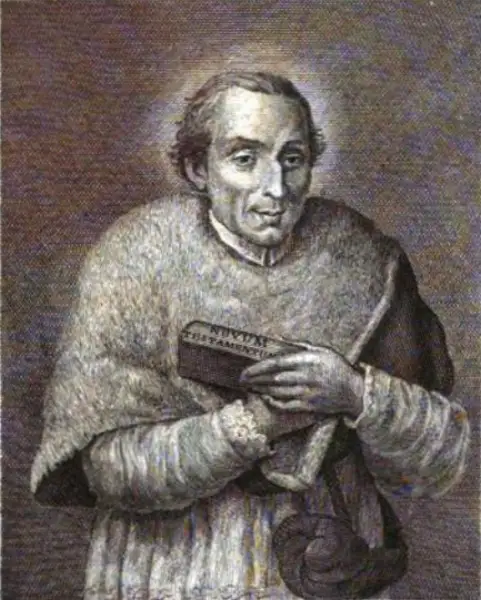
Giovanni Battista de' Rossi was an Italian priest whose entire ministry was spent among the abandoned of Rome: the homeless, the sick, and prisoners. Born at Voltaggio in Piedmont on 22 February 1698, the last of four children of poor but pious parents, he was educated first by two village priests, then as a page to a noble Genoese family, and finally at Rome, where he studied at the Collegium Romanum under the Jesuits. Epilepsy, which struck him during his student years, nearly barred him from ordination, and only a special dispensation opened the priesthood to him. He laboured for homeless women, helped to found a hospice near Saint Galla's, aided prisoners and workers, and became one of the city's most sought-after confessors, so much so that he was called a second Philip Neri. As canon of Santa Maria in Cosmedin he sold his inheritance for the poor and bore with heroic patience the violence of his ailing cousin and the slander of an envious colleague. Broken by illness, he died in Rome on 23 May 1764, and was raised to the altars by Pius IX and Leo XIII.
The Complete Life
A Poor Boy from Voltaggio
Giovanni Battista de' Rossi came into the world at Voltaggio, in the Piedmontese province of Alessandria, on 22 February 1698, the last of the four children of Carlo and Francesca Anfosi de' Rossi. The family was poor, but it was a poverty joined to piety, and his parents' faith shaped the boy's earliest years. His first schooling was entrusted to two priests of the neighbourhood, Scipio Gaetano and Giuseppe Repetto, who recognised the child's brilliance, made him their favourite student, and marked him out for something greater. Providence opened an unexpected door in 1708: after Mass one day the boy met Giovanni Scorza and Maria Battina Cambiasi, a noble couple from Genoa, who, with his father's consent, took him into their household as a page and sent him to school in the city. Genoa gave him refinement, but it also gave him sorrow, for his father died suddenly in 1710 and his elder brother followed their father to the grave not long after. His mother begged him to come home; the boy refused, firm in his resolve to continue his studies. Two Capuchin friars he met at the Scorza residence, one of whom belonged to his own family circle, offered to help him advance.
§ Education and ordination
Rome, Studies, and a Hard-Won Ordination
In 1711, at the suggestion of his cousin Lorenzo, a canon of Santa Maria in Cosmedin, the young man travelled to Rome to begin studies at the Collegium Romanum under the direction of the Jesuits. He pursued his philosophical and theological formation at the Dominican College of Saint Thomas, and about this time he joined the Ristretto of the Twelve Apostles, a circle that joined prayer to works of charity among the poor of the city. Then illness struck. Fainting after Mass one day, he was found to have suffered an epileptic seizure, an affliction that would trouble him for the rest of his life and that frequently kept him from his classes through exhaustion and pain. His longing for the priesthood collided with a hard ecclesiastical reality: epilepsy, under ordinary circumstances, excluded a man from holy orders. Yet the Church made room for grace, and a special dispensation was granted. He was ordained on 8 March. From the beginning his ministry took the shape it would keep for forty years: he went out to the homeless women who wandered the streets of Rome, helped to establish a hospice for them near Saint Galla's, assisted prisoners and labourers, and won such a reputation in the confessional that people called him a second Philip Neri, while he cherished a special devotion to Saint Aloysius Gonzaga.
§ Education and ordination
Canon of Cosmedin and Confessor of Rome
Lorenzo, his cousin and patron, wanted Giovanni Battista at his side as coadjutor to guarantee his succession, and Rossi accepted in February 1735. What followed was a long crucible. Lorenzo suffered a stroke of terrible violence that darkened his once gentle character; he raged at his cousin, blamed him for his sufferings, and hurled medicine bottles at his head, drawing blood. The servants kept away; Rossi alone stayed loving and faithful at the bedside of the man who tormented him. When Lorenzo died in 1737, Rossi became canon of Santa Maria in Cosmedin, and his first acts revealed the man: he bought the church a new organ, sold his cousin's sumptuous house, and distributed the proceeds among the poor. For years he had dreaded hearing confessions, fearing an epileptic seizure in the confessional, but in 1739 a friend persuaded him that he could do more good by opening that ministry. The Bishop of Cività Castellana, Giovanni Francesco Maria Tenderini, consoled his hesitation with the words that this too belonged to his vocation. Pope Clement XII dispensed him from his obligations in the choir so that he could hear confessions without distraction, Benedict XIV made the dispensation permanent, and Rossi became one of Rome's most beloved confessors, even bearing patiently the slander of a bitter colleague whom he afterwards visited in illness.
§ Canon
The Long Goodbye
By 1748 Rossi's strength was failing so markedly that he moved to Santissima Trinità dei Pellegrini, though he kept serving at Santa Maria in Cosmedin. When August 1762 came round, his friends at last persuaded him to seek recuperation at Lake Nemi, but there the seizures returned with greater violence than ever, and by the middle of October he was back in Rome, a sick man who could rarely leave his room. He still found strength for farewell: on 8 September 1763 he celebrated Mass at his old church and let those present understand that he would soon die. That December came his sharpest trial. It was on the morning of 27 December 1763 that a servant, knocking at eight o'clock, discovered him stretched on the ground, half-clothed and senseless after a fierce seizure; not until the following day did he regain awareness and receive the Viaticum together with the Anointing of the Sick. Everyone prepared for his death, and then, to general astonishment, he recovered enough to celebrate several Masses before relapsing into his sick bed. His condition worsened on 21 May 1764, and on 23 May, at nine in the morning, he died after multiple strokes, sixty-six years old. His remains were laid in the main altar of Santissima Trinità dei Pellegrini in Rome.
§ Declining health and death
A Cause That Outlasted Wars
The road to Rossi's canonization was itself a story of perseverance. It opened under Pope Pius VI on 27 June 1781, only seventeen years after his death, but it was almost immediately overtaken by history: the French Revolution, the Napoleonic Wars that followed it, and the European revolutions of 1848 each in turn suspended the work, so that the cause lay decades in arrears. Only in the mid-nineteenth century did it revive. On 7 March 1859 Pope Pius IX attributed two miracles to Rossi's intercession, clearing the way for the beatification, which the same pope presided over in Saint Peter's Basilica on 13 May 1860. A generation later, the acknowledgement of two further miracles in 1881 empowered Pope Leo XIII to enrol him among the saints, and the canonization was celebrated on 8 December 1881 in Saint Peter's Basilica. Thus, more than a century after his death and a full hundred years after the cause began, the priest of the Roman streets was raised to the honour of the altar, his quiet heroism of the confessional and the hospice confirmed before the whole Church.
§ Sainthood
A Titular Church in His Name
Rossi's memory took permanent architectural form in twentieth-century Rome. In 1940 a church was dedicated to him in the city, though the outbreak of the Second World War delayed its construction for a time. The building was at last consecrated on 22 May 1965, and on the following day, 23 May, the feast of the saint, his relics were translated from Santissima Trinità dei Pellegrini, where they had rested since his burial, into the church that bore his name. In 1969 the church was raised to still greater dignity when it became a titular church of the Roman clergy, assigned to cardinals of the rank of Cardinal-Priest, so that the poor priest of Santa Maria in Cosmedin now has his name spoken continually in the college that advises the pope. His body thus lies in a Rome that has honoured him twice over, once in the old church of the pilgrims where he ended his days, and once in the modern sanctuary that carries his name. Devotion to him remains alive especially in Voltaggio, his native town, of which he is the patron, and among all who suffer from epilepsy, the affliction he carried with such patience through a lifetime of service.
§ Titular church
Timeline
- 22 Feb 1698
Born at Voltaggio in Piedmont, the last of four children of Carlo and Francesca Anfosi de' Rossi.
§ Education and ordination
- 1708
Met the noble Scorza couple of Genoa after Mass and became a page in their household, continuing his schooling there.
§ Education and ordination
- 1710
His father died suddenly; his older brother died not long afterwards.
§ Education and ordination
- 1711
Travelled to Rome at his cousin Lorenzo's suggestion to study at the Collegium Romanum under the Jesuits.
§ Education and ordination
- Feb 1735
Accepted his cousin Lorenzo's request to serve as his coadjutor at Santa Maria in Cosmedin.
§ Canon
- 1737
Became canon of Santa Maria in Cosmedin after his cousin's death, bought the church a new organ, and gave his inherited fortune to the poor.
§ Canon
- 1739
Yielded to a friend's urging and sought authorization to hear confessions despite his epilepsy.
§ Canon
- 1748
His health so weakened that he moved to Santissima Trinità dei Pellegrini while still serving at Santa Maria in Cosmedin.
§ Declining health and death
- Aug 1762
Sent to Lake Nemi to recuperate, but his seizures grew more violent and he returned to Rome in mid-October, largely confined to his room.
§ Declining health and death
- 8 Sep 1763
Celebrated Mass at Santa Maria in Cosmedin, hinting to those present that his death was near.
§ Declining health and death
- 23 May 1764
Died in Rome at nine in the morning after multiple strokes, aged sixty-six.
§ Declining health and death
- 27 Jun 1781
The cause for his canonization was opened under Pope Pius VI.
§ Sainthood
- 7 Mar 1859
Pope Pius IX attributed two miracles to his intercession.
§ Sainthood
- 13 May 1860
Beatified by Pope Pius IX in Saint Peter's Basilica.
§ Sainthood
- 8 Dec 1881
Canonized by Pope Leo XIII in Saint Peter's Basilica after two further miracles were acknowledged.
§ Sainthood
- 1940
A church was dedicated to him in Rome, though wartime conditions postponed its construction.
§ Titular church
- 22 May 1965
The new Roman church dedicated to him was consecrated.
§ Titular church
- 23 May 1965
His relics were translated from Santissima Trinità dei Pellegrini to the newly consecrated church.
§ Titular church
- 1969
The church of San Giovanni Battista de' Rossi became a titular church for cardinals of the rank of Cardinal-Priest.
§ Titular church
The Record
- Major works
- Hospice for homeless women near Saint Galla's
- Patron of
- Voltaggio
- Symbols
- Priest's attire·Crucifix
- Canonization
- Beatified 13 May 1860 by Pope Pius IX; canonized 8 December 1881 by Pope Leo XIII.
Prayer
Bibliography
Show 4 sources
- Pettiti, Gianpiero. "Saint Giovanni Battista de' Rossi". Santi e Beati. Retrieved 28 March 2017.
- "Saint Giovanni Battista Rossi". Saints SQPN. 17 May 2015. Retrieved 28 March 2017.
- "Spiritual Newsletter". Abbey of Saint-Joseph de Clairval. Archived from the original on 6 July 2020. Retrieved 28 March 2017.
- Mougeot, E. St. John Baptist de Rossi. Benziger Bros., 1906.
Profile text adapted from the Wikipedia article, licensed CC BY-SA 4.0.
Pray with this saint every day
Save St. Giovanni Battista de' Rossi to your favorites, read the full profile, and get feast-day reminders in the Saints app.
Get the Saints AppFree on the App Store for iPhone and iPad