
1786 – 1842·Feast April 30
St. Giuseppe Benedetto Cottolengo
Founder of the Little House of Divine Providence
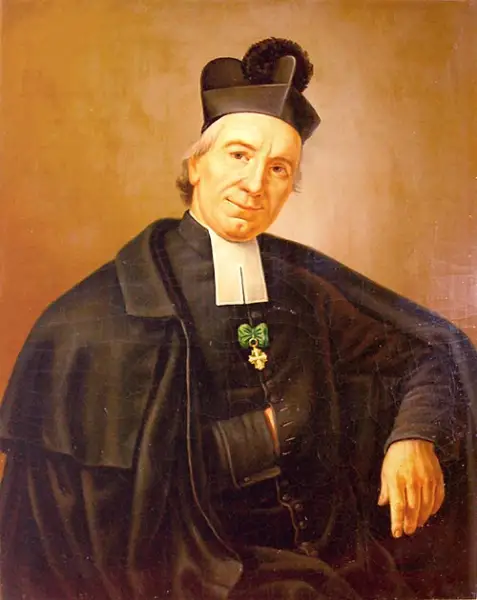
Overview
Giuseppe Benedetto Cottolengo was an Italian priest and the founder of the Little House of Divine Providence. Born at Bra in Piedmont in 1786, the eldest of twelve children, he was ordained for the diocese of Turin and appointed a canon at the Basilica of Corpus Domini, where he was noted for giving his preaching fees and Mass stipends to the destitute. A turning point came in his forty-first year when he attended a pregnant traveler dying of tuberculosis whom no hospital in Turin would admit. Shaken by her death, he sold his possessions, rented two rooms, and began sheltering the sick who had been turned away elsewhere. When the cholera epidemic of 1831 forced his small hospital to close, he moved to the outskirts of the city and established the Little House of Divine Providence at Valdocco, an enterprise that grew to embrace orphanages, monasteries, convents, and communities of priests, brothers, and lay volunteers. He contracted typhoid while caring for his patients and died at Chieri in 1842. Beatified in 1917 and canonized in 1934, he is invoked against infectious and liver diseases, and his institute continues its work across several continents.
The Complete Life
A Piedmontese Childhood and Priestly Formation
Giuseppe Benedetto Cottolengo was born on 3 May 1786 in Bra, a town in Piedmont then belonging to the Kingdom of Sardinia. His family was middle-class and large: he was the first of twelve children, though six of his siblings died in infancy, a common grief of the age that may have shaped his later sensitivity to suffering. As a young man he attached himself to the Franciscan way of life, becoming a third order member on 2 October 1802 while still in his teens. His path to the priesthood was not smooth. He entered the seminary at Asti in 1805, but the institution closed two years later, and he had to continue his studies privately at home. He received priestly ordination on 8 June 1811, amid the years when Piedmont was emerging from the upheavals of the French occupation. His first assignment was as a curate at Corneliano D'Alba, and he went on to complete a doctorate in theology in Turin. In 1818 he was received as a canon of the Basilica of Corpus Domini in Turin, an honorable position in the heart of the city. Even in this comfortable post he practiced striking detachment, giving away every gift, donation, preaching fee, and Mass stipend he received to the poor of the city.
§ Early life
The Call to Charity
Turin in the 1820s was a city under strain. Still recovering from the French occupation, it absorbed waves of immigration from the countryside that produced severe poverty: widespread pauperism and begging, illiteracy, recurring epidemics, many illegitimate births, and high infant mortality. Into this misery Cottolengo carried his canonical duties, but in his forty-first year the reading of St. Vincent de Paul's life made him grasp that charity itself must be his life's work. The conviction was sealed by a single encounter. A family traveling from Lyons to Milan came to his attention: the pregnant mother was gravely ill with tuberculosis, and the Maggiore Hospital refused her because of the infection, while the maternity hospital could not take her because of her fever, its rules barring anyone who might be contagious. Cottolengo could offer her only the last rites and baptism for her child, who died. The mother's fate, and the crying of her surviving children, pierced him. He resolved that no such person should die abandoned again. Selling everything he owned, down to his cloak, he rented two rooms to receive those whom the hospitals would not admit.
§ Charitable work
The Little House of Divine Providence
The work began modestly on 17 January 1828, when the two rented rooms received their first guest, an elderly paralytic, free of charge. Soon the premises had become a hospitality center for people excluded from ordinary hospitals. Cottolengo did not labor alone for long: Doctor Lorenzo Granetti and the pharmacist Paul Royal Anglesio lent their professional skill, while twelve Ladies of Charity, directed by the wealthy widow Marianna Nasi, visited and nursed the sick. The enterprise faced a severe test when cholera broke out in 1831. Fearing contagion, the authorities ordered the small hospital closed as a precaution. Rather than surrender the work, Cottolengo bought a house at Valdocco, on the outskirts of Turin, and moved there with two nuns and a single patient suffering from cancer. This relocation marks the true founding of the Little House of Divine Providence. Benefactors rallied to him, above all the Cavalier Ferrero, and an orphanage soon followed. The foundation kept multiplying: monasteries arose, convents too, houses for priests, houses for brothers, and organized contingents of lay volunteers, all taking shape under his direction, forming a many-branched family of works devoted to those no one else would receive.
§ Charitable work
Death Among His Patients
Cottolengo's end was of a piece with his life. He had spent himself for nearly fifteen years in serving the sick whom other institutions rejected, and in the spring of 1842 he contracted typhoid fever in the course of assisting his patients. The disease proved fatal. He died at Chieri on 30 April 1842, only fifty-five years old, leaving behind no written doctrine and no system of his own, but a living work: the Little House of Divine Providence, already flourishing at Valdocco and already a fixture of Turin's charitable landscape. He died as he had lived, exposed to the infections of the poor because he would not keep his distance from them. His feast day was accordingly fixed on the anniversary of his death, 30 April, and both his tomb and his institute became places of pilgrimage for the devout who came after him. The manner of his passing, succumbing to the sickness of those he served, has remained one of the most telling details of his witness: the founder of a hospital for the contagious died of the contagion he refused to fear.
§ Death
Honored by the Church
The Church's recognition of Cottolengo came in two solemn steps in the early twentieth century. On 29 April 1917, in Rome, Pope Benedict XV proclaimed him blessed, in the midst of the First World War, when the Church held up models of self-sacrificing charity for a suffering Europe. Seventeen years later, on 19 March 1934, Pope Pius XI canonized him in Rome, enrolling the Piedmontese priest among the saints of the universal Church. Since then his cult has spread well beyond Turin. Pope Benedict XVI listed him among the saints of charity in the 2005 encyclical Deus caritas est, presenting him to the whole Church as an exemplar of love put into practical service. Parishes and institutions bear his name in Italy and far beyond: the parish of Saint Joseph Benedict Cottolengo stands in Grosseto, a street carries his name in Pisa, and one of the most significant charity institutions of central Brazil, the Sao Jose Bento Cotollengo Institute at Trindade in Goiás, honors him as patron. His story has also reached popular culture, appearing in Bruce Marshall's novel The Divided Lady (1960) and in the Italian film Una cosa in mente (2006), where Massimo Wertmüller took the title role.
§ Legacy
A Living Work of Mercy
The institution Cottolengo founded, known colloquially as the Cottolengo, still exists in Turin, where its presence at the heart of the city is described as a lasting sign of evangelical service to the poorest. The religious community that grew from his work includes Fathers, Sisters, and Brothers who continue to labor together in activities aimed at communicating God's love to those in greatest need. Their facilities now reach far beyond Piedmont, operating in Ecuador, India, Kenya, Switzerland, Tanzania, the United States, and Italy itself, so that a work begun in two rented rooms in 1828 has become a worldwide family of charities carrying his name. Devotion to the saint himself has attached especially to the sick: he is invoked against infectious diseases generally, and against cirrhosis and other ailments of the liver, on account of a miracle recounting how he came in a dream to a nun whose cirrhosis then vanished. Places named for him across Italy and Brazil keep his memory public and his example visible, and his example endures as a summons to receive without qualification those whom systems and institutions find inconvenient.
§ Legacy
Timeline
- 3 May 1786
Born in Bra, Kingdom of Sardinia, eldest of twelve children of a middle-class family.
§ Early life
- 2 Oct 1802
Became a Franciscan tertiary at the age of sixteen.
§ Early life
- 1805
Entered the seminary at Asti, completing his studies at home after the seminary closed.
§ Early life
- 8 Jun 1811
Ordained a priest.
§ Early life
- 1818
Accepted as a canon of the Basilica of Corpus Domini in Turin after earning a doctorate in theology.
§ Early life
- 17 Jan 1828
Opened two rented rooms offering free lodging to a paralytic, beginning his hospital for the rejected sick.
§ Charitable work
- 1831
After authorities closed his hospital during a cholera outbreak, bought a house at Valdocco, founding the Little House of Divine Providence.
§ Charitable work
- 30 Apr 1842
Died of typhoid contracted while assisting his patients, at Chieri.
§ Death
- 29 Apr 1917
Beatified in Rome by Pope Benedict XV.
§ Legacy
- 19 Mar 1934
Canonized in Rome by Pope Pius XI.
§ Legacy
The Record
- Major works
- Little House of Divine Providence (founded 1832 at Valdocco)·Orphanage at Valdocco·Monasteries, convents, communities of priests and brothers, and lay volunteer groups
- Patron of
- against infectious diseases·against cirrhosis and other liver diseases
- Canonization
- Canonized by Pope Pius XI in Rome on 19 March 1934, after beatification by Pope Benedict XV in 1917.
Prayer
Bibliography
Show 6 sources
- Arduino, Fabio. "St. Joseph Benedict Cottolengo", Santi e Beati, 21 April 2004
- Tuninetti, Joseph. "Joseph Benedict Cottolengo, saint", Treccani
- "Message to the Society of the Priests of St Joseph Benedict Cottolengo (September 2, 2002)", John Paul II, www.vatican.va
- "La Storia", Cottolengo (in Italian)
- Melton, J. Gordon (2014). Faiths Across Time: 5,000 Years of Religious History. ABC-CLIO. p. 1817. ISBN 978-1-61069-026-3
- Škrobonja, Ante (2006-01-26). "Patron Saints and Gastrointestinal Diseases in the Christian Tradition". Medicus (in Croatian). 15 (1): 195–200. ISSN 1330-013X
Profile text adapted from the Wikipedia article, licensed CC BY-SA 4.0.
Pray with this saint every day
Save St. Giuseppe Benedetto Cottolengo to your favorites, read the full profile, and get feast-day reminders in the Saints app.
Get the Saints AppFree on the App Store for iPhone and iPad