
c. 1365 – 1425·Feast July 14
St. Giyorgis of Segla
Ethiopian Monk, Theologian, and Hymnographer of Ge'ez
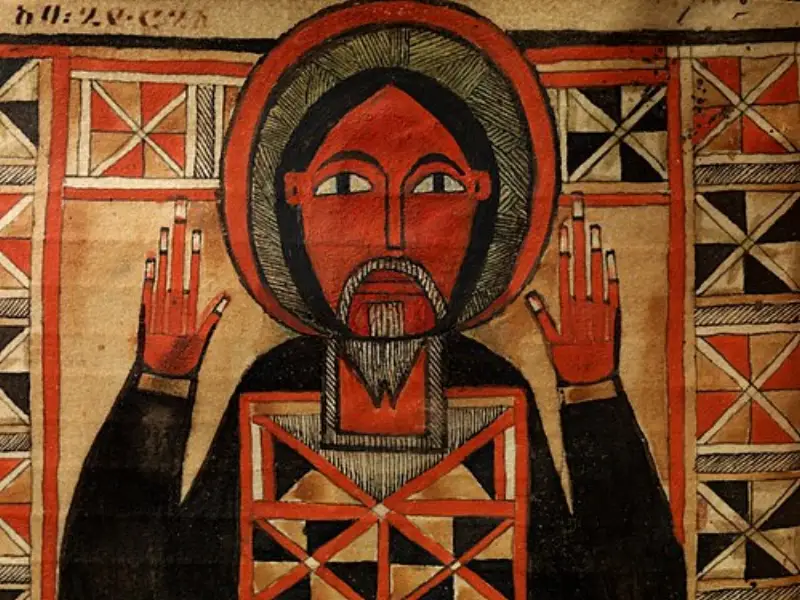
Overview
Giyorgis of Segla, also known as Giyorgis of Gasicha or Abba Giyorgis, was an Ethiopian Oriental Orthodox monk, saint, and author of religious books, ranked among the most important Ge'ez writers of fifteenth-century Ethiopia. Born around 1365, reportedly in Tigray or Wollo to noble parents, he was counted among the students of the monastic leader Iyasus Mo'a at the monastery on Lake Hayq, though his early learning was so slow that his teacher despaired of him until, tradition says, the Blessed Virgin appeared to him in a night vision and urged him to diligent study. He rose to become court chaplain under Emperor Dawit I and tutored the royal princes, among them the future emperor Zara Yaqob. His views on the Sabbath brought him into conflict with other churchmen and with Dawit, who imprisoned him, partly through the influence of the foreigner Bitu; he was freed when Tewodros I took the throne and remained influential under Yeshaq I until his death on 1 July 1425. His Book of Hours and his anti-heretical Book of Mystery, completed in 1424, shaped Ethiopian liturgy and literature, and his hymns and calendar reforms left a lasting mark on the Church's worship.
The Complete Life
Noble Birth and a Slow Beginning
Giyorgis is said to have been born around 1365, either in Tigray or in Wollo, to parents of noble descent. His father, Hezba Tseyon, served Emperor Dawit I as a court chaplain, and contemporaries called him one who grasped the Scriptures as Salathiel had — Salathiel being Ezra the Scribe; his mother, ʾEmmena Ṣeyon, came from the Walaqa region. Into this cultivated and pious household the future monk was born, and he was numbered among the students of the Ethiopian saint and monastic leader Iyasus Mo'a at the prominent monastery on Lake Hayq, a place that had already become a destination of pilgrimage during Iyasus Mo'a's own lifetime. The beginning of Giyorgis's career, however, was marked by hardship. Ethiopian education of the era relied heavily on memorization, and in an oral culture a student without evident ability could advance no further. Giyorgis learned so slowly that at one point his teacher lost hope. Facing this crisis, he went daily to the church, where he prayed in tears, wholly concentrated, to God and to the Blessed Virgin. One night, the story runs, she appeared to him with the command to press on diligently with his learning, urging him even to give up sleep at night.
§ Early life
The Making of a Court Chaplain
From the monastery school at Lake Hayq, Giyorgis passed into a career that united scholarship with service at the highest level of the Ethiopian state. Like his father before him, he rose into the position of court chaplain during the reign of Emperor Dawit I, and the royal princes of the court were tutored by him. Among his students was the future emperor Zara Yaqob, who throughout his life would hold theological views remarkably similar to his teacher's. The relationship between master and pupils proved historically consequential: eight sons of Dawit I, all taught by Giyorgis, became rulers of the Ethiopian Empire one by one. His standing as an author grew alongside his courtly role. He became one of the most important theological writers in the Ge'ez language in fifteenth-century medieval Ethiopia, a stature that can be compared with that of Emperor Zara Yaqob himself and of the pseudonymous Ritu'a Haymanot, The One with the Orthodox Faith. Yet his independence of mind was already visible, and the same conviction that made him a formative teacher would soon bring him into open conflict with his sovereign and with other churchmen over the observance of the Sabbath.
§ Career
Controversy, Prison, and Monasteries
Giyorgis's thoughts concerning the Sabbath brought him into dispute with other churchmen and with Emperor Dawit I, who had him imprisoned. The quarrel was not merely academic: disputes about the Sabbath were politically destabilizing in fifteenth-century Ethiopia, a realm troubled by monastic infighting and much contact with the outside world, whose missionaries of competing traditions sometimes influenced political leaders. A foreigner called Bitu, who wielded great influence over the emperor, was involved in the decision to imprison Giyorgis; the two men differed in religious views, as Giyorgis's Book of Mystery shows, devoting a chapter to refuting Bitu's teaching on the Image of God. Only when a former royal pupil of his, Tewodros I, mounted the throne was Giyorgis set free; his dissent did not strip him of standing, which lasted until he died in the days of Yeshaq I. His monastic life also bore institutional fruit. Having wished to join the monastery of Dabra Libanos, he was diverted by the Sabbath disputes to Dabra Gol in the historical Wollo region, where late in life he became head of the community of Abba Batsalota-Mikael. He served as abbot, or Nebura'ed, of the important monastery of Debre Damo, and founded the monastery of Debre Bahriy in Gasicha.
§ Career
Theology of the Sabbath and the Soul
Giyorgis's theological mind is displayed most fully in his Book of Mystery, an extensive anti-heretical work of thirty chapters completed on 21 June 1424, regarded as the most important original Ethiopian theological work and still used in the liturgy, its treatises appointed to be read on the great feast days of the Ethiopian Church. There he teaches that man is a creature of God endowed with an immortal soul, and that with this divine gift he differs from all other creatures as an intelligent and speaking being, a view of man that scholars characterize as dualistic. His most distinctive position concerned the Sabbath. While holding, as is customary in Christianity, that Jesus established Sunday as the Lord's Day, Giyorgis reasoned that if Christ came to fulfill the Mosaic Law, hints of the Sunday Sabbath should be discoverable in the Pentateuch itself. Relying on the Book of Jubilees and the Enoch calendar, both part of the Ethiopian canon, he constructed a mathematical demonstration based on the 364-day year and the seven-year Jubilee cycle to show that Sunday corresponds to the Jubilee, the Sabbath's Sabbath. The Church had long since adopted the 365-day Ethiopian calendar, so his calculation bore no practical fruit for the liturgical year, but the Sermon on the First Sabbath remains a monument of his scriptural imagination.
§ Views on the Sabbath
Last Years at Dabra Gol and Death
The close of Giyorgis's life was spent in monastic leadership rather than at court. Disputes over the Sabbath had prevented him from joining the monastery of Dabra Libanos, as he had wished, and instead he took his place at Dabra Gol in the historical Wollo region, where, in his last years, he took charge of Abba Batsalota-Mikael's community. His former royal pupils, the eight sons of Emperor Dawit I whom he had tutored, succeeded one another as rulers of the Ethiopian Empire, so that even in the monastery the old teacher remained connected to the throne. Though the dissidence had once cost him his freedom, his influence persisted to the end: he died on 1 July 1425, in the reign of Emperor Yeshaq I. His memory took root immediately in the tradition of the Church: a Gadl, the Saint's Life written by disciples after a holy man's death, was composed for him, and a single remaining copy of it is kept in the monastery of Hayq where he had studied under Iyasus Mo'a. At the monastery that bears his name, the bark of a warka tree carries, so it is claimed, a crosscut that Giyorgis left there in person — a relic of his passing that says nothing and yet speaks.
§ Career
Veneration in the Tewahedo Church
Giyorgis of Segla is venerated as a saint in the Ethiopian Orthodox Tewahedo Church by ancient, pre-congregation custom, without any formal act of beatification or canonization by a later authority. His feast is kept on 14 July, and he stands in the Church's calendar among the great figures of Ethiopian holiness, listed with Yared, Tekle Haymanot, and the Nine Saints. His sanctity was recognized in the living memory of the community that produced his Gadl, the hagiography his disciples wrote after his death, and in the miraculous narratives that gathered around his name: a miracle of the Archangel Uriel worked for Abba Giyorgis of Gascha was circulated in Ge'ez literature, and a late seventeenth-century Gondarine manuscript of the Miracles of Mary includes a story of how the Virgin Mary favored his book of hours above others. The veneration is attached not only to his person but to his works, which the Church received as instruments of grace, using his hours, his hymns, and his Book of Mystery in its liturgy century after century, so that the saint lives on whenever the Ethiopian Church prays with the books he gave it.
§ Career
Influence on Prayer, Hymn, and Letters
Ethiopian monastic calendars, hymnody, and Ge'ez letters all bear the stamp of Giyorgis's writing; among the Ge'ez authors of fifteenth-century Ethiopia he ranks among the most significant. His book of hours — the Sa'atat, as it was simply called — competed with the widely used Ge'ez version of the Coptic Book of Hours and with the compilations of individual monasteries, and though the Coptic book prevailed to some extent, Giyorgis's was the most prevalent book in use; it was gradually expanded with additional material such as hymns in the century after its creation. As a composer he wrote hymns in honor of Saint Peter and Saint Paul and produced a hymn collection that competed for adoption as the saints' hymnal of the Ethiopian Church; its contents inclined toward Roman Catholic viewpoints at a remarkably early date, though Emperor Zara Yaqob's hymnal ultimately proved the most successful. At his direction, scholars of Debre Negudgad and Debre-Egziabiher pulled the fasting-season hymns out into a division of their own — a break with the threefold division of Saint Yared's sixth-century degua. No complete inventory of his compositions exists, and several local anaphoras of the Divine Liturgy trace back, perhaps, to his own hand, a measure of how deeply his voice entered Ethiopian worship.
§ Hymnody
Timeline
- 1365
Born around this year, in Tigray or Wollo, to parents of noble descent.
§ Early life
- 21 Jun 1424
Completed the Book of Mystery, an anti-heretical work of thirty chapters still used in the liturgy.
§ Career
- 1 Jul 1425
Died during the reign of Emperor Yeshaq I, still holding influence despite his earlier dissidence.
§ Career
In Their Own Words
And in substitution of the number of the days of the year of release the Lord gave the commemoration of His resurrection, that is the first of the Sabbath.
The Record
- Major works
- Hours (Sa'atat), a book of hours·Book of Mystery (Masehafa mestir), thirty anti-heretical chapters completed 21 June 1424·Book of Thanks (Book of Light)·Horologium of the Night Hours (Sa'atat Zelelit)·Hymns of Praise (Enzira Sebhat)·Praises of the Cross (Wǝddase Mäsqäl)·Arganonä Maryam (The Organ of Mary)·Saqoqāwa dǝngǝl (Lament of the Virgin)·Fékkare haymanot (Synopsis of the Faith)·Hohétä Bérhan (The Gate of Light)·Sermon on the First Sabbath·Monastery of Debre Bahriy founded at Gasicha
- Symbols
- crosscut in the bark of a warka tree at the monastery named after him
- Canonization
- Pre-congregation saint of the Ethiopian Orthodox Tewahedo Church; venerated since his death in 1425.
Prayer
Bibliography
Show 10 sources
- Getatchew Haile (1991). Ethiopian Saints: Claremont Coptic Encyclopedia. Vol. 2
- Seife, Daniel; Feleke, Michael (2015). "SAINT ABBA GIORGIES OF GASSICHA THE ETHIOPIAN THEOLOGIAN"
- Getatchew Haile (2009). "A Miracle of the Archangel Uriel Worked for Abba Giyorgis of Gasǝč̣č̣a"
- Heldman, Marilyn Eiseman; Frē Ṣeyon (1994). The Marian Icons of the Painter Frē Ṣeyon: A Study of Fifteenth-century Ethiopian Art, Patronage, and Spirituality. Otto Harrassowitz Verlag. ISBN 978-3-447-03540-8
- Tsehai Berhane Selassie (1997). "Giyorgis, Abba, Ethiopia, Orthodox". The Encyclopaedia Africana – Dictionary of African Biography. Vol. 1. ISBN 9780917256011
- Hastings, Adrian (1995). "The Policies of Zara Ya'iqob". The Church in Africa, 1450-1950. Clarendon Press. pp. 34–37. ISBN 978-0-19-152055-6
- Lourié, Basil (2016). "An Archaic Jewish-Christian Liturgical Calendar in Abba Giyorgis of Sägla". Scrinium. 12 (1): 73–83. doi:10.1163/18177565-00121p07
- Munro-Hay, Stuart (2005). "Saintly Shadows". In Afrikas Horn. Otto Harrassowitz Verlag. p. 156. ISBN 978-3-447-05175-0
- Tadesse Tamrat (1972). Church and State in Ethiopia, 1270–1527. Oxford: Clarendon Press. ISBN 9780198216711
- Huntingford, G. W. B. "GIYORGIS, Ethiopia, Orthodox". The Dictionary of Ethiopian Biography, Vol. 1
Profile text adapted from the Wikipedia article, licensed CC BY-SA 4.0.
Pray with this saint every day
Save St. Giyorgis of Segla to your favorites, read the full profile, and get feast-day reminders in the Saints app.
Get the Saints AppFree on the App Store for iPhone and iPad