
fl. early 5th century·Feast May 3
St. Glywys
Legendary king of Glywysing and Cornish hermit
Overview
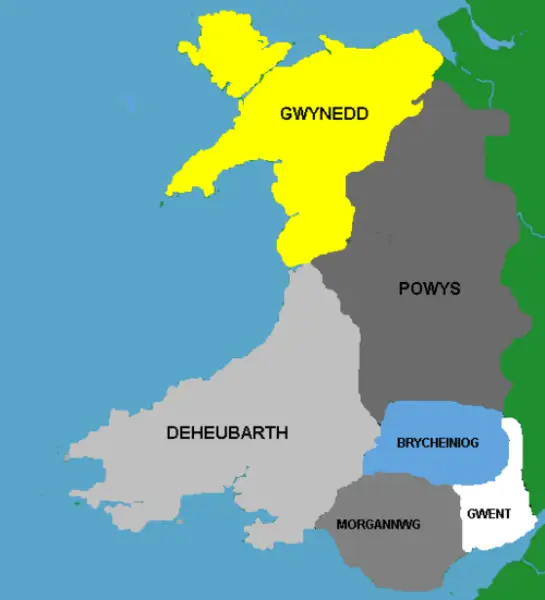
Glywys stands at the head of one of the most tangled royal lineages of early Wales. Medieval genealogists remembered him as a king of the fifth century who gave his name to Glywysing, a realm in the southeast of the country whose heartland lay between the rivers Tawe and Usk. One pedigree makes him the first-born of Solor, himself a son of Mor; by his union with Gwawl, daughter of Ceredig of Ceredigion, he is said to have fathered twenty-two children, all boys but one, among them the churchmen Pedrog and Edelig. After his death, twelfth-century writers relate, his sons divided the kingdom into three cantrefi: Gwynllwg under Gwynllyw, father of St Cadoc; Penychen under Pawl; and Gorfynydd under Merchwyn. Legend adds that in his last years Glywys stepped away from the cares of rule and withdrew to Cornwall as a hermit, planting the church of St Gluvias by Penryn; hence the style Glywys Cernyw, the Cornish Glywys, that some writers give him. Some scholars suspect his name is a back-formation from that of the kingdom rather than the reverse, and possibly a survival of the Romano-British name of Gloucester. Whatever the historical reality, he was honored as a saint, and his feast is kept on 3 May.
The Complete Life
A Founder at the Head of a Royal Line
The sources that preserve the memory of Glywys are genealogies rather than biographies, and they introduce him as the first-born son of Solor, himself the son of Mor. Through this descent he belongs to the network of princely houses that early Welsh writers traced back generation by generation, and his position at the head of the list gave his name an authority that later scribes were careful to repeat. The marriage recorded for him joined two important families of the west: his wife Gwawl was the daughter of Ceredig, the founding figure of Ceredigion. From this union the genealogists count no fewer than twenty-two children, twenty-one sons and a single daughter, an extravagant figure even by the standards of royal legend. What matters most in the record, however, is not arithmetic but vocation: two of the sons, Pedrog and Edelig, were remembered as churchmen, and the eldest, Gwynllyw, carried the line forward in the southeast. A pedigree like this served a political purpose, binding later rulers to an eponymous ancestor, and scholars note that invented founding kings are common in British genealogy. Yet the tradition was old enough and persistent enough to fix Glywys firmly in Welsh memory as the ancestor of saints and kings alike.
§ Biography
King of the Land Between Tawe and Usk
Whatever else the legends say, they agree that Glywys ruled, and that his rule gave a name to the land. Glywysing, the kingdom associated with him, occupied the southeastern corner of Wales, with its heartland lying between the river Tawe and the river Usk, a strategic coastal country that later became Glamorgan. The attachment of a king's name to a territory was a powerful act of memory: to say Glywysing was to invoke the founder, and the name endured for centuries in Welsh usage. The twelfth-century accounts add a telling detail about succession. When Glywys died, his realm was divided among three of his sons into three cantrefi. Gwynllyw, who would himself be remembered as a saint and the father of St Cadoc, took Gwynllwg, the district that still preserves his name in Newport's cathedral, once known as St Woollos, and in the place-name Wentlooge. Pawl received Penychen, and Merchwyn held Gorfynydd. The division suggests how a single princely house could seed the political geography of an entire region, and it kept the founder's family at the center of local identity even as the older kingdom, still called Glywysing, continued to exist alongside the new cantrefi.
§ Biography
Hermit of Cornwall and Saint of Two Lands
The closing tradition of Glywys's life turns from kingship to retreat. His later years, as belief holds, were given to the hermit's life: he crossed the Bristol Channel into Cornwall and there established the church of St Gluvias by Penryn. That is why the Cornish know him by a second name, Glywys Cernyw, the Glywys of Cornwall, a title marking a saint honored on both banks of the water. His veneration found a fixed date early: his feast day is 3 May. Modern scholarship has debated the very substance of his name. Some suspect that Glywys never existed as a man at all, and that his name is a back-formation from that of his supposed kingdom. Glywysing itself may preserve the Romano-British name of the territory and citizens of Glevum, the Roman Gloucester, whose Old Welsh form Caerloyw means the bright or glowing fortress. In that case Glywys belongs to a family of legendary founders, cousin to the Gloyw who appears in the pedigrees of Vortigern and in the Mabinogi. Yet the cult is real, the church in Cornwall is real, and the feast has been kept. A saint may begin as a name in a genealogy and end as an object of devotion.
§ Biography
The Record
- Major works
- Church of St Gluvias near Penryn, Cornwall
- Canonization
- Pre-congregation: venerated as a saint from the early medieval period, with a feast kept on 3 May
Prayer
Bibliography
Show 6 sources
- Davies, John, Nigel Jenkins, Menna Baines and Peredur Lynch (2008). The Welsh Academy Encyclopaedia of Wales, p. 323. ISBN 978-0-7083-1953-6
- Morgan, C. O. S. (1885). "St Woollos Church, Newport, Monmouthshire". Archaeologia Cambrensis, ser. 5, 2: 280.
- Carver, Martin (2006). The Cross Goes North: Processes of Conversion in Northern Europe, AD 300-1300. Boydell Press, p. 125. ISBN 978-1-84383-125-9
- Koch, John T., ed. (2006). Celtic Culture: A Historical Encyclopedia. Santa Barbara: ABC-Clio, p. 1312. ISBN 978-1-85109-440-0
- Cameron, Kenneth. English Place Names
- "EBK: Glywys, King of Glywysing"
Profile text adapted from the Wikipedia article, licensed CC BY-SA 4.0.
Pray with this saint every day
Save St. Glywys to your favorites, read the full profile, and get feast-day reminders in the Saints app.
Get the Saints AppFree on the App Store for iPhone and iPad