
c. 585 – 649·Feast July 6
St. Goar of Aquitaine
Priest hermit of the Rhine at Oberwesel
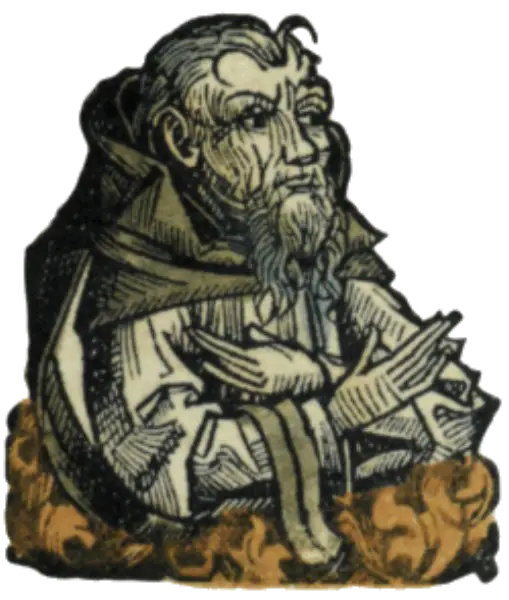
Overview
Goar of Aquitaine, remembered in Latin as Goaris, was a seventh-century French priest who abandoned a brilliant ecclesiastical career for solitude on the Rhine. Born to a noble family around 585, he showed unusual devotion from youth, and after ordination his preaching drew wide attention. Uncomfortable with fame, he left his homeland in 618 for the diocese of Trier and settled as a hermit near Oberwesel, intending a hidden life of obscurity. His reputation for holiness spread anyway, and travelers sought him out for counsel. Two pilgrims accused him before Rusticus, Bishop of Trier, of hypocrisy regarding his vows; at the hearing the hermit was vindicated by a decisive miracle that instead exposed the bishop's own guilt. King Sigebert III of Austrasia then summoned Goar to Metz and offered him the vacant see of Trier. In a second version of the story the bishop charged the hermit with sorcery, and the king cleared him before deposing his accuser. Either way, Goar shrank from the burdens of office, asked for time to consider, returned to Oberwesel, fell ill, and died there on 6 July 649, never having become a bishop. A life of the saint was written in 839, and his cult gave its name to the town of Sankt Goar on the Rhine.
The Complete Life
A Noble Son of Aquitaine
Goar was born around 585 into an aristocratic family of Aquitaine, the southwestern land of old Roman Gaul. The sources agree that even as a boy he stood out for his piety, a seriousness of devotion that set the direction of his whole life. In an age when noble birth typically pointed toward estates, courts, and military command, his inclinations pointed instead toward the church. When he came of age he was ordained a priest, and his preaching quickly made him famous: contemporaries were struck by the force and conviction with which he set out the faith. That very success, however, disturbed him. A celebrated pulpit meant crowds, and crowds meant reputation, and reputation was precisely what he did not want. He had resolved to serve God discreetly, to give his strength to prayer rather than to public esteem. The decision that followed was radical for a man of his background and gifts: he would leave Aquitaine altogether, crossing far beyond the reach of the audiences that praised him, and seek in a foreign diocese the hiddenness his soul required. In 618 he set out for the lands of the Rhine and the diocese of Trier, one of the oldest Christian sees of Germany, there to begin the second life that would make his name endure.
§ Life
From Famous Preacher to Hidden Hermit
The move from celebrated preacher to nameless solitaire defined Goar's vocation. In 618 he settled near the small town of Oberwesel, on the left bank of the Rhine in the diocese of Trier, and embraced the eremitical life. He intended to live in solitude and obscurity, and by every human calculation he should have vanished from memory within a generation. Instead the opposite happened: word of his holiness spread through the whole country around him. Pilgrims and travelers found their way to his retreat, asking his advice and carrying away reports of his sanctity, so that the man who had fled fame became famous precisely by fleeing it. Hiddenness, for Goar, was not misanthropy. He received those who came to him, and the counsel he gave became the instrument of a quiet ministry that no pulpit had ever matched. The pattern is one of the oldest in Christian hagiography: the desert that was sought as escape became a place of encounter for thousands. His discretion, meanwhile, remained intact. He made no claim for himself, published nothing, and sought no office, a reserve that would soon be tested in the most public way imaginable when enemies began to question the reality of the poverty and chastity he professed.
§ Life
Calumny, Miracle, and Vindication
The trial that made Goar's reputation decisive began with two pilgrims who visited his hermitage and came away sneering. They reported to Rusticus, Bishop of Trier, that the hermit was a hypocrite whose vows of poverty and chastity were a performance. Summoned to answer the charge, Goar appeared before his accuser, and legend relates that God defended him with a miracle that settled the matter in a single stroke: the sign that proved the hermit innocent also exposed the bishop as guilty of the very imprudence and lasciviousness he had alleged against his accuser. The Vita composed at Prum some two hundred years afterward tells the tale at greater length. In it, an abandoned child found in a church close by is carried to Goar, and the bishop, seeking proof of his own innocence, requires the hermit to identify the boy's father. The test rebounded: the hermit named Rusticus himself, and the stunned bishop begged forgiveness. A variant tradition holds that Rusticus accused Goar of sorcery, that King Sigebert cleared him at Metz, and that only after the bishop was deposed for dishonesty did the offer of the see come. In every version the pattern is the same: truth defended not by argument but by the naked credibility of a holy life.
§ Veneration
Poverty Guarded, Honor Refused
The miracles attached to Goar's memory all orbit a single spiritual center: the conviction that a vocation is a covenant with God, not a ladder of advancement. His poverty and chastity, slandered by his enemies, were vindicated by events; his refusal of the bishopric, the strangest act of his life, was likewise ratified by a sign. When Sigebert III summoned him to Metz and pressed on him the vacant see of Trier, the hermit declined, and, according to the legend that explains his most curious emblem in art, he flung his cappa across a ray of sunlight, and the cloak stayed hanging there as if the beam of light could bear weight. This was no act of showmanship. It was a declaration that his refusal was divinely justified, that the God who made light bear a mantle could make a hermitage bear more fruit than a cathedral throne. Iconographers remembered him accordingly: a hermit fed with milk by three hinds, a figure with the devil on his shoulder or crushed beneath his feet, a man holding a pitcher, or holding in his hands the very church of Saint Goar am Rhein that grew from his solitude. The emblems portray a soul at war with the demonic and at peace with creation.
§ Veneration
A Bishop's Throne Declined, a Hermit's Death Chosen
Faced with the king's command that he fill the bishopric of Trier, Goar did what his whole life had prepared him to do: he asked for time. The duties and strains that come with a bishop's charge were burdens he had no wish to take up, and he appears to have trusted that postponement might gentle the king's insistence. Back at Oberwesel, though, sickness overtook him, and the waiting turned into his last act of self-possession. He died there on 6 July 649, aged about sixty-three, having never become bishop. In the economy of holiness the episode reads as his last and greatest sermon: the foremost see of the region lay open before him, with all its power and patronage, and he chose instead to die in the small silence where his life had been spent. The date of his death, 6 July, became his feast day, and the place of his retirement became, in time, a town bearing his name. He had sought obscurity and received immortality, not through the offices he declined but through the fidelity with which he declined them. The bishop's ring that never graced his finger proved a lighter burden than the hermit's pitcher he carried to the end.
§ Life
The Saint Who Named a Town on the Rhine
Goar's afterlife on the Rhine was more visible than his life had been. Charlemagne is reported to have built a church over the site of the hermitage, and around that church the town of Sankt Goar am Rhein grew up on the left bank between Wesel and Boppard, taking the saint's name into the geography of Germany itself, together with its neighbor Sankt Goarshausen across the river. In 839, less than two centuries after his death, the monk Wandalbert of Prum composed the Vita Sancti Goaris, a semi-legendary life that gathered the miracle stories, above all the vindication before Rusticus and the mantle hung on the sunbeam, and fixed them in literary form for the Middle Ages. Devotion lasted into modern times: per the Catholic Encyclopedia, a church in Goar's honor was consecrated in 1768 at the small Rhine settlement that bears his name. His cult passed into the universal calendars of East and West, and popular religion assigned him the patronage of innkeepers, potters, and vine growers, the trades of the river country where he had lived. He is remembered on 6 July as a model of the holiness that seeks no audience.
§ Veneration
Timeline
- 585
Born into a noble family in Aquitaine and noted for piety from his earliest years.
§ Life
- 618
Left his homeland for the diocese of Trier to live as a hermit near the town of Oberwesel.
§ Life
- 6 Jul 649
Died at Oberwesel after illness, having declined the bishopric of Trier.
§ Life
- 839
The monk Wandalbert of Prum composed the Vita Sancti Goaris, a semi-legendary account of the saint's miracles.
§ Veneration
- 1768
A modest church honoring Goar was consecrated at Saint-Goar, the Rhine settlement named after him.
§ Veneration
In Their Own Words
as though the shaft of light were solid
The Record
- Patron of
- Innkeepers·Potters·Vine growers
- Symbols
- Hermit given milk by three hinds·Holding a pitcher·Devil on his shoulder or under his feet·Holding the church of Saint Goar am Rhein·Hanging his hat on a sunbeam
- Canonization
- Pre-congregation: venerated from the early medieval period along the Rhine
Prayer
Bibliography
Show 6 sources
- Herbermann, Charles, ed. (1913). "St. Goar". Catholic Encyclopedia. New York: Robert Appleton Company.
- Butler, Alban (1894). "St. Goar, Priest". Lives of the Saints. Benziger Brothers.
- Jones, Terry. "Goar". Patron Saints Index. Archived from the original on 19 November 2007.
- "St. Goar". Saints and Angels. Catholic Online. Retrieved 9 November 2007.
- "Vita Sancti Goaris" (in German). mittelrheintal.de. Retrieved 9 November 2007.
- Spence, Lewis (1915). Hero Tales and Legends of the Rhine. George G. Harrap & Company.
Profile text adapted from the Wikipedia article, licensed CC BY-SA 4.0.
Pray with this saint every day
Save St. Goar of Aquitaine to your favorites, read the full profile, and get feast-day reminders in the Saints app.
Get the Saints AppFree on the App Store for iPhone and iPad