
died 670·Feast June 20
St. Gobain
Irish hermit and martyr of the forest of Voas
Overview
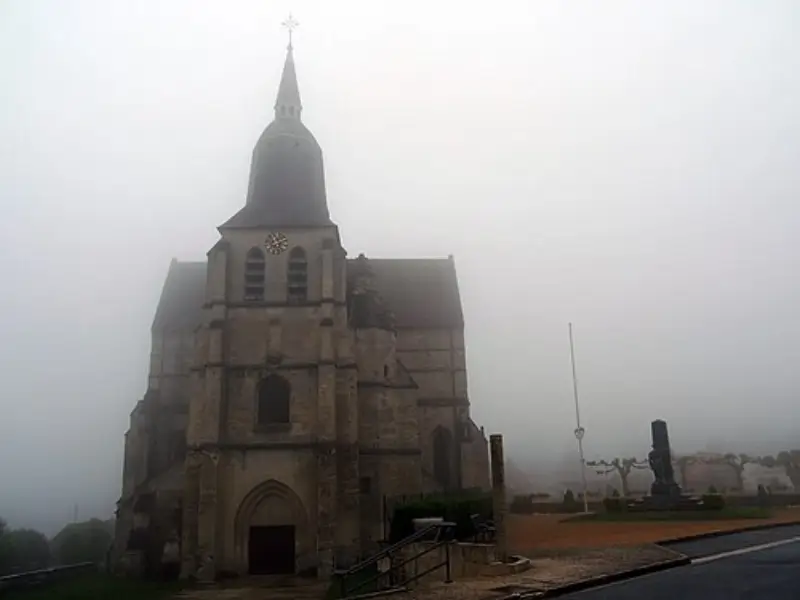
St. Gobain, also called Goban, was an Irish monk of the seventh century who died a martyr in France around the year 670. Born in Ireland, he was brother to St. Wasnon, whose memory is honored by a church dedicated in his name at Condé-sur-l'Escaut. Gobain became a spiritual disciple of St. Fursey, the celebrated Irish missionary, at Burgh Castle in Norfolk, England, and when Fursey crossed over to Francia, Gobain accompanied him. On the Continent he is said to have passed through the Abbey of Saint Vincent in Picardy, or alternatively the abbey of Corbény in Champagne, before withdrawing to live as a hermit in the woods of Voas, close by the village now called Saint-Gobain. There a cherished tradition holds that he struck his pilgrim's staff into the earth and made a spring rise. In 670 raiders violated his solitude and beheaded him; his body was laid to rest in his own oratory, and pilgrims soon found their way to his grave. His feast is observed on 20 June, and a church at Saint-Gobain in the Aisne still commemorates him.
The Complete Life
From Ireland to Burgh Castle
Gobain's life belongs to the seventh-century movement by which Irish monks carried the monastic ideal across Britain and the Continent. He was born in Ireland, and his family produced another saint besides himself: his brother Wasnon, remembered through a church dedicated to him at Condé-sur-l'Escaut in the north of France. The decisive influence upon Gobain's vocation, however, was St. Fursey, one of the great Irish missionary figures of the age. Gobain placed himself under Fursey's direction at Burgh Castle in Norfolk, England, the monastery Fursey had founded in East Anglia, and there he was formed in the discipline of prayer, asceticism, and apostolic readiness that marked his master's school. When Fursey left England for Francia, continuing the restless missionary journeying that characterized the Irish church, Gobain did not remain behind. He crossed to the Continent in his teacher's company, leaving his homeland behind him forever. For an Irish monk of that century such a departure was not exile but vocation: the pilgrim life for Christ's sake, willingly embraced, in which home is wherever the next foundation of prayer and penance is raised.
§ Introduction
Hermit of the Forest of Voas
In Francia Gobain's path passed through the great religious houses of the region. Accounts differ as to where he settled first: some place him at the Abbey of Saint Vincent in Picardy, others at the abbey of Corbény in Champagne. Whatever the truth of his itinerary, he did not end his days in any monastery. He withdrew at last into a hermitage in the forest of Voas, a solitude in the deep woods near the settlement now known as Saint-Gobain, which still carries his name. There the tradition preserves one cherished image of his holiness: thrusting his pilgrim's staff into the ground, he brought forth a spring, the sign beloved of hagiographers by which a man of God makes the desert glad and marks the place of his dwelling with an enduring gift. The miracle tells us how his contemporaries understood him — not as a preacher among crowds, but as a fountain of quiet intercession, whose presence turned wilderness into sanctuary. The spring of Saint-Gobain became, with the martyr's grave that followed, part of the memory that fixed his name upon the village and the forest where he prayed.
§ Introduction
Martyrdom and Pilgrimage
The hermitage in the forest of Voas was the scene of Gobain's death. In the year 670, marauders — men of violence moving through a countryside where law was often far away — came upon the solitary and beheaded him. He had fled Ireland, crossed England, and buried himself in the woods of France seeking a life of peace, and the peace he found was that of the martyr: death at the hands of the lawless, endured in the place of prayer. His disciples and neighbors buried him in his oratory, the little church that had been the heart of his solitude, and the grave immediately revealed its power. The oratory became a place of pilgrimage, drawing the faithful to the tomb of the murdered hermit, and devotion to him spread through the region of the Aisne, where the Church of Saint-Gobain stands to this day. His feast is observed on 20 June. Alongside his brother Wasnon, honored at Condé-sur-l'Escaut, he remains one of the Irish saints whose journey across the sea planted the memory of holiness in French soil.
§ Introduction
The Record
- Canonization
- Pre-congregation; cult confirmed by centuries of popular devotion
Prayer
Bibliography
Show 2 sources
- Wyard O.S.B., Robert. Histoire de l'abbaye de Saint-Vincent de Laon p. 83, (1858)
- Rabenstein, Katherine I., "Goban (Gobain, Govan)", Saints of the Day, St. Patrick's church, Washington, D.C.
Profile text adapted from the Wikipedia article, licensed CC BY-SA 4.0.
Pray with this saint every day
Save St. Gobain to your favorites, read the full profile, and get feast-day reminders in the Saints app.
Get the Saints AppFree on the App Store for iPhone and iPad