
fl. 6th century·Feast February 11
St. Gobnait
Beekeeping abbess and foundress of Ballyvourney
Overview
Gobnait, whose name also appears as Gobnat, Mo Gobnat, Abigail, or Deborah, was an early medieval Irish woman saint whose church stood at Móin Mór, later called Bairnech, in the village of Ballyvourney in County Cork. Tradition makes her a native of County Clare, born in the fifth or sixth century and a sister of Saint Abbán. She fled a family feud to Inisheer in the Aran Islands before an angel directed her to seek nine white deer, which she found at the site of her future convent. She founded a religious community at Ballyvourney, on the border between the Múscraige Mittine and Eóganacht Locha Léin, and ruled it as abbess. No hagiographical Life of Gobnait survives; she is known through the early thirteenth-century Life of her companion Abbán, through the note to the Félire Óengusso, and through continuing local cult. She is remembered for her care of the sick, her reported use of honey as a remedy, her deliverance of Ballyvourney from plague, and her lifelong bond with bees, driving off a cattle raider with a swarm. Her feast is kept on February 11.
The Complete Life
A Flight from Feud
Tradition makes Gobnait a daughter of County Clare, born in the fifth or sixth century, and a sister of Saint Abbán, the great Munster missionary. Her earliest recorded act is a flight: caught in a family feud, she left her home and took refuge on Inisheer, the southernmost of the Aran Islands, where an early Christian tradition held that she was the only woman ever permitted to remain. The island gave her shelter, but not a destiny. While she lived there, an angel came to her with word that the island was not to be her resting place, and that she must journey on until she came upon nine white deer grazing; the place where she found them would be the place of her resurrection, the ground of her life's work. She found the herd at the spot still known as St. Gobnet's Wood, and there she settled. The story is hagiographical rather than documentary, yet it preserves a real geography of foundations, for churches honoring her were later remembered in Clare's neighboring counties and across Munster, from the Kerry coast to the Cork hills.
§ Life
Foundress at Ballyvourney
At the wood of the nine deer Gobnait established the community for which she is remembered. Saint Abbán is said to have labored with her in founding the convent and to have set her over it as abbess, making her a monastic foundress in her own right rather than merely a subject of another house. Her church and convent lay at Móin Mór, later called Bairnech, in Ballyvourney, County Cork, on the frontier between the peoples of Múscraige Mittine and Eóganacht Locha Léin, and she is closely associated with the Múscraige. No hagiographical Life of her was ever written; what is known comes from the Life of Abbán, composed in the early thirteenth century, and from the claim in Saint Finbarr's Life that her church belonged rather to Finbarr's foundation at Cork, allegedly begun by one of his disciples. The claim did not displace her: her cult flourished at Ballyvourney all the same, and a ruined medieval church bearing her dedication still rises on the spot. To the work of governance she added beekeeping, keeping hives as a lifelong commitment and, it has been speculated, employing honey as a healing aid for the sick she served.
§ Life
Honey, Plague, and the Brigand
The legends told of Gobnait gather around her bees. Celtic lore honored bees greatly, believing that the soul left the body in the shape of a bee or a butterfly, and Gobnait's affection for them became the emblem of her sanctity. One story tells that a brigand raided her neighborhood and was driven off when she sent a swarm of bees after him, compelling him to restore the cattle he had stolen. Another memory credits her with saving the people of Ballyvourney from the plague, a deliverance that bound the district to her forever. Her charity extended beyond crisis: she began a religious order, dedicated her days to helping the sick, and is thought to have treated them with honey from her own hives. Local tradition also linked her by blood to other holy women, counting her and Saint Latiaran, patron of the sacred well at Cullen, among three sisters. Whether as healer, protector of herds, or plague-stopper, she appears in the stories as an abbess whose authority over her hives mirrored her care for the living people committed to her.
§ Legends
Devotion That Endured
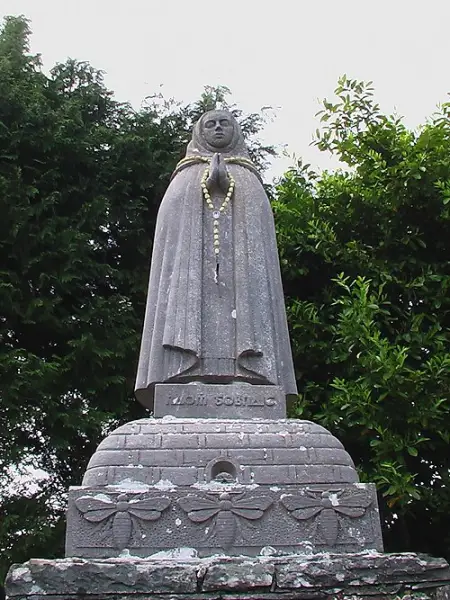
Gobnait's cult proved durable. In 1601, in the depth of the penal age, Pope Clement VIII bestowed a special indulgence on the faithful who kept her day at the parish church with confession and communion, praying for peace among Christian princes, for the rooting out of heresy, and for the exaltation of the church. She was originally a patron of ironworkers, and excavation at Ballyvourney has uncovered considerable evidence of ironworking on the site of her church. Her holy wells drew pilgrims for centuries: rounds and a pattern were held at the well near Ballyagran on February 11 until about 1870, and the well at Dún Chaoin in Kerry is still visited each year on her feast. Devotion remains strongest at Inis Oírr in the Aran Islands, at Dún Chaoin, and at Ballyvourney, and her feast has been given national rather than merely local rank among Irish saints. Former churches in her honor survive in the townlands named Kilgobnet across Kerry, Waterford, Limerick, and Cork. Harry Clarke portrayed her in the Honan Chapel window of 1916, its base panel showing the brigand driven off by her bees, and Séamus Murphy carved her statue at Ballyvourney in 1951.
§ Veneration and depictions in art
Timeline
- 1601
Pope Clement VIII bestowed a special indulgence on those keeping her feast at the parish church with confession, communion, and prayers for peace among Christian princes.
§ Veneration and depictions in art
- 1870
Rounds and the annual pattern at St Gobnait's well near Ballyagran, held on her feast day, ceased around this time.
§ Well
- 1916
Harry Clarke's stained glass window of Saint Gobnait, depicting the story of her driving off the brigand, was made for the Honan Chapel in Cork.
§ Veneration and depictions in art
- 1951
Séamus Murphy carved the statue of Saint Gobnait that stands at Ballyvourney.
§ Introduction
In Their Own Words
Mo Gobnat from Muscraige Mitaine, i.e. a sharp-beaked nun, Ernaide is the name of the place in which she is. Or Gobnat of Bairnech in Món Mór in the south of Ireland, and of the race of Conaire she is; a virgin of Conaire's race
The Record
- Major works
- Founded the convent at Ballyvourney and ruled it as abbess·Established a religious order and introduced beekeeping among its works
- Patron of
- bees·ironworkers·against plague
- Symbols
- bees·nine white deer
- Canonization
- Pre-congregation: an early medieval Irish saint whose cult was never subject to a formal process of canonization
Prayer
Bibliography
Show 5 sources
- Óengus of Tallaght (1905). Stokes, Whitley (ed.). The Martyrology of Oengus the Culdee. Henry Bradshaw Society. Vol. 29. London. pp. 60, 72–73 (11 February).
- Bowe, Nicola Gordon (1988). "Wilhelmina Geddes, Harry Clarke, and Their Part in the Arts and Crafts Movement in Ireland". The Journal of Decorative and Propaganda Arts. 8: 58–79.
- Harris, Dorothy C. (1938). "Saint Gobnet, Abbess of Ballyvourney". The Journal of the Royal Society of Antiquaries of Ireland. Seventh Series. 8 (2): 272–277.
- Johnston, Elva. "Munster, saints of (act. c.450–c.700)". Oxford Dictionary of National Biography. Oxford University Press, September 2004.
- Meehan, Cary (2004). Sacred Ireland. Somerset: Gothic Image Publications. p. 629. ISBN 0 906362 43 1.
Profile text adapted from the Wikipedia article, licensed CC BY-SA 4.0.
Pray with this saint every day
Save St. Gobnait to your favorites, read the full profile, and get feast-day reminders in the Saints app.
Get the Saints AppFree on the App Store for iPhone and iPad