
died 17 November 914·Feast November 17
St. Gobron
Georgian commander martyred at the fortress of Q'ueli
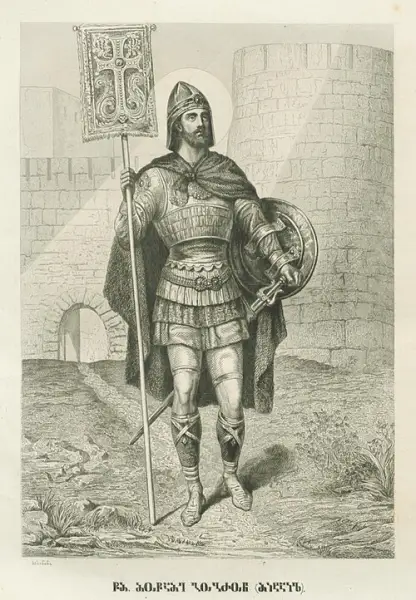
Overview
Gobron, also called Mikel-Gobron or Michael-Gobron, was a Georgian Christian military commander who died a martyr's death on 17 November 914. His baptismal name, according to his Passion, was Mikel. In 914 the Sajid emir of Azerbaijan, Yusuf ibn Abi'l-Saj, launched one of the Abbasid Caliphate's last great campaigns to assert its fading authority over the divided Georgian lands, marching from Armenia through Tiflis, Kakheti, Kartli, Samtskhe, and Javakheti. Q'ueli, a fortress held by the Bagratid prince Gurgen of Tao, resisted for twenty-eight days under Gobron's command before he was forced to surrender. A substantial ransom offered by Gurgen was refused, and Gobron and 133 fellow captives were held. The emir repeatedly urged Gobron to convert to Islam, offering him honors and wealth, but he refused every entreaty and was beheaded; his 133 companions were executed with him and their bodies cast into three pits. His death was recorded by Bishop Stephen of T'beti in a Passion composed between 914 and 918, and noted in medieval Georgian and Armenian chronicles. The Georgian Orthodox Church enshrined him among its saints.
The Complete Life
A Commander of the Caucasian Frontier
Gobron lived as a soldier in the turbulent Caucasus of the early tenth century, when the Christian Georgian lands were divided among rival principalities and enclaves under Muslim control. His original name, his Passion records, was Mikel or Michael, and he rose to military command in the service of the Georgian Bagratid house. The stage for his death was set in 914, when Yusuf ibn Abi'l-Saj, the Sajid emir of Azerbaijan, led an expedition that ranks among the Caliphate's final major efforts to impose its waning authority on Georgia. Advancing from Armenia through the Muslim Emirate of Tiflis into Kakheti, and then across Kartli into Samtskhe and Javakheti, Yusuf failed to take the fortress of Tmogvi but turned next upon Q'ueli, a stronghold held by Prince Gurgen of Tao. There Gobron took charge of the defense, organizing resistance and leading repeated sorties against the besiegers. For twenty-eight days the fortress held out, a stretch of determined resistance that made the fall, when it came, a matter of surrender rather than conquest. The campaign that ended at Q'ueli was one of the Caliphate's final great pushes to hold the Caucasian lands, and the quarrels between Christian princes gave the invader his opening; that Gobron held out for nearly a month against it made his surrender honorable and his capture costly.
§ Biography
The Siege and the Ransom Refused
When Q'ueli at last could hold no longer, Gobron surrendered to spare what remained, and he fell into captivity together with 133 other Georgians. Gurgen of Tao did not abandon his commander: he sent a substantial ransom to buy the prisoners' freedom, but Yusuf refused it and kept Gobron and his fellows in chains. What followed became the substance of his sanctity. The emir pressed him again and again to embrace Islam, and hagiographical tradition preserves the offer in still greater detail: impressed at first by the prisoner's courage, the emir, called Abu al-Qasim in that account, ordered him treated with respect, dangled worldly honors and riches before him, and then, when he refused, executed the Christian captives before his eyes to break his resolve. Gobron watched them die and did not waver. Twice more he was compelled to bow his head beneath the sword, and twice he answered with a confession of Christ. His steadfastness converted his military defeat into a witness that outlasted the campaign that destroyed it. The refusal of the ransom made the emir's aim plain: he wanted conversion, not money, and conversion was the one price Gobron would not pay. Every entreaty, every execution staged before his eyes, served that single demand.
§ Biography
Martyrdom, 17 November 914
His execution came on 17 November 914. Ordered once more to bow for beheading after refusing Yusuf's final summons, Gobron received the first blow of the sword and, with the blood that ran from the wound, traced the sign of the cross upon his own forehead, thanking the Lord Jesus Christ for counting him, the chief of sinners, worthy to die for his sake. The gesture so enraged the emir that he decreed that the remaining Georgian captives should die immediately, their corpses refused any grave. In the parallel tradition, the same refusal ended with the same order for execution. Gobron and his 133 companion martyrs were buried together in three great pits, and Christians were barred from drawing near the site. Tradition holds that the graves confounded the prohibition, shining at night with a divine light that Christians and non-Christians alike could see, a visible sign that the site of dishonor had become a place of honor. In the parallel tradition the dead were gathered into the pits rather than left to lie, but the ban on Christian mourners was the same; only the light that burned over the graves each night defied it, and it shone for unbeliever and believer alike.
§ Biography
Enshrined Among the Georgian Saints
Memory of the martyrdom took literary shape almost immediately. Between 914 and 918, at the request of the Bagratid prince Ashot I of Tao, Bishop Stephen of T'beti composed the saint's Passion, a work on which nearly all later knowledge of the event rests. The church's judgment followed: Gobron and the 133 martyrs who died with him were recognized as saints by the Georgian Orthodox Church, which assigns their commemoration to 17 November, the date traditionally associated with the martyrdom, corresponding to 30 November in the Gregorian reckoning. Medieval historians confirmed the outline of the Passion: the anonymous eleventh-century Chronicle of Kartli, within the Georgian Chronicles, records his defense of Q'ueli, his capture, and his death, referring readers to Stephen's fuller account, while the tenth-century Armenian historian John of Draskhanakert, followed by Stephen of Taron, notes the execution of Mik'ayel of Gogarene. Veneration has continued in the Georgian church to the present day. The feast day chosen for him preserves the date of the execution itself, and its Gregorian equivalent keeps the memory fixed for Orthodox communities reckoning by the newer calendar.
§ Biography
Witness in the Chronicles
Gobron's martyrdom fixed an image of Christian resistance at a decisive moment, for Yusuf's expedition of 914 was among the last great Abbasid attempts to discipline the Caucasian lands, and the refusal of one captured commander to trade baptism for advancement became a story worth preserving in three independent traditions. Georgian hagiography kept his Passion, with its account of the ransom refused, the captives executed before his eyes, and the shining graves. The Georgian Chronicles abbreviated the same events and pointed readers back to the fuller source. Armenian historians, writing of the same decade, remembered the execution of Mik'ayel of Gogarene from their own side of the frontier. Later devotion gathered him with his 133 companions under the title of great-martyr, and modern Orthodox commemoration, in Georgia and beyond, continues to tell how a soldier who could not save his fortress saved his faith instead. He stands among the military martyrs of the Caucasian church, commemorated each 17 November alongside the men who died in the pits beside him. The shining light said to hang over the burial pits carried one message to Christian and Muslim onlookers alike: the ground the emir meant to erase had become a shrine, and the commander who lost his fortress had won a lasting memorial.
§ Biography
Timeline
- 914
Yusuf ibn Abi'l-Saj invaded the Georgian lands from Armenia and laid siege to the fortress of Q'ueli, which Gobron defended for twenty-eight days.
§ Biography
- 17 Nov 914
Gobron, unbowed by the emir's repeated summons to accept Islam, was beheaded, and his 133 fellow captives were condemned to die with him.
§ Biography
- 918
Bishop Stephen of T'beti composed The Passion of the Holy Martyr Gobron between 914 and 918 at the behest of the Bagratid prince Ashot I of Tao.
§ Biography
In Their Own Words
I thank you, Lord Jesus Christ, that you have accounted me, the most contemptible and chief among sinners, worthy to lay down my life for your sake!
I am a Christian and will never retreat from the name of my Christ!
The Record
- Major works
- The Passion of the Holy Martyr Gobron, Who Was Taken from the Fortress of Q'ueli, the hagiography composed about him by Bishop Stephen of T'beti
- Symbols
- military attire
- Canonization
- Canonized by the Georgian Orthodox Church, which commemorates him and his 133 companion martyrs on 17 November Old Style (30 November Gregorian)
Prayer
Bibliography
Show 6 sources
- Rayfield, Donald (2000). The Literature of Georgia: A History. Routledge. pp. 48–49. ISBN 0-7007-1163-5.
- Toumanoff, Cyril (1963). Studies in Christian Caucasian History. Georgetown University Press. pp. 437–440, 494–495.
- Thomas, David; Roggema, Barbara, eds. (2010). Christian-Muslim Relations: A Bibliographical History. Vol. 2. Leiden: Brill. pp. 142–144.
- Machitadze, Zakaria. "Great-Martyr Mikael-Gobron and his 133 Soldiers (†914)". Pravoslavie.ru.
- "Martyr Gobron (Michael) and 133 Soldiers of Georgia". Orthodox Church in America.
- Maksoudian, Krikor Vardapet (trans.). Yovhannēs Drasxanakertc'i's History of Armenia. Robert Bedrosian's Armenian History Workshop.
Profile text adapted from the Wikipedia article, licensed CC BY-SA 4.0.
Pray with this saint every day
Save St. Gobron to your favorites, read the full profile, and get feast-day reminders in the Saints app.
Get the Saints AppFree on the App Store for iPhone and iPad