
1066 – 1115·Feast November 8
St. Godfrey of Amiens
Reforming bishop who fled his own honors
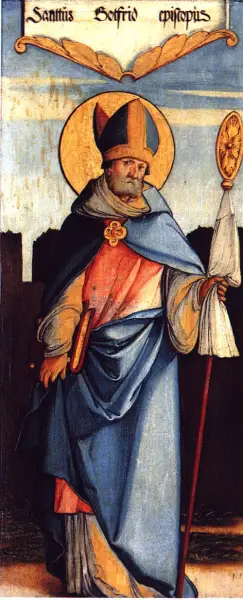
Overview
Godfrey of Amiens, in French Geoffroy d'Amiens, was born in 1066 at Moulincourt in the Diocese of Soissons, the third child of a noble family. Left motherless young, he was taken at the age of five by his uncle, the Bishop of Soissons, and educated at the Benedictine abbey of Mont-Saint-Quentin, where his godfather Godefroid was abbot. Given charge of the sick as the abbey's hospitaller, he welcomed the poor at the gate. Ordained priest at twenty-five, he became abbot of the Abbey of Nogent-sous-Coucy in Champagne in 1096, rebuilding a house overrun by weeds and establishing a hostel for pilgrims. He turned down Saint-Remi's abbacy and the Reims episcopate before being pressed into the see of Amiens, to which King Philip and the Council of Troyes summoned him for his skill in business. As bishop he enforced clerical celibacy and opposed drunkenness and simony with a rigidity that provoked an attempt on his life. Longing for the penitential life of the Grande Chartreuse, he withdrew to a monastery in 1114, was recalled in 1115, fell sick, and died at the abbey of Saint Crépin in Soissons on November 8, 1115.
The Complete Life
Given to the Church as a Child
Godfrey was born in 1066 at Moulincourt, in the Diocese of Soissons, the third child of a noble family. His childhood was marked early by loss and by vocation: when his mother died, his father Frodon resolved to embrace the monastic life himself, and the boy was taken in hand by his uncle, the Bishop of Soissons. At the age of five Godfrey was sent to be educated at the Benedictine abbey of Mont-Saint-Quentin, where his godfather Godefroid served as abbot. The arrangement made him a monk's pupil before he could well read, and the abbey formed him entirely; there is no record of a life or ambition outside the cloister. Within the community he was not kept among the dignitaries but put to practical and humbling work: the sick were entrusted to him, and he served as hospitaller, the brother stationed at the abbey gate to welcome the poor. His formation, in other words, joined noble birth to the daily discipline of almsgiving, an education in both administration and mercy that would define the rest of his career. The monastic habit thus settled on him years before he could choose it for himself, and the sick and beggars of the abbey gate became his first charge and his first teachers.
§ Life
Abbot of a Ruined House
At the age of twenty-five Godfrey was ordained priest by the Bishop of Noyon, and in 1096 he was made abbot of the Abbey of Nogent-sous-Coucy in Champagne. He found the monastery in a sorry state, its grounds overrun by weeds, its observance evidently as neglected as its fields. The new abbot set about rebuilding, restoring both the physical plant and, by implication, the regular life of the house, and he added a work of hospitality characteristic of his training: a hostel for pilgrims attached to the abbey. His success did not escape notice, and honors began to pursue him. He declined the abbacy of the great royal abbey of Saint-Remi at Reims, and when the bishopric of Reims was offered he refused that as well. Neither refusal ended the pressure; it merely narrowed the choices of his superiors, who eventually settled on a smaller but still reluctant prize. His pattern was fixed: placed in office, he governed diligently; offered advancement, he fled to something humbler, and had to be compelled nearly every step of the way. The revival at Nogent displayed exactly the gifts his superiors kept trying to promote: he could govern, rebuild, and provide, and monasteries in need of such a man were not easily refused.
§ Life
Reforming Bishop of Amiens
Godfrey was chosen bishop of Amiens not for his willingness, which was absent, but for his competence: King Philip and the Council of Troyes settled on him partly for his command of practical administration, a rarity among candidates for high office. Once consecrated, he governed Amiens with an austerity he imposed first on himself and then on all around him. Two reforms dominated his episcopate. He enforced clerical celibacy against a clergy accustomed to concubinage, and he waged open opposition against drunkenness and simony, the purchased buying and selling of sacred office. These were exactly the abuses that the reforming papacy of his age condemned, and exactly the abuses whose beneficiaries resisted correction. His zeal for discipline was answered with violence: the war he waged on drunkenness and simony brought an attempt against his life. The shepherding of a medieval city, with its tangled interests of clergy, nobility, and people, proved as dangerous as any frontier, and the monk who had wanted nothing but the abbey gate found himself a marked reformer in a hostile see. Amiens accordingly received a pastor who would rather have been in the desert and who, for that very reason, governed with a single-mindedness no courtier could imitate.
§ Life
Flight to the Chartreuse and a Bishop's Death
The burden of office never suited Godfrey, and throughout his episcopate he cherished the wish to retire to the Grande Chartreuse, the austere Carthusian motherhouse, to spend what remained of his life in penitence. In 1114 he acted on the desire, withdrawing from Amiens to a monastery and laying down the government of the see. The pause lasted hardly a year: in 1115 fresh summons dragged him back to duty, forcing upon him again the administration he had tried to escape. He did not long survive the return. Falling sick, he took refuge not in his own palace but in the abbey of Saint Crépin at Soissons, the town of his birth and his uncle's see, and there he died on November 8, 1115. The place of his death was fitting: he ended where he had effectively begun, among monks, within the diocese that had first given him to the Church. The date became his feast, and November 8 remains the day on which the Catholic Church remembers the reluctant bishop of Amiens. Hagiographers treat the recall as obedience owed rather than desire fulfilled, and the order of events matters: the bishop died at his post among monks, not in the mountain retreat he longed for.
§ Life
Remembrance in Amiens
Godfrey's cult has always been local and modest, matching the man. He is remembered in the Catholic Church on November 8, the anniversary of his death at Saint Crépin, and medieval tradition counted him among the saints without any surviving record of a formal canonization. The chief civic monument to him is homely: a street in Amiens bears his name, so that the city whose clergy he disciplined and whose reforms he enforced daily pronounces the name of the bishop who loved it enough to be hated for its good. His historical afterlife rests on the accounts gathered by Butler and by the Monks of Ramsgate, which preserve the portrait of a nobleman's son who served the sick at a gate, rebuilt a weedy abbey, refused two great ecclesiastical dignities, governed a hostile see with integrity, and died trying to get back to the desert. For the diocese of Amiens he remains the type of the reforming prelate: severe with himself, incorruptible in office, and longing, to the end, for the silence of the Chartreuse. For later generations his story taught the difference between ambition and duty, which is perhaps why Butler and the Ramsgate monks kept it in circulation for readers who would never govern a see.
§ Veneration
Timeline
- 1066
Born at Moulincourt in the Diocese of Soissons, third child of a noble family.
§ Life
- 1096
Ordained priest by the Bishop of Noyon and installed as abbot of the Abbey of Nogent-sous-Coucy in Champagne, which he rebuilt and endowed with a hostel for pilgrims.
§ Life
- 1114
Withdrew to a monastery, fulfilling his long-held wish to live in penitence at the Grande Chartreuse.
§ Life
- 1115
Recalled from monastic retirement to resume his duties as bishop of Amiens.
§ Life
- 8 Nov 1115
Fell sick and died at the abbey of Saint Crépin in Soissons.
§ Life
The Record
- Major works
- Rebuilt the Abbey of Nogent-sous-Coucy and founded a hostel for pilgrims there
- Canonization
- Venerated as a saint in the Catholic Church from medieval times; the article records no formal act of canonization
Prayer
Bibliography
Show 5 sources
- Monks of Ramsgate. "Godfrey". Book of Saints, 1921. CatholicSaints.Info. 16 July 2013.
- Butler, Alban. "St. Godfrey, Bishop of Amiens". The Lives of the Saints. Vol. XI, 1866.
- "St. Godfrey of Amiens". Catholic News Agency.
- Guérard. Essai sur Saint Geoffroy, évêque d'Amiens (in French). 1843.
- Dusevel, Hyacinthe R. Histoire de la ville d'Amiens depuis les gaulois jusqu'à nos jours (in French). Amiens, 1848. p. 259.
Profile text adapted from the Wikipedia article, licensed CC BY-SA 4.0.
Pray with this saint every day
Save St. Godfrey of Amiens to your favorites, read the full profile, and get feast-day reminders in the Saints app.
Get the Saints AppFree on the App Store for iPhone and iPad