
1512 – 9 July 1572·Feast July 9
St. Godfried Coart
Franciscan friar of the Martyrs of Gorkum
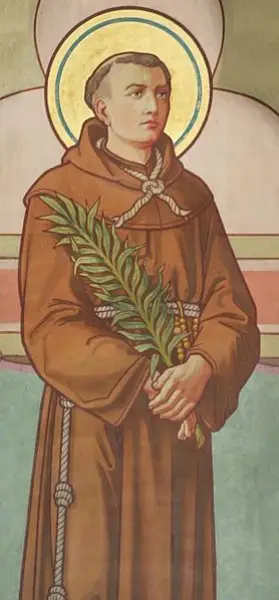
Overview
Godfried Coart, also called Godfried van Melveren or Godfried of Mervel, was born in 1512 in a house on the Keelstraat in Melveren, near Sint-Truiden, and baptized in the Holy Trinity Church. A Franciscan of the Friars Minor, he finished his formation at the order's college in 's-Hertogenbosch and received priestly ordination, then took up duties as sacristan and confessor at the Gorcum friary, where his warmth made him popular with the townspeople; he amused his leisure by printing pictures of the saints for distribution and by painting. In 1572, during the Dutch Revolt, the Watergeuzen rebels seized Gorinchem and captured him with eleven fellow Franciscans and other clergy. After imprisonment at Gorinchem and transfer to Brielle, the prisoners were told they might walk free if they renounced the Catholic doctrine of the Eucharist and the primacy of the pope. Though William the Silent sent word commanding their protection, a sham trial ended on the gallows of a turfshed at Rugge on 9 July 1572. With the rope at his neck, Godfried forgave his killers. He was beatified in 1675 and canonized with the Martyrs of Gorkum by Pope Pius IX.
The Complete Life
A Son of Melveren
Godfried Coart was born in 1512 in a house on the Keelstraat in Melveren, a village now part of Sint-Truiden in the Belgian province of Limburg, and was baptized in the parish of the Holy Trinity Church. His family were townspeople of the region, and their attachment to him proved permanent: after his martyrdom the Coart family cherished a special devotion to their kinsman, and ever since the head of the family has borne the first name Godfried. The geography of his childhood remains traceable in the village. The street where Melveren Castle stands was later renamed Sint-Godfriedstraat in his honor, the chapel raised at the corner of the Schoolstraat around 1700 was eventually moved onto that same street, and in 1989 the residents of the Keelstraat built a new chapel along the meadow that had once bordered his birthplace, where for years an open-air mass was sung each July 9, followed by a village feast. Few saints remain so concretely present in the streets of their birthplace. Between baptism in the parish church and the friary at Gorcum, the village saw little of him; the chapels his neighbors later raised show how completely they reclaimed the friar who died at Brielle.
§ Life
Friar, Sacristan, and Confessor at Gorcum
Godfried joined the Friars Minor and trained at their college in 's-Hertogenbosch, one of the houses of learning through which the order formed its clergy in the Low Countries. Ordained a priest, he was assigned to the Franciscan friary at Gorinchem, in Holland, where he held the offices of sacristan and confessor. The assignments suited his temperament. As sacristan he kept the sacred things of the friary church in order; as confessor he sat day after day listening to the townspeople of Gorcum, and every account agrees that the locals held him in deep affection. He possessed, unusually for his office, the skills of a craftsman and artist: he printed pictures of the saints and distributed them to the faithful, and he painted as well. A painting by his hand was still preserved centuries later in the Friars Minor Museum at Sint-Truiden. His ministry, then, was domestic and pastoral rather than prominent, the faithful service of a friar two towns from his birthplace, with no sign that he sought anything beyond it. Sacristan's care, confessor's patience, and an artist's hand together sketch a friar of the ordinary pastoral round, precisely the sort of priest the fury of 1572 would single out.
§ Life
The Revolt Overtakes Gorcum
The mission that made him a saint was not one he chose. During the Dutch Revolt against Spanish rule, the inhabitants of the northern Netherlands, largely Protestant, began to turn violently against the Catholic priests and monastics in their midst, and the clergy were especially targeted by the Watergeuzen, the rebel sea-beggars. On 26 June 1572, sensing the danger, Father Nicolaes Pieck, head of the Gorcum friary, allowed any brother who chose to seek safer refuge; only two fathers left. The next day the Watergeuzen seized Gorinchem, and among the prisoners taken were eleven Franciscans, Godfried among them, together with other religious and clergy. After roughly ten days of imprisonment in the town, the captives were transferred to Brielle, which the rebels held. There their captors offered them freedom on a single condition: denial of Catholic teaching on the Eucharist and on papal primacy. Of the twenty-three captives, four accepted and were released. Godfried was not among them; with the rest, his fate was sealed. Godfried stood with the Franciscan group of eleven, and the rebels' offer split the twenty-three prisoners into the four who yielded and the great majority who would not, himself among them.
§ The Dutch Wars
The Turfshed at Rugge, 9 July 1572
Even the authority of the Prince of Orange could not save them. William the Silent wrote commanding every office-holder to spare priests and religious from harassment, yet the prisoners were still dragged through a mock trial at Brielle. On 9 July 1572 they were hanged in a turfshed at the site of a burned-out monastery at nearby Rugge, the nineteen who had refused the rebels' terms dying together for the Eucharist and the papacy they would not deny. Godfried's death was marked by a single recorded gesture: with the noose at his throat, Friar Godfried pardoned the men killing him. The bodies of the martyrs were mutilated, before or after death, and thrown into a ditch, where they lay until 1616, when they were translated with honor to the Franciscan church in Brussels. The shed at Rugge and the field beside it became, and have remained, a place of pilgrimage, the ground where a popular confessor of Gorcum kept his faith to the last inch of the rope. The ditch that received the bodies lay near the shed, and there the martyrs lay for more than four decades, until the altered fortunes of the Low Countries allowed their honorable translation in 1616.
§ The Dutch Wars
From Beatification to the Altars
The church's recognition of the nineteen came in stages. Godfried and his companion martyrs of Gorcum were beatified on 14 November 1675 by Pope Clement X, a century after their deaths, and canonized by Pope Pius IX on 29 June 1865, when the confessors of 1572 were raised to the altars as Saint Nicholas Pieck and his companions. Godfried holds a distinction within that company: Belgium counts him its first canonized saint. His feast, observed with the other martyrs, falls on July 9, the anniversary of the hanging at Rugge. A reliquary holding remains of the martyrs is housed in the Church of Saint Nicholas in Brussels, while the place of their martyrdom at Brielle has for many years been the scene of pilgrimages and processions. In Mechelen, a statue of Saint Godfried stands in St. Rumbold's Cathedral, placing the friar of Melveren among the great church of the Belgian primate; the Stieltjeskerk in Rotterdam was dedicated to the martyrs until its closure and demolition in 1976. The long interval between beatification and canonization reflects the turmoil of the Low Countries rather than any doubt about the martyrs, whose pilgrimage shrine at Brielle was never forsaken.
§ Veneration
Memory in Streets, Chapels, and Paintings
Godfried's legacy lives most concretely at home. Melveren renamed the street by its castle Sint-Godfriedstraat, raised a bluestone chapel in his honor at the corner of the Schoolstraat around 1700, later moved to that street, and in 1989 the residents of the Keelstraat erected another chapel beside the meadow that had once bordered his birthplace, where an open-air mass was sung each ninth of July and the whole village feasted afterward. His own kin, the Coarts, have kept his name alive in the flesh: since the martyrdom, the eldest of the family has carried the name Godfried. His paintings survive too, for the Friars Minor Museum in Sint-Truiden holds a painting by his hand, the work of a friar who decorated the church with saints' images being honored in a museum with his own. Devotion at Brielle continues at the turfshed where he died, and the Franciscan church in Brussels keeps the relics translated there in 1616. He stands as the village friar of the Martyrs of Gorkum, remembered less for deeds of state than for constancy and forgiveness. His memorial lives in bluestone and street names, in museum walls and family baptisms, the homely monuments of a village friar whom the universal church also raised to the altars.
§ Veneration
Timeline
- 1512
Born in a house on the Keelstraat in Melveren and baptized in the Holy Trinity Church.
§ Life
- 26 Jun 1572
Father Nicolaes Pieck, guardian of the Gorcum friary, permitted the friars who wished to flee the approaching rebels to seek safer havens.
§ The Dutch Wars
- 27 Jun 1572
Protestant Watergeuzen rebels seized Gorinchem and captured eleven Franciscans, including Godfried, along with other clergy and religious.
§ The Dutch Wars
- 9 Jul 1572
After imprisonment and a mock trial at Brielle, he was hanged in a turfshed at Rugge, forgiving his killers with the rope at his neck.
§ The Dutch Wars
- 1616
The mutilated bodies of the martyrs, at first thrown into a ditch, were moved to the Franciscan church at Brussels.
§ Veneration
- 14 Nov 1675
Godfried and his companion martyrs of Gorcum were beatified by Pope Clement X.
§ Veneration
- 1700
A bluestone chapel in his honor rose at the Schoolstraat corner in Melveren, later moved to the Sint-Godfriedstraat.
§ Veneration
- 29 Jun 1867
Canonized by Pope Pius IX with the Martyrs of Gorkum as Saint Nicholas Pieck and his companions.
§ Veneration
- 1989
Residents of the Keelstraat in Melveren erected a chapel along the meadow that once bordered his birthplace, where an open-air mass was celebrated each July 9.
§ Veneration
The Record
- Major works
- Served as sacristan and confessor at the Franciscan friary of Gorinchem·Printed and distributed pictures of the saints and worked as a painter
- Canonization
- Beatified 14 November 1675 by Pope Clement X; canonized 29 June 1865 by Pope Pius IX with the Martyrs of Gorkum, as Saint Nicholas Pieck and his companions; honored as the first canonized saint of Belgium
Prayer
Bibliography
Show 6 sources
- Albers, Petrus Henricus. "The Martyrs of Gorkum". The Catholic Encyclopedia. Vol. 6. New York: Robert Appleton Company (1909).
- Farmer, David (ed.). "Martyrs of Gorkum". The Oxford Dictionary of Saints, 5th ed. Oxford University Press, 2011. ISBN 9780199596607.
- Odden, Per Einar. "De nitten hellige Gorkum-martyrene (d. 1572)". Den katolske kirke, October 12, 2001.
- "Godfried (Coart) van Melver is een rasechte Truiense martelaar". Truiens Nieuws, July 10, 2020.
- "Geschiedenis van de H. Godefridus van Melveren". Melveren.be.
- "Coart, Godfried, Govaert, van Melveren, Mervellanus, martelaar". Erfgoud Sint Truiden.
Profile text adapted from the Wikipedia article, licensed CC BY-SA 4.0.
Pray with this saint every day
Save St. Godfried Coart to your favorites, read the full profile, and get feast-day reminders in the Saints app.
Get the Saints AppFree on the App Store for iPhone and iPad