
c. 1065 – 1170
St. Godric of Finchale
Merchant turned hermit by the River Wear
Overview
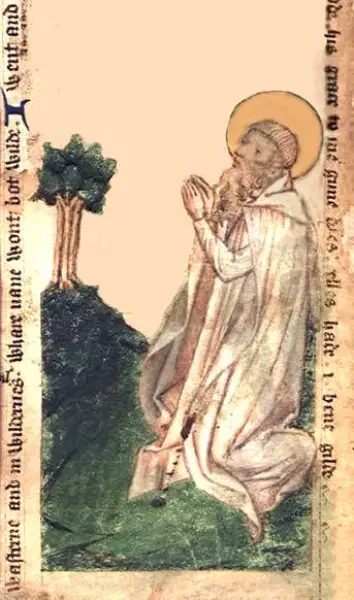
Godric of Finchale, sometimes written Goderic, was born around 1065 to 1070 at Walpole in Norfolk, the son of Ailward and Edwenna, parents of slender means but noted virtue. He began life as a peddler carrying small wares among the villages of his neighborhood, grew into a merchant partnered with city traders, took command of ships, and held shares in two of them; one of these may have carried Baldwin I of Jerusalem to Jaffa in 1102. After pilgrimages around the Mediterranean he was inspired to a changed life off the Farne Islands near Lindisfarne. Back in England he spent two years with the hermit Aelric at Wolsingham, made a final pilgrimage to Jerusalem, served as doorkeeper at St Giles Hospital in Durham, and persuaded Bishop Ranulf Flambard to grant him a hermitage at Finchale by the River Wear, where he cleared forest, built an oratory of wood and later a chapel of stone, and lived his final sixty years in austerity, kindness to animals, and prayer. Never formally canonized, he was nonetheless one of the most popular saints of medieval England, consulted by Thomas Becket and Pope Alexander III, and remembered above all for four hymns that are the oldest surviving English songs with their music.
The Complete Life
A Peddler's Son of Norfolk
Godric was born around 1065 to 1070 at Walpole in Norfolk, into a family of little account. His hagiographer Reginald of Durham, a monk who recorded his life, describes his parents Ailward and Edwenna as poor in goods and standing yet rich in uprightness and goodness, a formula that frames the whole career: greatness of soul in a setting of poverty. The boy's first trade was the humblest in the medieval economy, that of the peddler, hawking his little stock from village to village and farm to farm close to home. But he had commercial instinct. In process of time he bound himself by compact with city merchants, scaling his trade from a pack on his back to capital and credit, until he became an entrepreneur in the fuller sense. He rose further still, to the command of ships: he became a ship's captain and held part ownership of two vessels. Reginald's physical portrait shows the man this life made, middle-sized, broad-shouldered, deep-chested, grey-eyed and sharp-sighted, with knees already hardened by kneeling, a body shaped by labor and journeying before it was shaped by prayer.
§ Life
The Sea Road to Conversion
Godric's merchant career carried him far beyond the coasts of England. As captain and part owner he sailed on pilgrimage routes, and one of his two ships is said to have conveyed Baldwin I of Jerusalem to Jaffa in 1102, inserting the Norfolk peddler's son into the world of the crusading kingdom. He made many pilgrimages around the Mediterranean in these years. The turning came off the Farne Islands near Lindisfarne, the lonely haunts of the great Northumbrian saints, where he was inspired to change his life. He returned to England and sought formation, spending two years at Wolsingham under an aged hermit called Aelric, whose own death came in 1107. When his teacher died, Godric undertook a final journey to Jerusalem, counted by some tellings as the seventh of his pilgrimages, and then came home for good. Earlier he had kept the door, humblest office of the minor orders, in the hospital church of St Giles at Durham; out of that service he approached Ranulf Flambard, Bishop of Durham, and persuaded him to grant a place where he might live as a hermit: Finchale, a wooded bend of the River Wear.
§ Life
Building Finchale
Finchale was wilderness when Godric received it. He cleared the forests with his own hands and built a wooden oratory dedicated to the Virgin Mary, and as the years passed he replaced or supplemented it with a chapel of stone dedicated to St John the Baptist. The hermitage he made there became, over sixty years, a recognized place of holiness. He did not live in absolute seclusion: he received visitors, though only such as the local prior approved, and the trickle of pilgrims to his riverbank cell grew as his reputation spread. In time the wise and holy man of Finchale was sought out by the great of the age; Thomas Becket and Pope Alexander III are both reported to have asked his advice. After his death the site was not abandoned but institutionalized: Finchale Priory, whose ruins still stand above the Wear, rose on the ground of Godric's hermitage, so that the monastery preserved the memory of the wooden oratory and stone chapel he had carved out of the Northumbrian forest. His mission was thus not preaching but presence, a life of prayer whose magnetism gathered an abbey around it.
§ Life
Kindness to Beasts and the Song of the Virgin
Godric is perhaps best remembered for the kindness he showed beasts, and story after story tells how he shielded the creatures of the woods around him. He hid a stag from hunters in chase, and he let serpents bask beside his hearth, a tenderness that modern readers have found the most winning trait of a severe ascetic. His own life at Finchale was deliberately harsh: his fare was wild honey, acorns, crab-apples, and nuts, gathered herbs among it, and the bare earth served him for a bed, until kneeling in prayer roughened his knees and age softened his rough skin. Yet the same man received heavenly instruction in song. Reginald records that in a vision the Virgin Mary came to Godric attended by two maidens of matchless beauty dressed in radiant white garments, who promised to stand by him in every need, and that the Virgin herself taught him a song of consolation against grief and temptation. Of the four hymns Reginald preserved from him, these are earliest English songs whose original melodies have come down to us, devotions to Saint Mary and Saint Nicholas in a plain, tender Middle English that still can be sung.
§ Life
Sixty Years by the Wear
The final sixty years of Godric's life were spent at Finchale, an extraordinarily long tenure of one small cell, from middle age to extreme old age. His regime altered little: the herbs and wild honey, the bare ground, the approved visitors, the chapel bells of his own building. What changed was his renown. As the years passed, the hermit of Finchale became one of the most famous holy men in England, consulted by the greatest figures of the day, among them Thomas Becket and Pope Alexander III, who reportedly sought his advice as a wise and holy man. Reginald of Durham, a monk of the Durham cathedral community, recorded his life while he lived it, preserving not only his deeds but his appearance, his portrait of the saint running from the broad forehead and piercing grey eyes to the knees horny with frequent kneeling. Godric died at Finchale on 21 May 1170, an old man who had outlived nearly everyone who had known the merchant he once was. He was buried where he had prayed, and the date of his death, the day before Becket's murder that December, remained the anchor of his commemoration.
§ Life
A Saint Without a Decree
Godric was never formally canonized. No papal inquiry examined his life, no decree enrolled him among the saints of the calendar, yet from his death onward he was venerated as a popular medieval saint, and the title sanctus attaches to him in the sources without embarrassment. His case belongs to the older pattern of English sanctity, in which local devotion, pilgrimage to a grave, and the testimony of a hagiographer made a saint without process. Reginald of Durham's Life supplied the narrative foundation, and several other hagiographies of Godric are also extant, a remarkable body of writing for a hermit of no institutional position. His cult flourished at Durham and Finchale, where the priory kept his memory at the site of his cell. The absence of formal canonization has never much mattered to his reputation: medieval chroniclers, musicians, and readers treated him as a saint, and modern historians rank him among the most popular saints of twelfth-century England. He remains a standing example that holiness, once recognized, does not wait upon paperwork. The Durham community that buried him and recorded his life had every institutional reason to seek a papal decree, yet his cult rested securely on devotion alone, and devotion proved enough.
§ Life
The First English Songs and Afterlives
Godric's most durable legacy is musical. Reginald of Durham recorded four songs of his, and none of them lacks its music: they are the earliest English lyrics to reach us with their melodies intact, brief hymns to the Virgin and to Saint Nicholas in Middle English. Reginald describes the circumstances in which Godric learned the first of them, the vision in which the Virgin Mary herself taught him the song of consolation. The hymns have been recorded by early music ensembles such as La Reverdie, and scholars have mined them for what they reveal of twelfth-century English language and melody; the musicologist Brian Trowell gave him his entry in Grove, and J. B. Trend wrote of the first English songs a century before. A hymn tune named for him by John Bacchus Dykes appears in dozens of hymnals, carrying his name into churches that know nothing else of him. Literature has claimed him too: the novelist Frederick Buechner made his life the subject of Godric, published in 1981, a fictional retelling of the merchant's travels and conversion that was a finalist for the Pulitzer Prize. And his riverbank hermitage endures in the ruins of Finchale Priory above the Wear.
§ Life
Timeline
- 1065
Born about this year at Walpole in Norfolk, child of Ailward and Edwenna, a couple poor in goods but famed for virtue.
§ Life
- 1102
As captain and part owner of two vessels, he is said to have carried Baldwin I of Jerusalem across to Jaffa in one of them.
§ Life
- 1107
After two years training under the aged hermit Aelric at Wolsingham, he lost his master to death and set out on a last Jerusalem pilgrimage.
§ Life
- 21 May 1170
Died at Finchale in County Durham, closing roughly sixty years of eremitical life beside the River Wear.
§ Life
In Their Own Words
Saintë Marië Virginë, Moder Iesu Cristes Nazarenë, Onfo, schild, help thin Godric, Onfong bring hegilich With the in Godës riche.
Saintë Marië Cristes bur, Maidenës clenhad, moderës flur; Dilie min sinnë, rix in min mod, Bring me to winnë with the selfd God.
The Record
- Major works
- Four hymns in Middle English, recorded by Reginald of Durham, the oldest songs in English for which the original musical settings survive·The wooden oratory of the Virgin Mary and the stone chapel of St John the Baptist built at Finchale
- Symbols
- hermit
- Canonization
- Never formally canonized: venerated as a popular medieval saint by longstanding local devotion
Prayer
Bibliography
Show 8 sources
- Amt, Emilie; Smith, Katherine Allen (2018). Medieval England, 500-1500: A Reader (2nd ed.). Toronto: University of Toronto Press. p. 187. ISBN 9781442634688.
- "Godric of Finchale [St Godric of Finchale]". Oxford Dictionary of National Biography (online ed.). Oxford University Press. doi: 10.1093/ref:odnb/10884.
- Hoppin, Richard (1978). Medieval Music. The Norton Introduction to Music History. New York: W. W. Norton & Company. ISBN 978-0-393-09090-1. pp. 322–323.
- Trowell, Brian (2001). "Godric". Grove Music Online. Oxford: Oxford University Press. doi: 10.1093/gmo/9781561592630.article.11345.
- Coulton, G. G., ed. (1918). "Reginald of Durham, Life of St. Godric". Social Life in Britain from the Conquest to the Reformation. Cambridge: Cambridge University Press.
- Barlow, Frank (1979). The English Church 1066–1154: A History of the Anglo-Norman Church. New York: Longman. p. 73. ISBN 0-582-50236-5.
- Clay, Rotha Mary (1914). The Hermits and Anchorites of England. London: Methuen. p. 59.
- Trend, J. B. (1928). "The First English Songs". Music & Letters. 2 (2): 111–128. doi: 10.1093/ml/IX.2.111.
Profile text adapted from the Wikipedia article, licensed CC BY-SA 4.0.
Pray with this saint every day
Save St. Godric of Finchale to your favorites, read the full profile, and get feast-day reminders in the Saints app.
Get the Saints AppFree on the App Store for iPhone and iPad