
6th century – after 614·Feast June 17
St. Gondulph of Maastricht
Bishop of Tongeren-Maastricht, patron of Maastricht
Overview
Gondulph of Maastricht, in Latin Gondulfus or Gundulphus and perhaps also Bethulphus, sometimes styled of Tongeren, was a bishop of Tongeren-Maastricht in the sixth and seventh centuries whom the Roman Catholic and Eastern Orthodox Churches honor as a saint. Very few facts about him survive, and he remains an enigmatic figure at the head of one of the Low Countries' oldest episcopal lines. Alongside St. Servatius and St. Monulph, he numbers among the patron saints of Maastricht itself. The legends that grew around him give his parents as Munderic and Arthemia and describe a marriage to Palatina, daughter of the Gallo-Roman aristocrat Maurilion Gallo, with a possible son, Bodegisel II, who would become Duke of Aquitaine. By tradition he occupied the see for seven years, found burial within the nave of the St. Servatius church that his predecessor Monulph had raised, and labored to rebuild Tongeren after the barbarian invasions. Scholars have long debated whether he can be distinguished from Betulph, a bishop of Maastricht attested at the Council of Paris in 614. His cult received solemn recognition in 1039, when his remains were exhumed with those of Monulph in the presence of Emperor Henry III.
The Complete Life
An Enigmatic Bishop of an Ancient See
Gondulph appears in history as a bishop of Tongeren-Maastricht, successor in a line that reached back through Monulph to the great Servatius, and his obscurity is itself a fact of the record: very few facts about him are known, and he remains an enigmatic figure. The episcopal see he inherited carried an old and shifting title. According to some eleventh-century sources it was his predecessor Monulph who transferred the seat of the diocese from Tongeren to Maastricht, yet the official title 'bishop of Tongeren' was retained into the tenth century, even after the see itself had passed on from Maastricht to Liège. The details of Gondulph's family come only from legend: his parents are named as Munderic and Arthemia, and he is said to have married Palatina, daughter and sole recorded heir of Maurilion Gallo, a Gallo-Roman nobleman whose ties likely reached the Merovingian court. On some reconstructions the couple had a son, Bodegisel II, who rose to be Duke of Aquitaine. Such reconstructions are marked as uncertain by the sources themselves. What is certain is the veneration: the Church has honored him as a saint from an early age, alongside Servatius and Monulph, as one of the patron saints of Maastricht.
§ Legend
Shepherd in Uncertain Times
The traditions about Gondulph's episcopal labors paint a picture of a church under strain. Ecclesiastical tradition assigns him seven years in the see of Maastricht, though that span sits uneasily with the securely dated career of Betulph, a bishop of Maastricht who was present at the Council of Paris in 614; scholars have questioned whether Gondulph and Betulph might in fact be one man, much as Bertulfus and Crotoldus appear to coincide in the archbishopric of Mainz. The disputed episcopal lists of the eleventh and twelfth centuries disregard the attested Betulphus entirely and set Gondulph straight after Monulph instead. If the medieval biographer Jocundus is to be believed, Gondulph took in hand the rebuilding of Tongeren, a town left in ruins by the barbarian invasions, a work of restoration among colonists still pagan in their habits. The same account tells of a fearful wonder: heavenly intervention sent ravening wolves upon the pagan colonists, devouring them under the bishop's horrified gaze. The medieval lives of Gondulph are largely extracts from Jocundus's Vita Servatii, written more than four centuries after his death, and for that reason they are not reckoned reliable, yet they preserve the shape of a bishop remembered for rebuilding, teaching, and confrontation with paganism.
§ Ecclesiastical tradition
Tomb, Cenotaph, and Rising Legend
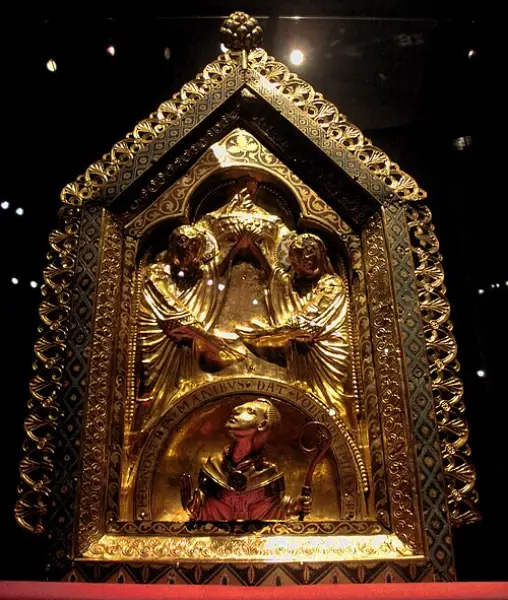
Tradition places Gondulph's burial within the nave of Maastricht's church of St. Servatius, the very church that his predecessor Monulph had built, so that the two bishops rested in a shared grave. In the eleventh century the provost Humbert raised a cenotaph above the alleged tomb of the two saints, and their memory took on a public, ceremonial form. The decisive moment came in 1039, when Monulph and Gondulph were exhumed with solemn rites by Nithard, bishop of Liège, and Gerard of Florennes, bishop of Cambrai, in the presence of Henry III, Holy Roman Emperor, an event of high ecclesiastical and imperial theater. An epitaph commemorating the translation later suffered a strange fate of misinterpretation: from it grew a legend that the two saints had left their tomb in 1039 to be present at the consecration of Aachen Cathedral, a tale that bound the bishops of Maastricht to the imperial church itself. In art the two saints remain inseparable, shown together holding miniature churches, and on June 17 the Church keeps the feast of Gondulphus of Tongeren, as the patron of Maastricht whose history is dim but whose intercession has never lapsed.
§ Ecclesiastical tradition
Timeline
- 614
A bishop of Maastricht named Betulph, possibly identical with Gondulph, attended the Council of Paris.
§ Line of succession
- 1039
Monulph and Gondulph were exhumed with solemn rites by Bishop Nithard of Liège and Bishop Gerard of Cambrai before Emperor Henry III.
§ Ecclesiastical tradition
The Record
- Patron of
- Patron saint of Maastricht, together with St. Servatius and St. Monulph
- Symbols
- Depicted with Monulph, both holding miniature churches
- Canonization
- Pre-congregation; venerated in the Roman Catholic and Eastern Orthodox Churches
Prayer
Bibliography
Show 2 sources
- "Saint Gondulphus of Tongeren", catholic.org
- Catholic Encyclopedia
Profile text adapted from the Wikipedia article, licensed CC BY-SA 4.0.
Pray with this saint every day
Save St. Gondulph of Maastricht to your favorites, read the full profile, and get feast-day reminders in the Saints app.
Get the Saints AppFree on the App Store for iPhone and iPad