
1557-1597·Feast February 6
St. Gonsalo Garcia
Franciscan Lay Brother and Martyr
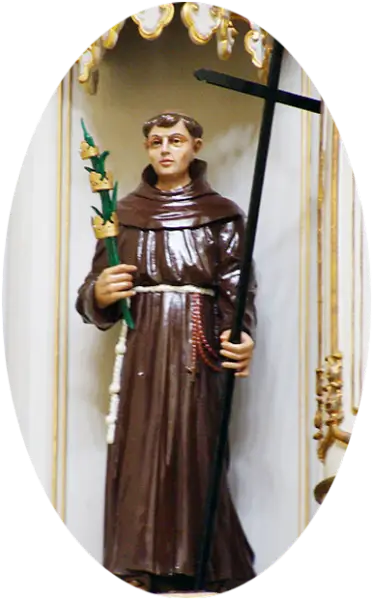
Overview
Gonsalo Garcia was born in 1557 in Bassein, in Portuguese India north of Bombay, the son of a Portuguese soldier and a Canarim mother of the Konkan; his family lived inside the fort, where he studied at the Jesuit school and served the church later renamed for him. Around 1580 he sailed with Jesuit missionaries for Japan, where his warmth and quick mastery of the language drew children to him in public places, and he gave eight faithful years of service as a catechist. Leaving the Jesuits, he settled at Alacao as a merchant and grew wealthy, his trade carrying him through every rank of Japanese society and on frequent visits to Manila, where acquaintance with the Franciscans drew him to join them as a lay brother. When Manila's governor sent a delegation to Japan under Pedro Bautista, Garcia was chosen as his interpreter and companion, sailing on 26 May 1592; the Franciscans settled at Kyoto and Osaka and won many. After the wreck of the Spanish ship San Felipe in October 1596 stirred the regent Hideyoshi to order the arrest of the missionaries, Garcia was seized with Bautista on 8 December 1596. The condemned were marched some six hundred winter miles to Nagasaki and crucified at Nishigaoka on 5 February 1597, Garcia given the middle place among the twenty-six, and finished with the executioners' spears.
The Complete Life
Early Life
Gonsalo Garcia was born in 1556 or 1557 in Bassein — Vasai, some thirty miles north of Bombay — in the Portuguese 'Province of the North' of India, then among the richest of Portugal's overseas possessions. His father was a Portuguese soldier; his mother a Canarim — the Portuguese name for a woman of the Konkan. A mestiço — the son of a European father by an Indian mother — he belonged to the mixed society the Portuguese ports created, and his family lived inside the Fort of St Sebastian at Bassein — his father having been permitted to leave military service for a civilian post in the fort under the colonial policy that favored Portuguese who married local women. Garcia studied at the Jesuit school in the fort and served at its church of the Holy Name of Jesus — the building now named St Gonsalo Garcia Church — where the priest Sebastião Gonsalves became his friend and lifelong guide. There he learned grammar, philosophy, and Roman history.
§ Early life
Conversion and Vocation
Around 1580 Garcia left Bassein with Jesuit missionaries bound for Japan. His vocation, in the strict sense, took decades to settle. In Japan he quickly mastered the language and served for eight years as a catechist, drawing children to him in public places by his warmth, his fluency, and his kindness. On leaving the Jesuits he did not return home but settled at Alacao as a merchant, and prospered greatly — his trade carried him through every rank of Japanese society, and he grew wealthy. It was his commercial travels, with frequent calls at Manila, that brought him among the Franciscan friars of the Philippines; drawn to them more and more, he joined the order as a lay brother. In Manila he resumed work as a catechist, his Japanese the decisive qualification — and when the Spanish governor chose the Franciscan Pedro Bautista to lead a delegation to Japan, Garcia was taken as interpreter and companion. He accepted at once. The party sailed from Manila on 26 May 1592.
§ A Franciscan preacher
Mission and Ministry
In Japan Garcia again became, as the sources put it, a center of attraction: he knew the language and the country as no other member of the mission did. After initial difficulties the Franciscans settled and began their work at Kyoto and Osaka, and their simple manner of living commended them to the Japanese. The regent Toyotomi Hideyoshi was at first friendly to the friars — a forbearance the Jesuits, laboring under heavier suspicion, did not enjoy — and the mission grew: many Japanese, overlords among them, accepted Christianity. Garcia's own part in this was the interpreter's and brother's part: opening doors, building the hospitals and houses the Franciscans were known for, and embodying the mission's bridge between the Spanish Philippines and Japanese society.
§ A Franciscan preacher
Trial and Final Years
The mission's protection collapsed in a stroke. In October 1596 the Spanish ship San Felipe, sailing from Manila to Acapulco and laden with silver, was driven by typhoons onto a sandbar at Urado Bay. Her captain, Francisco de Olandia, boasting to Japanese officials, told them the King of Spain sent missionaries first to soften a country before conquering it — and spoke of the Spain of the conquistadors. Hideyoshi, whose physician and advisor Yakuin Zenso pressed the matter, ordered the arrest and execution of the Christian missionaries in his realm. The Franciscans, including Bautista and Garcia, were seized on 8 December 1596 and sentenced to death, along with three Jesuits among them the Japanese seminarian Paul Miki. On 4 January 1597 the condemned began the six-hundred-mile winter march from Kyoto through Sakai, Okayama, Hiroshima, Shimonoseki and Karatsu to Nagasaki, which they reached on 4 February. The next morning, on the hill of Nishigaoka, they were crucified — six Franciscan friars, seventeen Japanese Franciscan tertiaries including teenage boys, and the three Jesuits, twenty-six in all. Garcia, prominent among them, was given the middle cross; lances finished the martyrs within half an hour. Portuguese and Japanese Christians broke past the guards to soak cloths in the blood and gather the earth beneath the crosses.
§ Arrival in Japan
Canonization
The path to canonization was slow. In 1627 Pope Urban VIII declared the twenty-six venerable and permitted the Jesuits and Franciscans to venerate them; and two years later the permission was extended to the entire Church. The cause then lay neglected for more than two centuries before being taken up again: on 8 June 1862 Pope Pius IX canonized Garcia and his companions as the 26 Martyrs of Japan — the group's feast kept on 6 February, since 5 February, the day of their death, is the feast of St Agatha.
§ Introduction
Legacy
With that canonization Gonsalo Garcia became the first Catholic saint of India and of the Indian subcontinent — a fact commemorated in 2012 on the 150th anniversary. He is patron of the Roman Catholic Diocese of Vasai, which keeps his memory in his native Bassein, and a college at Vasai bears his name. His veneration traveled early and widely: a statue carried to Recife in Brazil, out of Portugal, as far back as 1745 — chosen, it is said, because of his brown complexion, itself testimony to his Indian ancestry — found instant devotion there. Bishop Thomas Dabre of Vasai has pointed to the universalism of his charity as his standing relevance: an Indian layman who crossed three empires and died a martyr in a fourth.
§ Legacy
Timeline
- 5 Feb 1557
Born at Bassein in Portuguese India to a Portuguese soldier father and a Konkani mother
§ Early life
- 1580
Left Bassein with Jesuit missionaries heading for their mission in Japan
§ Lay missionary
- 26 May 1592
Sailed from Manila on 26 May as translator and companion to Friar Pedro Bautista's delegation to Japan
§ A Franciscan preacher
- 8 Dec 1596
Arrested with the Franciscans and sentenced to death after the San Felipe incident provoked Hideyoshi
§ Arrival in Japan
- 4 Jan 1597
Began the six-hundred-mile forced march from Kyoto toward Nagasaki
§ Arrival in Japan
- 5 Feb 1597
Crucified at Nishigaoka near Nagasaki with Pedro Bautista and the other martyrs of Japan
§ Death by crucifixion
- 14 Sep 1627
Beatified by Pope Urban VIII, who permitted the Jesuits and Franciscans to venerate the twenty-six
§ Veneration
- 1629
Veneration of the twenty-six martyrs was permitted throughout the Universal Church
§ Veneration
- 1745
A small statue of Garcia was carried from Portugal to Recife in Brazil, where his veneration took hold
§ Legacy
- 8 Jun 1862
Canonized by Pope Pius IX as one of the 26 Martyrs of Japan, becoming India's first Catholic saint
§ Veneration
The Record
- Patron of
- Roman Catholic Archdiocese of Bombay·Indian Catholic Youth Movement·East Indian Community of Bombay
- Canonization
- Beatified by Pope Urban VIII on 14 September 1627; canonized by Pope Pius IX on 8 June 1862 with the 26 Martyrs of Japan
Prayer
Bibliography
Show 8 sources
- 1 2 3 D'Mello, Ashley, "St Gonsalo Garcia: The 1st Indian saint" [ link removed ] . The Times of India , 13 October 2008
- ↑ "Vasco da Gama" . 6 June 2023.
- ↑ Fernandez, Peter (1907). "Bassein" . The Catholic Encyclopedia. Vol. 2 . New York: Robert Appleton Company . Retrieved 26 January 2013 . Its fertility and position, together with its healthy climate, made it a commercial centre of some im
- ↑ Pandit, Suraj (6 December 2020). "वसईचा पहिला संत गोन्सालो गार्सिया" . Lokmat (in Marathi) . Retrieved 6 December 2020 .
- 1 2 3 4 D'sá, Manoel. "St. Gonsalo Garcia." The Catholic Encyclopedia Vol. 6. New York: Robert Appleton Company, 1909. 31 Octobrt 2021 This article incorporates text from this source, which is in the public domain .
- ↑ Murdoch, James; Yamagata, Isoh (1903). A History of Japan: During the Century of Early Foreign Intercourse (1542–1651) . Kobe, Japan: Kobe Chronicle. p. 287.
- ↑ Boxer, C. R. The Christian Century in Japan: 1549–1650 . University of California Press, (1951) p. 166
- ↑ Murdoch & Yamagata 1903 , p. 295.
Profile text adapted from the Wikipedia article, licensed CC BY-SA 4.0.
Pray with this saint every day
Save St. Gonsalo Garcia to your favorites, read the full profile, and get feast-day reminders in the Saints app.
Get the Saints AppFree on the App Store for iPhone and iPad