
9th century·Feast July 27
St. Gorazd
Disciple of Cyril and Methodius in Great Moravia
Overview
St. Gorazd was a ninth-century cleric of Great Moravia and a leading disciple of Ss. Cyril and Methodius, heralds of the Gospel among the Slavic peoples. Born to noble blood and speaking the Slavic tongue of his homeland from birth, he commanded Latin fluently and probably Greek as well, and in 867 he traveled with his teachers to Rome, where he was ordained a priest the following year alongside Clement of Ohrid and Naum. When Archbishop Methodius died in 885, Gorazd was his designated successor and sought to lead the Archbishopric of Moravia, but he could not win the backing of the ruling prince, Svatopluk I. Under Bishop Wiching of Nitra, the new pope forbade the Slavonic liturgy, the Byzantine missionaries' disciples were accused of heresy, and the followers of Cyril and Methodius were driven from Moravia; Clement, Naum, and Angelar fled to Bulgaria, while Gorazd's own fate remains unknown — later traditions place him in Bulgaria or Poland, and scholars suggest he may have been imprisoned before serving as a bishop in Nitra or Olomouc. He is numbered among the Seven Apostles of Bulgaria, and his feast is kept on 27 July in East and West alike.
The Complete Life
A Nobleman of Great Moravia
Gorazd emerged from the native nobility of Great Moravia, the Slavic realm that Duke Rastislav had offered to the Byzantine missionaries Cyril and Methodius. A saying attributed to Methodius and preserved by the historian Francis Dvornik describes him as sprung from a noble family, and the scholar Ján Stanislav has suggested that he came from the country between Bratislava and Nitra, in the region of Močenok in the Šaľa district. Unusually well educated for his setting, he spoke the local Slavic dialect as his mother tongue but commanded Latin with fluency — possibly the fruit of schooling in Bavaria — and likely knew Greek as well. This combination of noble birth, local speech, and classical learning made him a natural candidate for the missionary enterprise of the two brothers from Thessalonica, who had been invited to Moravia to teach the faith in the language of its people. When Cyril and Methodius gathered disciples to carry forward their work of translating the scriptures and the liturgy into Slavonic, Gorazd stood among the foremost of them, a Moravian serving the evangelization of his own nation.
§ Life
Priesthood in Rome
The earliest secure witness to Gorazd's career comes from the Greek manuscript known as The Long Life of Clement of Ohrid, composed at the turn of the twelfth century by Archbishop Theophylact of Ohrid, drawing on older Slavic sources now lost. According to this account, Gorazd joined the journey that carried Cyril and Methodius to Rome in 867, when the brothers traveled to the Apostolic See to answer charges raised against their mission and to place their Slavonic liturgical books before the pope. There, in the following year, Gorazd received priestly ordination at the hands of bishops Gauderich and Formosus — the latter destined himself to wear the papal crown — together with his fellow disciples Clement of Ohrid and Naum. The ordination in Rome gave the Slavonic enterprise an official standing within western Christendom and bound the young Moravian priest to the Roman Church as well as to the Byzantine tradition of his teachers. From that point Gorazd stood at the very center of the Slavonic liturgical movement, marked out among Methodius's clergy as a man of standing, learning, and trust.
§ Life
An Unwon Succession
When Archbishop Methodius died in 885, he left the church of Great Moravia to Gorazd as his designated successor, and the disciple attempted to assume leadership of the Moravian archbishopric in accordance with that charge. The succession failed. Prince Svatopluk I withheld his support, and it is uncertain whether Gorazd was ever consecrated bishop at all — Dvornik judges it unlikely, since the western prelates who had opposed Methodius viewed the archbishop's choice of a Moravian noble with suspicion, seeing in it an attempt to draw the local aristocracy toward Byzantium. The political tide ran strongly against the disciples of the two brothers. Bishop Wiching of Nitra, a Benedictine from Alamannia and an uncompromising enemy of Byzantine influence, secured from the new Pope Stephen V the bull Quia te zelo fidei, which forbade the use of the Slavic language in liturgy and sacraments and confined it to sermons for the common people. With the blessing of both pope and prince, Wiching seized control of the Moravian church, accused the Byzantine missionaries' followers of heresy over the filioque and their manner of keeping feasts, and drove them from the realm.
§ Life
A Fate Unknown
What became of Gorazd after the expulsion of 885–886 is one of the open questions of early Slavic church history. Clement, Naum, and Angelar fled to Belgrade and found refuge in the First Bulgarian Empire, and some later traditions, reflected in the modern Prologue from Ohrid, number Gorazd among those who fled to Bulgaria — yet the principal medieval source for these events, The Long Life of Clement of Ohrid, does not list him among the fugitives. Dvornik reasons that Wiching may have been unable to exile a man of local noble stock, who could count on kinsmen to shelter him, though he allows that the bishop probably held Gorazd in prison for a time. Once his relatives had secured his release, Dvornik suggests, Gorazd may have exercised episcopal office at Nitra, at Olomouc, or perhaps among the semi-autonomous Slavic lords of southeastern Slovakia who paid tribute to the Hungarians. A fourteenth-century Polish calendar — the only western medieval source to mention him — commemorates his feast at Wiślica and maintains that he escaped Wiching not to Bulgaria but to Poland, finding refuge among the Vistulans. Since the nineteenth century, his body has been claimed to rest at Berat in Albania.
§ Life
The Seven Apostles and Modern Veneration
Gorazd has been venerated in the Eastern Christian churches since the late Middle Ages, especially in the Slavic lands and the Balkans. By the sixteenth century he was counted among the Seven Apostles of the Slavs, joined there with his masters Cyril and Methodius and his fellow disciples Clement of Ohrid, Naum of Preslav, Angelar, and Sava; in the Eastern Church he shares the feast of 27 July with the whole company, remembered as one of the Seven Apostles of Bulgaria. His cult grew during the Bulgarian National Revival, and in the twentieth century his veneration became widespread among Roman-rite and Byzantine-rite Catholics in Slovakia. Twelve Slovak churches bear his name and two more are dedicated to the Seven Apostles, all built between 1993 and 2010. The Orthodox cathedral at Olomouc, erected in 1939 and the seat of the local eparchy from 1950 onward, bears his dedication, and the sainted hierarch Gorazd Pavlík, martyred by the Nazis, took his monastic name in his honor. A peak in Antarctica bears his name, as does the Czech digital research hub GORAZD for Old Church Slavonic studies.
§ Legacy
Timeline
- 867
Traveled to Rome in the company of Saints Cyril and Methodius
§ Life
- 868
Ordained a priest in Rome by bishops Gauderich and Formosus, together with Clement of Ohrid and Naum
§ Life
- 880
Wiching, later the chief opponent of Methodius's disciples, became Bishop of Nitra
§ Life
- 885
On Methodius's death, tried to lead the Moravian church as designated successor but lost Prince Svatopluk I's support; Pope Stephen V banned the Slavic liturgy
§ Life
- 886
Under Wiching's influence the disciples of Cyril and Methodius were expelled from Great Moravia; Clement, Naum, and Angelar fled to Bulgaria
§ Life
- 1606
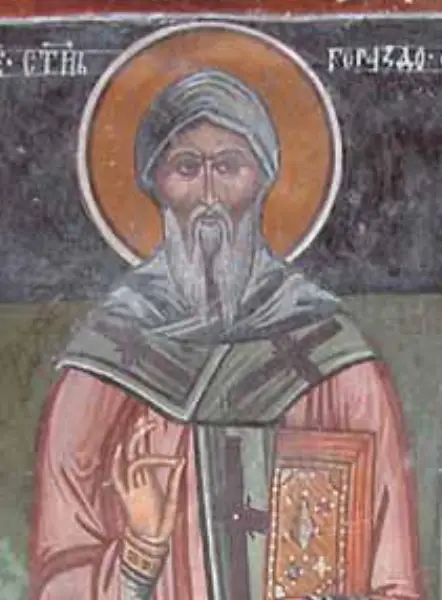
Depicted in a painting at the Slivnica Monastery in North Macedonia
§ Legacy
- 1939
The Orthodox church in Olomouc named after him was built
§ Legacy
- 1950
The Olomouc church bearing his name was made the cathedral church of the Olomouc-Brno diocese
§ Legacy
The Record
- Canonization
- Pre-congregation; venerated since late medieval times in the Eastern churches
Prayer
Bibliography
Show 8 sources
- Vlasto, Alexis P. (1970). The Entry of the Slavs into Christendom: An Introduction to the Medieval History of the Slavs. Cambridge: Cambridge University Press.
- Dvornik, Francis (1970). Byzantine missions among the Slavs: SS. Constantine-Cyril and Methodius. New Brunswick, N.J: Rutgers University Press. ISBN 0813506131.
- Škoviera, Andrej (2013). Pramene o živote svätých Cyrila a Metoda a ich učníkov (1st ed.). Bratislava: Post Scriptum. ISBN 978-80-89567-23-2.
- Rutgers, Carel Arnold; Petri, Franz; Dittrich, Zdenek R. (1962). Christianity in Great-Moravia. J.B. Wolters. p. 271.
- Farmer, David (2011). The Oxford Dictionary of Saints (5th edition, revisited ed.). Oxford University Press. p. 394. ISBN 978-0191036736.
- Stanislav, Ján (1955). O prehodnotenie veľkomoravských prvkov v cyrilometodejskej literatúre. Sofia. pp. 357–363.
- Botek, Andrej (2020). "On the problem of the priestly and episcopal consecrations of St. Gorazd". Historical Journal (in Slovak). 68 (3): 545–559.
- Bowlus, Charles R. (1995). Franks, Moravians, and Magyars: The Struggle for the Middle Danube, 788-907. Philadelphia: University of Pennsylvania Press.
Profile text adapted from the Wikipedia article, licensed CC BY-SA 4.0.
Pray with this saint every day
Save St. Gorazd to your favorites, read the full profile, and get feast-day reminders in the Saints app.
Get the Saints AppFree on the App Store for iPhone and iPad