
1879 – 1942·Feast August 22 (Julian) / September 4 (New Calendar)
St. Gorazd of Prague
Orthodox bishop executed by the Nazis in 1942
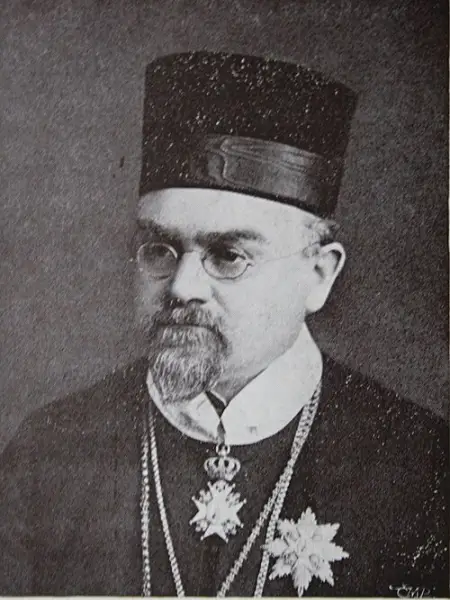
Overview
Gorazd of Prague, born Matěj Pavlík, was the hierarch who revived Orthodox Christianity in Czechoslovakia after the First World War and died a martyr under Nazi occupation. His birth came at Hrubá Vrbka in Moravia on 26 May 1879, within the Catholic world of Austria-Hungary, he studied theology at Olomouc, was drawn to the legacy of Cyril and Methodius and to Eastern Orthodoxy, and was ordained a priest. After the war, when religious freedom came to the new Czechoslovak state and many sought the Orthodox Church, the Serbian Orthodox Church agreed to consecrate him a bishop for his homeland; he took the name Gorazd, after the disciple of Methodius who had led the church in Moravia a thousand years before. Consecrated in Belgrade in 1921, he built the fledgling Czech Orthodox Church almost from nothing — eleven churches, two chapels, Czech service books — and helped establish the Eparchy of Mukachevo and Prešov. In 1942, after Czech resistance fighters assassinated Reinhard Heydrich and hid in the crypt of his Prague cathedral, Gorazd took the blame upon himself to shield his flock. He was arrested, tortured, and executed by firing squad on 4 September 1942. The Serbian Church recognized him as a new martyr in 1961, and he was glorified at Olomouc in 1987.
The Complete Life
A Moravian Boyhood and Catholic Formation
Matěj Pavlík was born on 26 May 1879 at Hrubá Vrbka in Moravia, then a province of Austria-Hungary and now part of the Czech Republic, the middle of three brothers. He grew up within the Roman Catholic society of the empire, and his education followed its ordinary channels: after finishing his earlier schooling he entered the Faculty of Theology in Olomouc, the intellectual center of Moravian Catholicism. Two interests took hold of him during those student years and set the course of his life. The first was the mission of Cyril and Methodius, the ninth-century apostles of the Slavs whose work in Great Moravia had been the founding moment of Christianity in his homeland. The second was Eastern Orthodoxy itself, the tradition those apostles had served and which centuries of Latin dominance had driven from Czech soil. He completed his studies and was ordained a priest of the Catholic Church, but the questions formed in Olomouc had not been laid to rest; they awaited only a historical moment in which they could be asked aloud.
§ Life
Consecration for a Reborn Church
The establishment of Czechoslovakia after the First World War brought complete religious freedom to a people long confined to one confession, and many used it: some left religion entirely, others joined the old Czech Protestant churches, and a significant number looked to Eastern Orthodoxy, for which the Serbian Orthodox Church provided shelter and oversight. Pavlík, already a leader among the Orthodox-minded in Moravia, was the man his compatriots sought for their bishop, and the Serbian Church consented to give him to his homeland as its bishop. On 24 September 1921 he received episcopal consecration in Belgrade's church of the Holy Archangel Michael from Serbian Patriarch Dimitrije, receiving the name Gorazd. The choice was a deliberate act of historical memory: Saint Gorazd had been the bishop who succeeded Methodius as head of the Moravian church after the apostle's death in 885, before Pope Stephen V drove Methodius's disciples from the land as the Latin rite was imposed. By taking the name, the new bishop proclaimed the continuity of the Orthodox church in Moravia across some eleven centuries of interruption.
§ Life
Building the Czech Orthodox Church
The church Gorazd received was a hope more than an institution, and the decade that followed was given to building it. With his faithful companions he organized parishes and raised churches across Bohemia — eleven churches and two chapels in all. Recognizing that a church worships in its own tongue or not at all, he had the essential service books translated into Czech and published, so that the liturgy the people heard was in the language of their homes. His care extended beyond Bohemia: with Carpathian Ruthenia and Slovakia within the same Czechoslovak state, he assisted the many there who were returning to their ancestral Orthodox faith, and his aid bore fruit in 1931 with the establishment of the eparchy seated at Mukachevo and Prešov. The conquest of Czechoslovakia by Nazi Germany in 1938 abruptly changed his circumstances, for the church was placed under the Metropolitan of Berlin, and Reinhard Heydrich was appointed ruler of the Protectorate of Bohemia and Moravia. The structure he had patiently built now stood in the shadow of a regime hostile to every independence, including that of the churches.
§ Life
Heydrich, the Crypt, and the Scaffold
On 27 May 1942 Czech resistance fighters struck down Heydrich, the SS officer called the Hangman of Prague, and while fleeing they slipped into the crypt of the Prague cathedral of Saints Cyril and Methodius and hid there. When Gorazd learned of it a few days later, he understood at once the burden their presence laid upon the Czech Orthodox Church; before leaving for the episcopal consecration of John Gardner in Berlin, he asked that the fighters move elsewhere as soon as possible. On 18 June the Nazis, betrayed by a member of the resistance group, discovered the hiding place and killed every fighter in the church. Reprisals fell immediately: the two priests and the senior lay officials of the church were arrested. Gorazd, determined to shield his fellow believers and the church itself, shouldered the entire responsibility for his cathedral's part, addressing letters of confession to the Nazi authorities. He was arrested on 27 June 1942 and tortured. On 4 September he died with his priests and lay officers before a firing squad at the Kobylisy range, and Strašnice crematorium received his remains. The persecution widened further: every Orthodox church in Moravia and Bohemia was shut and worship banned, though Metropolitan Seraphim boldly declined to utter any word against the bishop, and the village of Lidice was destroyed in the general terror.
§ Life
Glorification as a New Martyr
The manner of his death fixed the judgment of the church. By their bishop's sacrifice the Orthodox faithful of Czechoslovakia had shown the qualities of their small church — bravery, devotion to matters of justice, and firm connection to the Czech nation — and his memory was kept through the years when his church itself was forbidden to exist. On 4 May 1961 the Serbian Orthodox Church, the mother church that had consecrated him two generations before, officially recognized Gorazd as a new martyr, joining him to the great company of those killed under the Nazi and Communist persecutions of the twentieth century. The glorification was completed on 24 August 1987, when he was solemnly glorified in the Olomouc Orthodox Church in Moravia, the region of his birth and of his theological formation. He is honored in Eastern Orthodoxy under the title of New Martyr and Bishop of Prague, and depicted in icons as the Hieromartyr Gorazd Bohemian. His feast is celebrated on 22 August by the old calendar or 4 September by the new — the latter being the day of his execution.
§ Glorification
The Church That Survived
The Nazis intended Gorazd's execution to end the Orthodox church in the Czech lands, and for the duration of the war it did: the churches were shut, the clergy dead or scattered, and the faithful forbidden to gather. But the Metropolitan of Berlin's refusal to condemn the bishop preserved the church's honor, and when the war ended the Orthodox Church in Czechoslovakia was able to function again — the rebirth Gorazd had purchased with his life proved durable. His name carries a double inheritance. As a hierarch he stands in the line of the ninth-century Bishop Gorazd whose name he deliberately took, restoring to the Czech lands the Orthodox legacy of Cyril and Methodius after eleven centuries. As a martyr he belongs to the company of the modern confessors who opposed the totalitarian powers of the twentieth century, and his story is inseparable from the catastrophe that engulfed his nation — the reprisals that destroyed Lidice and the long night of occupation. The church he built from eleven churches and two chapels endured both the Nazis who killed him and the regimes that followed, a testimony that a shepherd's self-sacrifice outlasts every power that opposes it.
§ Life
Timeline
- 26 May 1879
Matěj Pavlík was born at Hrubá Vrbka in Moravia, the middle of three brothers.
§ Life
- 5 Jul 1902
Was ordained a priest after studying theology at the Faculty of Theology in Olomouc.
§ Life
- 24 Sep 1921
Was consecrated bishop in Belgrade by Serbian Patriarch Dimitrije, taking the name Gorazd.
§ Life
- 1931
Assisted Orthodox returnees in Carpathian Ruthenia and Slovakia, helping bring about the Eparchy of Mukachevo and Prešov.
§ Life
- 1938
After the Nazi conquest of Czechoslovakia, his church was placed under the Metropolitan of Berlin.
§ Life
- 27 May 1942
Czech resistance fighters assassinated Reinhard Heydrich and found refuge in the crypt of the Prague cathedral.
§ Life
- 18 Jun 1942
Nazis discovered the hiding place after a betrayal and killed all the resistance fighters sheltering in the church.
§ Life
- 27 Jun 1942
Gorazd, having taken the blame for the cathedral's role upon himself, was arrested and tortured.
§ Life
- 4 Sep 1942
Died before a firing squad alongside the cathedral clergy and senior lay officers; his remains were consigned to the Strašnice crematorium.
§ Life
- 4 May 1961
The Serbian Orthodox Church recognized Gorazd as a new martyr.
§ Glorification
- 24 Aug 1987
Was glorified in the Olomouc Orthodox Church in Moravia.
§ Glorification
The Record
- Major works
- Czech translations and publications of the essential Orthodox service books
- Canonization
- Recognized as a new martyr by the Serbian Orthodox Church on 4 May 1961; glorified in Olomouc on 24 August 1987 by the Czech and Slovak Orthodox Church
Prayer
Bibliography
Show 6 sources
- Šuvarský, Jaroslav (1979). Biskup Gorazd (in Czech). Prague: Ústřední církevní nakladatelství.
- Aleš, Pavel, ed. (1995). Pastýř a martyr. Sborník vzpomínek, statí a úvah o životě a odkazu svatého biskupa Gorazda k 50. výročí od jeho umučení a 5. výročí svatořečení (in Czech). Olomouc: Olomoucké detašované pracoviště Pravlavné bohoslovecké faculty v Prešově.
- Marek, Pavel; Bureha, Volodymyr (2008). Pravoslavní v Československu v letech 1918—1953: Příspěvek k dějinám Pravoslavné církve v českých zemích, na Slovensku a na Podkarpatské Rusi (in Czech). Brno: Centrum pro studium demokracie a kultury. ISBN 978-80-7325-171-0.
- Marek, Pavel (2019). Biskup Gorazd (Pavlík). Životní příběh hledání ideální církve pro 20. století (in Czech). Olomouc: Univerzita Palackého v Olomouci. ISBN 978-80-244-5413-9.
- "Svatý Gorazd II. (Matěj Pavlík)" (in Czech). Obec Hrubá Vrbka. Retrieved 16 June 2025.
- Gazdík, Jan (9 January 2009). "Riskoval život, tajně zapisoval jména obětí nacistů. Teď o tom promluvil". iDNES.cz (in Czech). Retrieved 16 June 2025.
Profile text adapted from the Wikipedia article, licensed CC BY-SA 4.0.
Pray with this saint every day
Save St. Gorazd of Prague to your favorites, read the full profile, and get feast-day reminders in the Saints app.
Get the Saints AppFree on the App Store for iPhone and iPad