
died 362·Feast May 10
St. Gordianus
Roman judge converted and beheaded under Julian
Overview
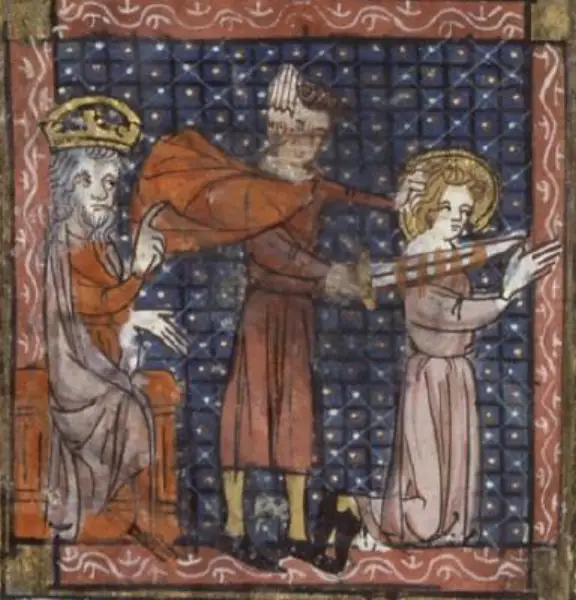
St. Gordianus was a Roman martyr put to death in 362, during the brief and troubled reign of Julian the Apostate. His funeral inscription sets his youth in contrast with the maturity of the faith he reached, and the later Acts of his martyrdom — a tradition of doubtful historical worth — make him a pagan and a judge who was charged with compelling Januarius to sacrifice to the emperor. Instead of carrying out the order, Gordianus allowed himself to be persuaded, embraced Christianity, and brought many members of his own household to the faith with him. Accused before his successor, or as other accounts say before the city prefect Apronianus, he was tortured and finally beheaded. Christians carried away his body and buried it in a crypt along the Latin Way, next to the relics of Epimachus of Alexandria, newly laid to rest there; from the pair the burial ground took its name, and the Catholic Church has honored the two martyrs together ever since. In the centuries that followed, portions of his relics reached Bavaria, and in the 1670s his remains began a journey that would eventually carry them to England.
The Complete Life
The Judge Who Was Persuaded
The story of Gordianus's conversion belongs to the age of Julian the Apostate, the emperor who sought to turn the empire back from Christianity after Constantine. The Acts of his martyrdom, composed later and regarded by scholars as of little historical value, nevertheless preserve the shape of the tradition: Gordianus appears as a pagan and a holder of judicial office, entrusted with the task of forcing a confessor named Januarius to offer sacrifice to the emperor. The plan reversed itself. Instead of bending the Christian, Gordianus listened, was persuaded, and passed over to the faith he had been sent to punish, bringing with him many of the members of his household — a whole family converted through the very mission meant to destroy one man's constancy. His funeral inscription, an older witness than the Acts, dwells on the contrast between the youth he had spent and the mature faith in which he ended his life, the portrait of a man who came late to belief and paid for it completely. Whether judge or simply citizen, he stands among the confessors of Rome's last great persecution.
§ Introduction
Martyrdom on the Latin Way
Apostasy carried consequences, and Gordianus was soon accused — some traditions say before his own successor in office, others before the prefect of the city, Apronianus. Condemned for the faith he had newly embraced, he endured torture and at last the sword: he was beheaded in 362, one of the victims of Julian's brief attempt to restore the old gods without the outright persecution his predecessors had waged. The Christians of Rome did not abandon the body. They carried it off and buried it with honor in a crypt beside the Latin Way, laying it beside the remains of Epimachus of Alexandria, a martyr whose own relics had recently been laid there. The joining of the two saints in one tomb proved lasting: the cemetery itself took its name from Gordianus and Epimachus, and the Catholic Church has honored them together ever since, keeping the feast of Gordianus on 10 May. The converts and judges of later ages could look to a man whose entire Christian life, from baptism of desire to beheading, was compressed into a single act of fidelity.
§ Introduction
The Journey of the Relics
The veneration of Gordianus traveled far from the crypt on the Latin Way. In 752 the Princely Abbey of Kempten in Bavaria was established and dedicated to the Virgin Mary together with Gordianus and Epimachus, and some relics of the two martyrs were brought to the abbey, rooting their cult in southern Germany. A church in Saint-Paul-d'Oueil in France also stands in his honor. The remains themselves rested in the cemetery of Cyriaca until late in the seventeenth century, when Ambrose, a religious of the Augustinian order, took the relics up and entrusted them to Father Christopher Anderson of the Society of Jesus. The relics were transferred to the Jesuit College of St. Omer, and when that college moved to Stonyhurst in England, the martyr traveled with it, coming to rest beneath the altar of the Sodality Chapel, where his bones have remained ever since. In 2006, during a restoration of the chapel, they were temporarily taken up, but they were afterwards returned to the same altar — the closing scene, so far, of a seventeen-century journey that has carried the Roman judge from the Latin Way to Lancashire.
§ Introduction
Timeline
- 362
Tortured and beheaded in Rome during the persecution under Julian the Apostate
§ Introduction
- 752
The Princely Abbey of Kempten in Bavaria was founded and dedicated to the Virgin Mary, Gordianus, and Epimachus, receiving relics of the two martyrs
§ Introduction
- 1670
Ambrose, an Augustinian monk, removed the remains from the Cyriaca cemetery and gave them to the Jesuit Christopher Anderson; they were transferred to the Jesuit College of St. Omer
§ Introduction
- 2006
His bones were temporarily removed from the Sodality Chapel at Stonyhurst during restoration, then returned
§ Introduction
The Record
- Canonization
- Pre-congregation; venerated as a martyr of the early Church
Prayer
Bibliography
Show 6 sources
- "Gordian and Epimachus", The Oxford Dictionary of Saints 5th ed. (David Farmer, ed.) OUP, 2011 ISBN 9780199596607.
- Murphy, John F.X. "Sts. Gordianus and Epimachus." The Catholic Encyclopedia Vol. 6. New York: Robert Appleton Company, 1909.
- "The Life of Saint Gordian", The Golden Legend.
- Butler, Alban. "Saints Gordian and Epimachus, Martyrs". Lives of the Fathers, Martyrs, and Principal Saints 1866. CatholicSaints.Info.
- Monks of Ramsgate. "Gordian". Book of Saints 1921. CatholicSaints.Info.
- Historischer Verein für Schwaben (1874). Zeitschrift des Historischen Vereins für Schwaben, Volumes 1-3. Augsburg. pp. 228–229.
Profile text adapted from the Wikipedia article, licensed CC BY-SA 4.0.
Pray with this saint every day
Save St. Gordianus to your favorites, read the full profile, and get feast-day reminders in the Saints app.
Get the Saints AppFree on the App Store for iPhone and iPad