
died c. 320·Feast January 3
St. Gordius
Centurion and martyr of Caesarea in Cappadocia
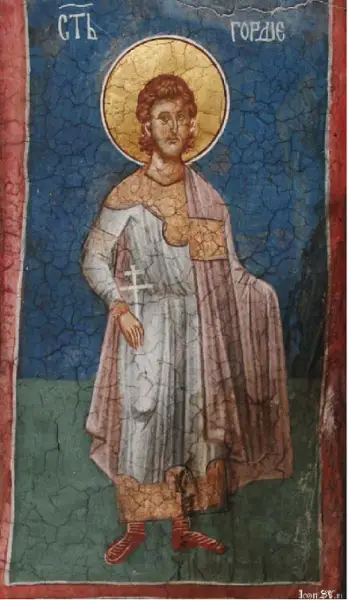
Overview
St. Gordius was a Christian soldier of Caesarea in Cappadocia, a centurion of the Roman army put to death for his faith in the early fourth century. When the emperor Licinius moved against the Christians in the ranks, Gordius was dismissed from the service together with other believers, and he withdrew into a solitary place to live as a hermit. The desire to give his blood for Christ, however, drew him back to the city: while the people of Caesarea were gathered for public games held in honor of Mars, he appeared before the crowd — gaunt from his long retirement, his beard and hair grown long, his clothes in rags, yet bearing in his face a majesty that commanded veneration — and openly proclaimed his faith, seeking to win converts. Seized and brought to trial before the governor, he confessed Christ loudly and without reserve and was condemned to be beheaded. Strengthening himself with the sign of the cross, he received the deadly blow with joy, in some year between 314 and 320. On his festival St. Basil the Great preached at Caesarea the celebrated discourse in his praise.
The Complete Life
Soldier and Hermit
Gordius served as a centurion in the Roman army stationed in his native Caesarea, the chief city of Cappadocia. His military career ended with the persecuting measures of the emperor Licinius, under whom he and other Christian soldiers were dismissed from the service for their faith. What might have been merely a disgrace became for him a retreat: he retired into a solitude, living as a hermit apart from the city of his birth in fasting and watchfulness, and there his body grew gaunt, his beard and hair long, his clothing reduced to rags. The sources see in those years of concealment not cowardice but readiness: the longing, in Butler's phrase, to pour out his blood for Christ had taken hold of him, and the desert became the school in which his confession ripened. Like the soldiers of his profession, he knew how to wait for the moment of engagement; unlike them, the battle he awaited was not against Rome's enemies but for the soul of the crowds he had left behind. His withdrawal ended when that battle called him back.
§ Butler's account
Confession in the Circus
The moment Gordius chose for his return was a festival of the old religion: the people of Caesarea were assembled in the Circus for the public games held in honor of Mars when the hermit stepped into their midst. His appearance alone commanded attention — the wasted frame, the long beard and hair, the ragged garments of an ascetic — yet more striking still was the graceful air of majesty, as Butler describes it, that shone in his countenance and drew the veneration of the whole assembly. Into that crowd, gathered to celebrate the god of war, the soldier of the true King made his proclamation, addressing the people and seeking to make converts of them. He was seized and brought before the governor for examination. There, in the formal setting of a Roman tribunal, he completed what he had begun in the Circus: interrogated by the magistrate, he confessed his faith loudly and without qualification. The trial he had courted through years of silence arrived, and he met it with the voice of a man who had long rehearsed his answer in the desert.
§ Butler's account
The Blow Received with Joy
Condemnation followed the confession, and the sentence was beheading. On his way to the block Gordius fortified himself with the sign of the cross, the soldier's last gesture of discipline turned into a sacrament of courage, and then received the deadly blow, in Butler's words, joyfully — the record of a death borne not as a loss but as the crowning of a long desire. He died at Caesarea in some year between 314 and 320, under the persecuting edicts that Licinius enforced in the East before his own conversion and fall. The memory of the centurion did not fade with his generation. Some among the hearers of St. Basil the Great, preaching at Caesarea decades later, had themselves seen Gordius die, and on the martyr's festival the great bishop pronounced in his praise the eloquent panegyric that the Roman Martyrology still recalls: the discourse delivered, as it notes, on the day of his festival. The Eastern Orthodox and Roman Catholic churches commemorate him on 3 January, and his emblem remains the martyr's cross with which he signed himself at the end.
§ Monks of Ramsgate account
In Their Own Words
At Caesarea, in Cappadocia, St. Gordius, centurion, in whose praise is extant a celebrated discourse, delivered by St. Basil the Great on the day of his festival.
The Record
- Symbols
- Martyr's cross
- Canonization
- Pre-congregation; venerated as a martyr since the early Church
Prayer
Bibliography
Show 3 sources
- Butler, Alban (1868), The Lives of the Fathers, Martyrs, and Other Principal Saints, vol. 1, J. Duffy.
- Gibbons, James, ed. (1916), The Roman martyrology, Baltimore: John Murphy.
- St. Augustine's Abbey, Ramsgate (1921). The Book of saints: a dictionary of servants of God canonized by the Catholic Church. London: A. & C. Black, ltd. OCLC 671676136.
Profile text adapted from the Wikipedia article, licensed CC BY-SA 4.0.
Pray with this saint every day
Save St. Gordius to your favorites, read the full profile, and get feast-day reminders in the Saints app.
Get the Saints AppFree on the App Store for iPhone and iPad