
died 304·Feast March 12
St. Gorgonius of Nicomedia
Imperial official martyred under Diocletian at Nicomedia
Overview
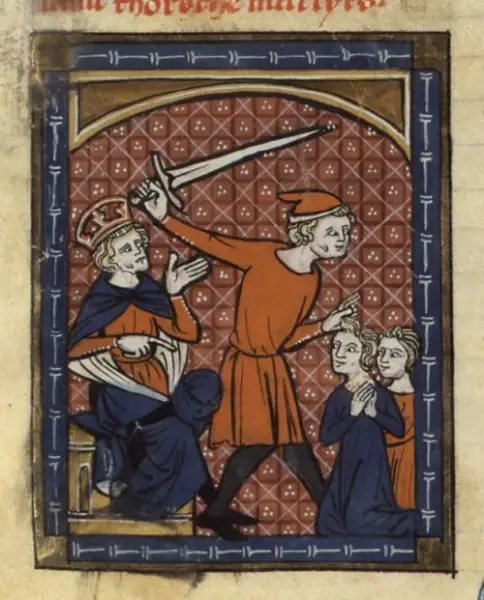
Gorgonius, also called Gorgon, was a Christian who suffered martyrdom at Nicomedia — modern Izmit in Turkey — in the year 304, during the Diocletianic Persecution, alongside Peter Cubicularius and a chamberlain named Dorotheus. The historians Lactantius and Eusebius both record that he served near the summit of the imperial court, which made him, when the persecution broke out, among the first to be charged; with his companions he was brutally tortured and finally strangled. A later version of the legend fills out the scene: seeking to expose the Christians who served him, Diocletian ordered his whole household to sacrifice to the Roman gods. Peter the butler was uncovered first, and Dorotheus and Gorgonius, an army officer, protested his treatment and were put to death with another official, Migdonius. The emperor commanded that the martyrs' bodies be thrown into the sea to deprive them of honor, but Christians recovered them, and the body of Gorgonius was eventually carried to Rome. In the eighth century his remains were translated by Bishop Chrodegang of Metz to the monastery of Gorze in Lorraine, and portions reached Minden and many French churches; most French relics perished in the Revolution. His feast is kept on 12 March in the Roman Catholic Church and 3 September in the East.
The Complete Life
A Christian in the Imperial Household
Gorgonius served at the very center of Roman power. The earliest witnesses, Lactantius and Eusebius, agree that he stood high in the emperor's own service, and his companions in glory came from the same milieu: Peter, the emperor's butler or chamberlain, and Dorotheus, an imperial chamberlain, with Gorgonius himself described in the later legend as an army officer. That Christians could rise so high in Diocletian's own service is a measure of how openly the faith was practiced before the great persecution, and how sudden was the reversal when it came. Such servants were doubly exposed: their rank made them conspicuous, and their intimacy with the emperor made their refusal to sacrifice an insult no ruler could overlook. The sources give no account of Gorgonius's origin or of how he came to the faith, but his conduct under examination answers the question of what that faith meant to him. When the persecution began, the historians record, he was consequently among the very first to be charged — a priority that was in the empire's eyes an indictment and in the church's eyes an honor.
§ Life
The Martyrdom at Nicomedia
The tradition preserves two tellings of the end. The first, that of the ancient historians, is stark: Gorgonius, with Peter, Dorotheus, and several others, was brutally tortured and then finally strangled. The second, a fuller legend, describes Diocletian's stratagem for unmasking the Christians of his court. Wishing to expose them, the emperor ordered everyone of his household to pay honor to the Roman gods, knowing that refusal would reveal the believers. The first exposed was his butler Peter, surnamed Cubicularius — valet or chamberlain — who was strung up while his flesh was torn from his bones. At the sight, two Christians of rank protested: Dorotheus the chamberlain and Gorgonius the officer denounced the treatment of their brother, and with another official named Migdonius they too were condemned. Peter, according to the differing accounts, was boiled or burned alive, or roasted on a gridiron. Diocletian, determined that the bodies should not receive the honors early Christians customarily paid to the relics of martyrs, ordered them all thrown into the sea; the Christians nevertheless obtained possession of them, and eventually Gorgonius's remains made their way to Rome.
§ Life
Relics from Rome to Gorze
The cult of Gorgonius grew around his remains. Presumably brought west with his body, the relics rested at Rome until the eighth century, when Chrodegang, Bishop of Metz, translated them to the monastery of Gorze in Lorraine — the same abbey that would later receive the body of Bishop Gondulphus of Metz. From Gorze the veneration spread widely: some relics were translated to Minden, where an arm reliquary of the saint was preserved at the cathedral, and many French churches obtained portions of his body from the Gorze community. Most of these French relics were lost in the chaos of the French Revolution. The church keeps his feast with that of his companions on 12 March in the Roman Catholic Church, while the Eastern Orthodox Church honors the martyrs on 3 September. Pope Damasus I composed an epigram for the martyr's tomb, celebrating Gorgonius as guardian of the altars of Christ and promising that those who seek the thresholds of the saints will find the blessed dwelling nearby. Distinct from him is Gorgonius of Rome, an early martyr of 9 September whose cult suffered from the confusion of the two names.
§ Veneration
A Name Carried to California
The martyr's name traveled farther than his relics. When Spanish missionaries established Rancho San Gorgonio in Southern California in 1824, one of the principal and most distant rancherias of the San Gabriel Mission near Los Angeles, they placed it under the patronage of Saint Gorgonius. The ranch occupied most of what is today the San Gorgonio Pass area, and its name flowed outward onto the landscape: San Gorgonio Pass itself, San Gorgonio Mountain rising 11,500 feet north of the pass, and the San Gorgonio River, a seasonal wash whose course these landmarks share. Each of these names in turn has been applied to establishments and organizations of the modern region, so that the martyr of Nicomedia remains attached to places he could never have imagined. His story also entered literature and history through other channels: the antiquary's pages that record the multiple saints of the name — the martyr of Nicomedia, the Roman martyr of the Via Labicana, and a third Gorgonius among the Forty Martyrs of Sebaste — note how frequently these figures were confused, and even a ridiculed namesake in a satire of Horace testifies to how widely the name once traveled.
§ Legacy
Timeline
- 304
Was martyred at Nicomedia with Peter Cubicularius, Dorotheus, and Migdonius during the Diocletianic Persecution.
§ Life
- 304
After his execution, Christians recovered his body from the sea into which Diocletian had ordered it thrown, and it was later carried to Rome.
§ Life
- 700
In the eighth century, Bishop Chrodegang of Metz translated the remains to Gorze in Lorraine, and some relics reached Minden.
§ Veneration
- 1824
Spanish missionaries founded Rancho San Gorgonio in Southern California, naming it in his honor.
§ Legacy
- 1969
The feast of Gorgonius of Rome, a distinct martyr often confused with him, was removed from the General Roman Calendar in its revision.
§ Gorgonius of Rome
In Their Own Words
This martyr's tomb beneath a great hilltop holds Gorgonius, guardian of the altars of Christ. Whoever comes to seek here the thresholds of the saints will find that in the nearby dwelling abide the blessed whom likewise, as they went, piety bore to heaven.
The Record
- Canonization
- Pre-congregation; venerated as a martyr from antiquity by the Catholic and Eastern Orthodox Churches
Prayer
Bibliography
Show 9 sources
- Murphy, John F.X. "St. Gorgonius." The Catholic Encyclopedia Vol. 6. New York: Robert Appleton Company, 1909.
- "Santi Pietro (detto Cubicolario), Doroteo e Gorgonio". Santi e Beati (in Italian).
- Saint Alfonso Maria de' Liguori, Victories of the martyrs; or, The lives of the most celebrated martyrs of the Church. Volume 9 of Ascetical works (Benziger Bros., 1888), 261.
- Sabine Baring-Gould, The lives of the saints (J. Hodges, 1875), 131.
- "Martyrologium Romanum" (Libreria Editrice Vaticana, 2001, ISBN 88-209-7210-7).
- Alban Butler; edited by Paul Burns, Volume 9 of Butler's Lives of the Saints (Continuum International Publishing Group, 2000), 81.
- "Calendarium Romanum" (Libreria Editrice Vaticana, 1969), p. 138.
- Gunther, Jane Davies (1984). Riverside County, California, Place Names; Their Origins and Their Stories. Riverside, California. pp. 456-461.
- Gudde, Erwin G. (1949). California Place Names (1st ed.). Berkeley and Los Angeles: University of California Press. p. 305.
Profile text adapted from the Wikipedia article, licensed CC BY-SA 4.0.
Pray with this saint every day
Save St. Gorgonius of Nicomedia to your favorites, read the full profile, and get feast-day reminders in the Saints app.
Get the Saints AppFree on the App Store for iPhone and iPad