
960 – 1038·Feast May 5
St. Gotthard of Hildesheim
Benedictine reformer and Bishop of Hildesheim
Overview
Gotthard, also called Godehard, was a German Benedictine abbot and reformer who became Bishop of Hildesheim and one of the most widely venerated saints of medieval Germany. His birthplace lay at Reichersdorf in the Bavarian countryside near Niederaltaich, within the diocese of Passau; his father Ratmund held land as vassal of the abbey's canons, he studied the humanities and theology at Niederaltaich, became a canon there, pursued his learning further in Salzburg's archiepiscopal court and in the school of Passau cathedral, and served as provost of the canons. When Duke Henry of Bavaria transformed the Niederaltaich chapter into a Benedictine monastery, Gotthard stayed on, took the monastic habit in 990, was ordained priest in 993, and became abbot in 996. He introduced the Cluniac reforms at Niederaltaich and, under the patronage of Emperor Henry II, trained abbots to restore Benedictine observance at Tegernsee, Hersfeld, and Kremsmünster. On 2 December 1022 he succeeded Bernward as Bishop of Hildesheim, and for fifteen years he fostered the education of the young clergy, made the cathedral school a center of learning, and ordered the building of some thirty churches. His death came on 5 May 1038 in the Mauritiusstift, the pilgrims' hospice of his own founding. Canonized at Rheims in 1131, the faithful seek his help in fever, dropsy, children's illnesses, hailstorms, labor pains, and gout, and honored as patron of travelling merchants.
The Complete Life
A Canon's Son of Lower Bavaria
Gotthard was born in 960 at Reichersdorf in Bavaria, near the abbey of Niederaltaich in the diocese of Passau. His father Ratmund stood in a dependent relation to the church, being a vassal of the abbey's canons, and the boy's path into the ecclesiastical world began naturally at its gate. Sent to Niederaltaich, he studied the humanities and theology within the abbey school and became a canon there under Abbot Erkanbert. His education did not stop at the abbey walls: he advanced his education under the archbishop's roof in Salzburg, administering church affairs there, gaining a practical knowledge of church governance that would serve him for the rest of his life. After traveling through various countries, among them Italy, he completed his advanced studies in the cathedral school at Passau under the master Liutfrid. Well read, broadly traveled, and experienced in administration, he returned to Niederaltaich and rejoined the canons, who appointed him their provost — by his mid-thirties, a man of standing in the church of southeastern Germany.
§ Life
Monk, Prior, Abbot
The decisive turn came when Duke Henry of Bavaria resolved to turn Niederaltaich's chapter into a house of Benedictine monks. Gotthard, already provost of the secular canons, could have left with the others; instead he remained, took his place among the novices, and became a monk in 990 under Abbot Ercanbert. Three years later, in 993, he was ordained a priest, and he was soon made prior and rector of the monastic school, ordering both the discipline of the house and the formation of its young. In 996 the community installed him as abbot, with Duke Henry himself present at the installation, a mark of how closely the abbey's fortunes were bound to the ducal house. As abbot he became a dedicated reformer, introducing the Cluniac reforms at Niederaltaich and helping to revive the Rule of St. Benedict in houses that had grown lax. His reputation as a restorer of observance reached the emperor: Emperor Henry II entrusted him with preparing abbots to renew observance at Tegernsee, Hersfeld, and Kremsmünster, sending them out to revive Benedictine life across the German lands.
§ Life
Bishop of Hildesheim
On 2 December 1022 Gotthard succeeded the saintly Bernward as Bishop of Hildesheim, receiving consecration from Aribo, Archbishop of Mainz. He was already past sixty, but the fifteen years of his episcopal government were among the most fruitful in the see's history, and he earned the lasting respect of his clergy. Education was his first concern: he took particular interest in the formation of the young clergy, started several schools, and raised the cathedral school of Hildesheim into a recognized center of learning, continuing the tradition of scholarly distinction his predecessor had fostered. He was a builder on a grand scale, ordering the construction of some thirty churches across the diocese. Around 1025 a monastery rose by his order next to the Zierenberg chapel, and a church followed on the site, dedicated to Saint Maurice and consecrated in 1028. Nor did age soften his vigilance: old age never dulled his tenacity in guarding what belonged to his see against every encroachment. He died on 5 May 1038, after a brief sickness, at the Mauritiusstift — the hospice for travelers that he himself had founded, closing his days in the house built for the care of strangers.
§ Life
Canonized at Rheims
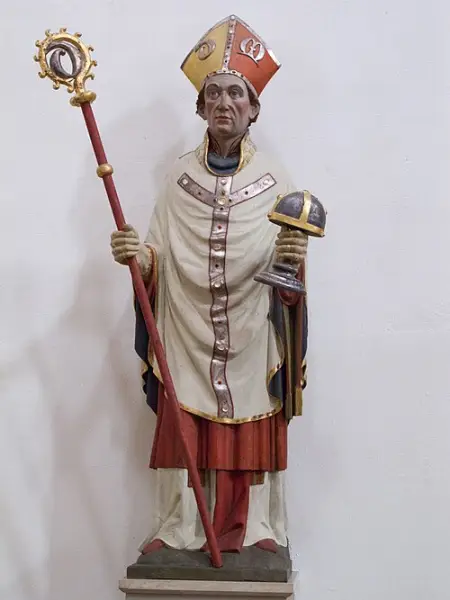
The movement to recognize Gotthard as a saint began within the episcopate he had governed. His successors in the see of Hildesheim, Bishop Bertold (1119-1130) and Bishop Bernhard I (1130-1153), actively pushed for his canonization, and their efforts bore fruit during Bernhard's episcopate. In 1131, at a synod in the city of Rheims, Pope Innocent II — in the presence of Bishop Bernard and of Norbert of Xanten, the founder of the Premonstratensians — officially enrolled Gotthard among the saints. The following year the saint's remains were carried in procession from the abbey church into Hildesheim's cathedral on 4 May 1132, and the following day brought the first solemn feast kept for him, with miracles reported at the relics. The shrine crafted to hold them, dating from about 1140, stands among the most ancient reliquaries to have come down from the medieval period, and his image stands in the tympanum of the Hildesheim basilica that bears his name beside Christ and Saint Epiphanius. The basilica of St. Godehard in Hildesheim keeps his memory and his statue, the bishop depicted with the relic receptacle of St. Mary.
§ Veneration
Patron of Merchants, Passes, and the Sick
Veneration of Gotthard spread quickly beyond Hildesheim, reaching Scandinavia, Switzerland, and Eastern Europe, and it took shapes suited to his people's needs. The faithful sought his help in fever, dropsy, children's illnesses, hailstorms, labor pains, and gout, and mariners in danger at sea called upon him. As patron saint of travelling merchants he was honored with churches and chapels across the Alps, where merchants crossed the mountains on the great trade routes; the pass and massif that bear the name of Saint-Gotthard in the Swiss Alps carry his memory into geography itself. An old tradition of Ticino credits the founding of the pass chapel to Galdino, Archbishop of Milan in the later twelfth century, though Goffredo da Bussero attributes it instead to Enrico da Settala, who governed the Milanese church from 1213 to 1230; Ticino placed the hospice in Capuchin hands in 1685 through Federico Visconti, and a local confraternity assumed its direction afterward. His fame returned to the abbey that formed him: Niederaltaich chose its celebrated abbot as namesake and guardian of the abbey's renowned Gymnasium. Szentgotthárd, the Hungarian town, and its abbey there preserve his name, and two battles of Saint Gotthard — one of 1664 in the Austro-Turkish war, one of 1705 in Rákóczi's rebellion — keep it in the annals of history; even the surname Gothard testifies to his popularity.
§ Veneration
Timeline
- 960
Was born at Reichersdorf in Bavaria, near Niederaltaich in the diocese of Passau.
§ Life
- 990
Became a monk at Niederaltaich when Duke Henry of Bavaria transformed its chapter house into a Benedictine monastery.
§ Life
- 993
Was ordained a priest, later serving as prior and rector of the monastic school.
§ Life
- 996
Was installed as abbot of Niederaltaich, with Duke Henry present at the installation.
§ Life
- 2 Dec 1022
Succeeded Bernward as Bishop of Hildesheim and was consecrated by Aribo, Archbishop of Mainz.
§ Life
- 1025
Laid the foundations of a religious house next to the Zierenberg chapel, about this year.
§ Life
- 1028
The church he had built on the Zierenberg, dedicated to Saint Maurice, was consecrated.
§ Life
- 5 May 1038
Died after a brief sickness at the Mauritiusstift, the hospice for travelers he had founded.
§ Life
- 1131
Was canonized by Pope Innocent II at a synod in Rheims, in the presence of Bishop Bernard and Norbert of Xanten.
§ Veneration
- 4 May 1132
Bishop Bernard moved the relics into Hildesheim cathedral from their abbatial resting place.
§ Veneration
- 5 May 1132
The first liturgical festivity in his honor was celebrated, with miracles attributed to the relics.
§ Veneration
The Record
- Major works
- Reform of Niederaltaich Abbey on the Cluniac model·Training of abbots for Tegernsee, Hersfeld, and Kremsmünster·Foundation of the monastery on the Zierenberg·Foundation of the Mauritiusstift hospice for travelers
- Patron of
- Travelling merchants·Invoked against fever, dropsy, childhood sicknesses, hailstones, the pain of childbirth, and gout·Invoked by those in peril of the sea
- Symbols
- Dragon·Model of a church
- Canonization
- Canonized in 1131 at a synod in Rheims by Pope Innocent II
Prayer
Bibliography
Show 6 sources
- "Godehard (Gotthard) von Hildesheim - Ökumenisches Heiligenlexikon".
- Schmucki, Ottaviano. "San Gottardo di Hildesheim", Santi e Beati, June 22, 2002.
- Charles Lamb, Elia (Scott, Foresman and Company, 1911), 328.
- "Bishop Godehard", Mariendom Hildesheim.
- Anke Twachtmann-Schlichter: Baudenkmale in Niedersachsen, p. 170. Hameln 2007.
- "The Gotthard Shrine", Mariendom Hildesheim.
Profile text adapted from the Wikipedia article, licensed CC BY-SA 4.0.
Pray with this saint every day
Save St. Gotthard of Hildesheim to your favorites, read the full profile, and get feast-day reminders in the Saints app.
Get the Saints AppFree on the App Store for iPhone and iPad