
died 7 June 1066·Feast June 7
St. Gottschalk
Prince and martyr of the Obotrite Slavs
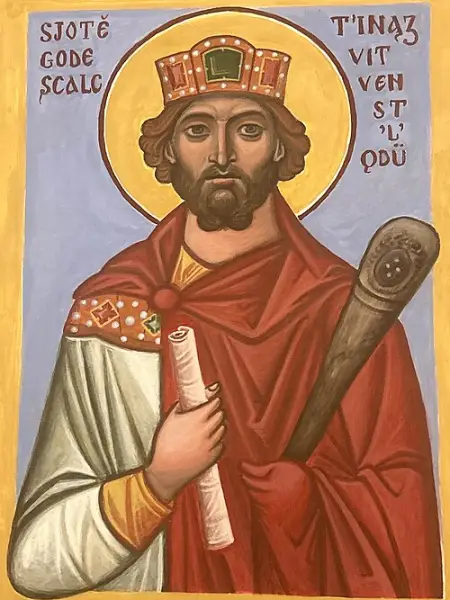
Overview
Gottschalk, sometimes rendered Godescalc, was a prince of the Obotrite confederacy who ruled from 1043 until his violent death in 1066. Born into a princely family that had wavered between Christianity and the old Slavic paganism, he was educated at the monastery of St. Michael at Lenzen and afterwards at Lüneburg. When his father Udo was murdered by a Saxon in 1028, the young Gottschalk renounced the faith and took command of the Liutizi to avenge him, ravaging Saxon territory until Duke Bernard II of Saxony defeated and captured him. Re-converted to Christianity, he entered the service of King Canute the Great of Denmark and fought in that king's wars against Norway and in England. In 1043, through his marriage to Sigrid, daughter of the Danish jarl Sven Estridson, he recovered his paternal inheritance and became Prince of the Obotrites. The following two decades he devoted to gathering the scattered Polabian Slavic tribes into one kingdom and leading that kingdom to Christ, founding monasteries and dioceses and aiding German missionaries. A pagan rising in 1066 ended his life at Lenzen, and the Church has kept his memory as a martyr.
The Complete Life
A Prince Between Two Faiths
Gottschalk was born into the ruling house of the Obotrites, a Slavic confederacy settled along the Elbe in what is now northeastern Germany. His family's Christian inheritance was fragile: his grandfather Mistiwoi had forsaken the Christian faith and gone back to the old Slavic paganism, and his father Udo, in the dry judgment of the chronicler Adam of Bremen, was a bad Christian. Udo nevertheless placed his son with the monks, sending the boy to the monastery of St. Michael at Lenzen and later to Lüneburg for his education. The peace of the cloister was shattered in 1028, when a Saxon murdered Udo. The young Gottschalk answered grief with blood, renouncing the Christianity of his schooling and placing himself at the head of the Liutizi to punish his father's killers. He slew many Saxons in the vendetta before Duke Bernard II of Saxony defeated and captured him, and his father's lands passed meanwhile to Ratibor of the Polabians. The episode marked him doubly: he had tasted both the faith of the monastery and the fury of the feud, and the road back from the second to the first would shape the rest of his life.
§ Life
The Convert in Exile
Captivity became, by God's hidden providence, the doorway to Gottschalk's return. Re-converted to the Christian faith, he regained his liberty and went to Denmark at the head of a following of his own people, entering the service of King Canute the Great in that monarch's wars against Norway. His valor pleased the king, who sent him to England in the company of Canute's kinsman Sweyn, and there the young Slav won a reputation as a soldier. These years of exile, spent far from the Elbe in the courts and armies of the Danish empire, forged in him both the political skill and the Christian conviction that would define his later reign. When Sven Estridson, jarl of Denmark, sought independence from King Magnus I of Norway in 1042, it was Gottschalk who mediated an alliance between Sven and the Obotrites, joining his two worlds together. In 1043 Ratibor of the Polabians perished in a siege by Magnus, together with his sons, and the way lay open: Gottschalk married Sven's daughter Sigrid and took up his father Udo's inheritance as the Obotrites' prince. The exile and avenger came home as a Christian king-in-waiting.
§ Life
Apostle of the Elbe Slavs
Gottschalk's ambition as prince was as simple as it was vast: to draw the dispersed tribes of the Slavs together in a single realm, and to lead that realm to Christ. From 1043 to 1066 he built a Polabian Slavic realm on the Elbe, subduing the Liutizi and conquering the Circipani and Kessini in the civil war of 1057, securing his gains with new fortresses while the old defenses of the conquered tribes were leveled. But his chief work was missionary. He organized bands of German priests and planted monasteries at Oldenburg, Mecklenburg, Ratzeburg, Lübeck, and Lenzen, and raised the first three among them to the rank of dioceses, and he was sustained throughout by Adalbert, Archbishop of Hamburg, whom he honored as a father. The Scottish missionary John, sent to preach at Mecklenburg, baptized many thousands across the prince's dominions. Gottschalk did not delegate the evangelization of his people: he often accompanied the missionaries on their rounds, interpreting their sermons and instructions into the Slavonic tongue for the crowds, so that the Gospel reached the Wagiri, the Obotridi, the Polabingi, and their neighbors in a voice they could grasp. Much of the nobility and peasantry, it is true, remained pagan; yet the seed was sown.
§ Butler's account
Piety on a Throne
Adam of Bremen, who knew the age, judged Gottschalk the mightiest prince the Slavs had ever known, surpassing all others in prudence, power, and valor — and, once converted, in devotion and holy zeal as well. That zeal took visible forms. He filled every part of his dominions with churches and priests, founding monasteries for both men and women at Lübeck, Oldenburg, Lenzen, Ratzeburg, in Magdeburg, and beyond. He regarded the archbishop of Hamburg as his own father in Christ, and he often went up to that city to make his devotions in the metropolitan church there. When his missionaries preached, he stood among his people and rendered their words into Slavonic with his own explanations and instructions, a king serving as catechist to his kingdom. His contemporaries gave him the title of another warrior of the faith, calling him the Machabee of the Christians. His was a robust, royal spirituality: the faith was not a private consolation but a program of state, to be advanced by fortresses, dioceses, schools of preachers, and the personal witness of a ruler who had once been the faith's apostate enemy and had learned, in exile, the worth of the mercy he now proclaimed.
§ Butler's account
Rebellion and Martyrdom
The closing years of Gottschalk's reign were clouded by the resentment of those who would not accept the new religion. In 1066 the Obotrites rose in rebellion, allied with the Lutici, the very people he had once led in his pagan days, and the rising began with the murder of the Christian prince himself. The rebels captured the castle of Lenzen, and there, on 7 June 1066, they slew Gottschalk in the city of Lenzen, and with him Ebbo, a priest who was stretched across the altar and stabbed there. His sons were forced to flee: Henry escaped to Denmark and Budivoj to Lüneburg. The rebellion's leadership passed first to Blus, and after his death that same year to Kruto, whose power was rooted in Wagria. Budivoj campaigned against the usurper with Saxon help but fell at Plön in 1075. The account was settled only a generation later, when Henry, Gottschalk's son, killed Kruto at a feast in 1090 and avenged his father at last. The prince who had sought to die for no one's cause but Christ's perished, in his enemies' own words, for the single reason that he had brought them the Christian religion.
§ Life
Honored Among the Martyrs
The Church received Gottschalk not by formal process but by the ancient instinct of the faithful: he died for the faith, and the faith numbered him among its martyrs. Historians of the northern nations, Alban Butler records, unanimously agreed that the only cause of his death was the hatred which the pagans had conceived for the Christian religion. On that basis the Carthusians of Brussels, when they supplemented the Martyrology of Usuard, enrolled Gottschalk and his companions among the martyrs honored on 7 June, the very day of his death, and the Bollandist Henschenius did not doubt that northern churches once honored him, their calendars and monuments having perished in later religious upheavals. His feast has accordingly been kept on 7 June. The hagiographers and historians who preserved his memory — Adam of Bremen, Helmold, Kranzius, and the Bollandist commentators — treated him not merely as a successful warlord who happened to be baptized, but as a king whose blood, shed beside that of a priest at the altar of Lenzen, sealed the evangelization of his people. No pope canonized him; the violence of 7 June 1066 was his canonization decree.
§ Butler's account
The Kingdom That Kept the Faith
Gottschalk's realm did not long survive him intact, but his deeper project outlived the rebellion that killed him. Of his sons, Budivoj died fighting the pagan usurper Kruto, while Henry, who destroyed Kruto in 1090 and restored the dynastic line, later championed the missionary work of Vicelinus among the same Slavic peoples his father had tried to convert — the apostolate of the Elbe continuing through the generation that avenged the martyr. Writers summed up his unfinished work in one sober sentence: had his life been spared, he would, men judged, have led every pagan to the Christian faith. The primary sources for his life, the chronicles of Adam of Bremen and Helmold, ensured that a Slavic prince on the edge of the Latin world would not vanish from history, and Alban Butler's eighteenth-century account carried him into the devotional literature of the universal Church. Modern historians of the Baltic, cataloguing the brief existence of a native Polabian Christian kingdom, still reckon his reign the one moment when the scattered tribes between the Elbe and Mecklenburg nearly became, at once, a single people and a Christian one. That near-realization is his monument, together with the dioceses and monasteries that first planted the faith there.
§ Butler's account
Timeline
- 1028
His father Udo was murdered by a Saxon; Gottschalk renounced Christianity and led the Liutizi in revenge, until Duke Bernard II captured him.
§ Life
- 1042
Mediated an alliance between Sven Estridson of Denmark and the Obotrites against King Magnus I of Norway.
§ Life
- 1043
After Ratibor died in a siege, Gottschalk married Sigrid and recovered his father's inheritance as Prince of the Obotrites.
§ Life
- 1057
During the Liutizi Civil War he conquered the Circipani and the Kessini and secured the territory with new fortresses.
§ Life
- 7 Jun 1066
Murdered at Lenzen by rebellious Obotrites allied with the Lutici, together with the priest Ebbo.
§ Life
- 1075
His son Budivoj, campaigning against the usurper Kruto with Saxon aid, was killed at Plön.
§ Life
- 1090
His son Henry avenged him by killing Kruto at a feast and later championed the missionary work of Vicelinus.
§ Life
In Their Own Words
A pious and god-fearing man
Had he lived, he would have brought all pagans to the Christian faith.
The Record
- Major works
- A unified Polabian Slavic kingdom on the Elbe·Monasteries at Oldenburg, Mecklenburg, Ratzeburg, Lübeck, Lenzen, and Magdeburg·The erection of Oldenburg, Mecklenburg, and Ratzeburg into dioceses
- Patron of
- languages·linguists·lost vocations·princes·translators·Polabians
- Canonization
- Pre-congregation canonization; honored as a martyr from an early date, with his feast recorded in the Martyrology of Usuardus by the Carthusians of Brussels
Prayer
Bibliography
Show 6 sources
- Butler, Alban (1799), The Lives of the Primitive Fathers, Martyrs, and Other Principal Saints, vol. VI, Edinburgh: J. Moir
- Gwatkin, H. M.; Whitney, J. P., eds. (1926), The Cambridge Medieval History, vol. III, Cambridge University Press, pp. 805-806
- Herrmann, Joachim (1970). Die Slawen in Deutschland. Berlin: Akademie-Verlag GmbH. p. 530
- North, Michael (2015), The Baltic, Harvard University Press, ISBN 9780674426047
- Grewolls, Grete (2011). Wer war wer in Mecklenburg und Vorpommern. Das Personenlexikon. Rostock: Hinstorff Verlag. p. 3451. ISBN 978-3-356-01301-6
- "St. Gottschalk". Bakersfield, California: Catholic Online. Retrieved 22 July 2020
Profile text adapted from the Wikipedia article, licensed CC BY-SA 4.0.
Pray with this saint every day
Save St. Gottschalk to your favorites, read the full profile, and get feast-day reminders in the Saints app.
Get the Saints AppFree on the App Store for iPhone and iPad