
c. 540 – 616·Feast July 1
St. Goulven of Léon
Breton bishop, hermit, and worker of miracles
Overview
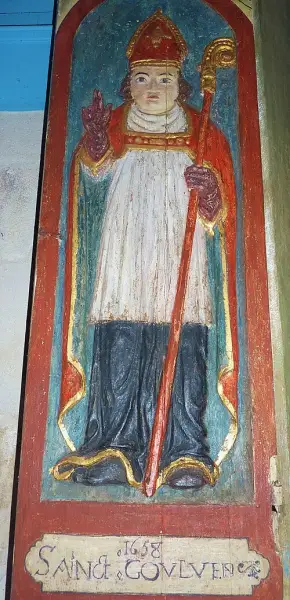
Saint Goulven of Léon — also called Golven, Golvinus, or Golvenus — was a Breton saint of the sixth and seventh centuries whose life is known almost entirely through his vita, a text of questioned historical accuracy that survives only in later transcriptions. According to that account, his parents had come across from the British Isles, settling in Brittany in 540, and he grew into an ascetic and anchorite whose prayer was credited with cures and with helping repel a Viking raid. Refusing wealth and even the office of abbot, he lived as a hermit beside the sea until 602, when the people of Léon elected him their bishop. He fled to Rome to escape the burden, but Pope Gregory the Great anointed him and sent him back, and he served the diocese with diligence for over a decade. He died at Rennes, far from his diocese, on 1 June 616, and was buried in the abbey of Saint-Melaine. His cult, built less on relics than on springs, crosses, and bells associated with him, endured in Brittany through the Reformation and the Revolution, and he remains the patron of communes in the pays de Léon that bear his name.
The Complete Life
Born of Exiles, Born Beside a Spring
The vita collected by Albert le Grand in the seventeenth century tells of Goulven's parents, Glaudan and the pregnant Gologuenn, who had crossed from the British Isles and come ashore in 540 on the Breton coast near Plouider. Turned away by a local farmer despite their poverty and need, they spent the night in a place called Odena, and there the child was born. The following morning, refused water for his wife and child and lost with them in the forest, Glaudan prayed in his agony, and a spring of sweet water broke from the ground in answer. That spring, the Feunteun Sant Goulven, near which the saint's church was later raised, was long claimed to work miraculous cures. A devout and childless rich man named Godian became the boy's godfather and foster father, overseeing his education; abstinence marked Goulven from earliest childhood, his food little more than bread and water. The story is hagiography of the classic Breton pattern — exile, rejection, a gift of water — and its historical accuracy is doubted by scholars. Yet it fixes the geography of his cult with precision, for the spring, the birthplace chapel at Odena, and the coastal places of the pays de Léon remained the centers of his memory for more than a thousand years.
§ Biography
The Hermit of the Open Door
When his studies were finished, Goulven withdrew into the woods to devote himself to God. When both his parents were gone, Godian offered him the inheritance of his foster home; the young ascetic refused the estate and raised instead a small chapel by the shore, called the Peneti Sant Goulven. Its door faced north and was always left open to the cold wind off the ocean, yet Goulven and his guests, the vita says, were as comfortable inside as in a well-insulated manor — an early sign that the elements would serve their master's servant. His discipline was severe and exact: one meal a day of bread and water, a single daily journey from his retreat to three stone crosses, at the foot of each of which he prayed. He welcomed crowds who came for teaching and cures, but would admit no woman to his hermitage or chapel. When Vikings threatened the coast, Count Even, a legendary figure for whom Lesneven is named, sought the hermit's prayers and won victory over the raiders; in gratitude Goulven asked only for land. As he walked its boundaries the ground rose miraculously on either side, forming the inviolable enclosure called the Menehi Sant Goulven, which became abundantly fertile. A disciple, Maden, joined him; a monastery was built; and Goulven, offered the abbacy, refused it and remained a hermit.
§ Biography
Crosses, Bells, and a Reluctant Bishop
The wonders recorded of Goulven's middle years cluster around objects rather than places. He sent his disciple Maden to a rich peasant with the instruction that the man should hand over whatever he held; the peasant gave the three lumps of earth in his hands, and when Maden delivered them, the dirt turned to gold. From this gold Goulven had three crosses and three bells fashioned, objects that performed miracles and punished false oaths for centuries: one bell and cross kept in the church at Goulven until lost in war, other bells honored at Lesneven and Rennes beside the saint's relics, and a fourth in Cornouaille. In 602 came the turning of his life: the people of Léon elected him bishop unanimously, and he answered by fleeing to Rome. There God revealed his reputation and purpose to Pope Gregory the Great; the Léoners had to choose another candidate, but they also informed the pope, who anointed Goulven bishop with his own hands and sent him home. He assumed his duties, the vita insists, with great diligence, though it also confesses that no written record or oral tradition survives of his reign as bishop — a silence scholars take seriously. Holiness, in his legend, speaks in bells and boundaries rather than decrees.
§ Biography
Ascetic of the Landscape
Goulven's spirituality, as his vita preserves it, was built on renunciation ordered by the hour and the place. Bread and water once a day; one departure daily from his cell; prayer at the foot of three stone crosses in sequence; continence guarded even by the exclusion of women from his chapel. Around this personal discipline the hagiographer arranged a spirituality of the Breton landscape itself: a spring that answered a father's desperation, ground that rose to mark the bounds of a monastery's land, a north wind kept out by the openness of a saint's hospitality. Julia Smith, the scholar of Breton hagiography, observes that his miracles do not rest on primary relics and do not take place within a clergy-run cult; only one is a cure, at his fountain. His life, death, and cult show a religious world in which the features of the land itself — springs, bells, and crosses — rather than bones and shrines, stood at the center of devotion — a trait she finds characteristic of Brittany. The refusal of inheritance and of the abbacy completes the pattern: Goulven's holiness was a studied emptiness, making room for God to act in earth, water, and metal. His was the prayer of a man who owned nothing, not even his own reputation, since he fled from honor to Rome.
§ Biography
Death Far from Home
A few years into his episcopate, business called Goulven to Rennes, on the far eastern side of Brittany from his diocese of Léon. There, the vita relates, God revealed to him that his death was at hand. He warned his disciple Maden that death was drawing near, and that his body would never be carried back to Léon — a prophecy that fixed the strange geography of his cult, with the body at Rennes and the veneration chiefly in the far west. Sickness overtook him, and on 1 June 616 he died, to be buried in the abbey of Saint-Melaine at Rennes. The vita later explains that while his body remained at Rennes, a hand was brought to Léon, and that in the relative absence of relics his cult was carried by the objects of his life: the fountain, the crosses, the chalice, and the golden bells. Modern scholars, notably Charles de Calan, have found the whole arrangement improbable — a bishop of Léon whose body lies at Rennes, buried among a community whose own patron was Saint Melan — and some have argued that Goulven may really have been a bishop of Rennes whose story was transferred. The text itself stands as the chief witness to a holy death it cannot fully explain.
§ Biography
Pre-congregation
Goulven belongs entirely to the age of pre-congregation sanctity: no decree of any pope raised him to the altars, only the unbroken gratitude of Breton Christians. According to François Plaine, the Benedictine scholar who studied his vita in 1889, the saint's death led at once to a cult in Rennes and throughout the Léon country whose people had seen his life, his virtues, and his earliest miracles. That cult survived the Reformation and the French Revolution; though he lost some standing, he was retained in the calendars of Rennes and Quimper and kept the patronage of a number of places. In the Rennes diocese his celebration reached its climax on 9 July, with an octave beginning on 1 July, the feast day itself, and the translation of his relics remembered on 23 August; on the feast his coffin was carried in public procession through the streets. From early times the dioceses of Saint-Pol-de-Léon and Quimper likewise kept his feast as a double celebration; after the Revolution they were restored as the diocese of Quimper under the Concordat of 1801. By 1889 he was still patron of two parishes there, Goulven and Goulien, each holding its relic or bell of the saint — a canonization by endurance rather than by document.
§ Cult and legacy
Bell, Fountain, and a Questioned Vita
Goulven's afterlife in Brittany is unusually rich for a saint so thinly documented. Places across the region bear his name — chapels and communes at Lanvellec, Caurel, Lanloup, Taupont, Bubry, Inguiniel, Locmaria-Plouzané, and the parish of Goulven itself, with possibly nine or ten more sites at Landunvez if he is the Gonvel venerated there. His body, left intact at Saint-Melaine until 1224, was gradually dispersed: a head reliquary in 1224, a renovated casket in 1336, an arm sent to the Goulven parish in 1533, so that by 1743 nothing was left but the head, split in two, and a scatter of bones; the head vanished in the Revolution, though bones remained in Rennes Cathedral into the modern era. In Finistère a wooden arm-reliquary, enclosing a silver arm, encloses the relic still venerated. Scholarship has been harder on the legend than devotion has: the Latin vita, probably an eleventh-century product of monastic reform and perhaps redacted as late as the thirteenth or fourteenth century, has been judged a fable by Charles de Calan, and Donatien Laurent showed how the saint's name became entangled with the folk-figure of the Gwerz Skolan. Yet the crosses of his prayer walks were still standing in the nineteenth century, and the fountain still carries his name.
§ Cult and legacy
Timeline
- 540
His parents, immigrants from the British Isles, landed at Plouider in Brittany, and Goulven was born at Odena; a healing spring appeared nearby.
§ Biography
- 602
Elected Bishop of Léon, he fled to Rome, but Pope Gregory I anointed him and he returned to serve the diocese.
§ Biography
- 1 Jun 616
Fell sick at Rennes after learning his death was near, and died; he was buried at Saint-Melaine Abbey.
§ Biography
- 1000
A Latin vita of Goulven was probably composed during the eleventh century, amid Brittany's Benedictine monastic reform.
§ Textual history
- 1224
The bishop of Rennes, Jean Gicquel, removed the saint's head from his intact body and placed it in a separate reliquary.
§ Cult and legacy
- 1336
The cask holding Goulven's remains was renovated at Rennes under bishop Guillaume Ouvrouin.
§ Cult and legacy
- 1533
Bishop Yves Mahyeuc detached one of the saint's arms and sent it to the parish of Goulven in Léon.
§ Cult and legacy
- 1637
Albert Le Grand published the saint's life in his Lives of the Saints of Armorial Bretaigne.
§ Biography
- 1891
Arthur Le Moyne de La Borderie published the standard edition of the Latin vita with historical commentary.
§ Textual history
The Record
- Major works
- The monastery of the Menehi Sant Goulven, founded on land granted by Count Even·The hermitage and chapel called the Peneti Sant Goulven·Three golden crosses and three golden bells made from miraculously transformed earth
- Patron of
- patron of the parishes of Goulven and Goulien in Finistère
- Symbols
- the saint's bell·a golden cross·a healing spring
- Canonization
- Pre-congregation canonization; cult attested from shortly after his death and retained in the calendars of Rennes and Quimper
Prayer
Bibliography
Show 7 sources
- Baring-Gould, Sabine (1901). "A Catalogue of Saints Connected with Cornwall, with an Epitome of Their Lives, and List of Churches and Chapels Dedicated to Them, D-G". Journal of the Royal Institution of Cornwall. 14: 85-172
- La Borderie, Arthur (1891). "Texte de la vie latine ancienne et inédite de Saint Goulven avec notes et commentaire historique". Société d'Émulation des Côtes du Nord Mémoires de l'année 1891: 214-250
- De Calan, Charles (1908). "Mélanges Historiques". Revue de Bretagne. 31: 121-27
- Le Grand, Albert (1901). "La vie de Saint Goulven". Les vies des saints de la Bretagne Armorique (5 ed.)
- Lobineau, Guy Alexis (1836). "S. Goulven, évêque de Léon". Vies des saints de Bretagne. Méquignon Junior. pp. 323-29
- Plaine, François (1889). "Vie inédite de Saint Goulven Évêque de Saint-Pol-de-Léon (550?-614?)". Bulletin de la Société archéologique du Finistère. 18: 24-33
- Smith, Julia M. H. (1990). "Oral and Written: Saints, Miracles, and Relics in Brittany, c. 850-1250". Speculum. 65 (2): 309-343
Profile text adapted from the Wikipedia article, licensed CC BY-SA 4.0.
Pray with this saint every day
Save St. Goulven of Léon to your favorites, read the full profile, and get feast-day reminders in the Saints app.
Get the Saints AppFree on the App Store for iPhone and iPad