
c. 500 – 586·Feast March 26
St. Govan
Herm of the Pembrokeshire cliff fissure
Overview
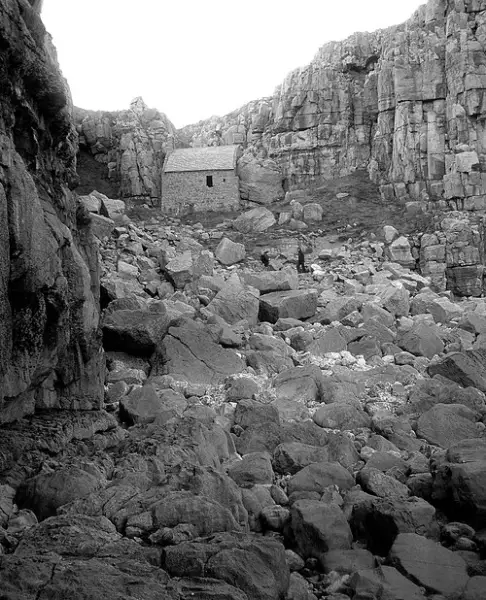
St. Govan was a hermit of the sixth century who made his dwelling in a narrow cleft halfway down a sea cliff near Bosherston, in what is now the Pembrokeshire Coast National Park in Wales. Tradition makes him an Irish monk, born about 500 in County Wexford, who went to Wales in his last years looking for the kin and companions of the master who had formed him — named in different tellings as St. David or St. Ailbe of Emly. The legends tell how pirates, from Ireland or from nearby Lundy Island, set upon him; the cliff opened to receive him, a crack barely broad enough to shelter his body until the raiders sailed away. Thankful for the deliverance, he remained on the cliff for the rest of his life, catching fish and drawing water from two nearby springs, and perhaps watching the sea to warn the locals of future raids. He died there in 586. In the 1200s a modest stone chapel with a vaulted roof rose above his cave on the headland that now bears his name, and the legends of his silver bell, his handprints in the cave floor, and his burial beneath the chapel altar still draw pilgrims to St. Govan's Head.
The Complete Life
The Monk from Wexford
The traditions agree that Govan came from Ireland, born around the year 500 in County Wexford, and that he was formed in monastic life before he ever saw the Welsh coast. One story sends him to Wales late in life on a mission of affection: to look for the kin and companions of the master who had formed him, whom the legends name either as St. David himself, the patron of Wales, or as St. Ailbe of Emly. Another and wilder tradition dissolves the historical monk altogether, identifying Govan with Sir Gawain, one of King Arthur's Knights of the Round Table, said in Welsh legend to be the son of Caw — Hueil mab Caw, the Pictish rival of Arthur — and to have withdrawn into seclusion as old age came upon him. Behind the legendary accretions stands a figure the Church has always remembered the same way: a man of the sixth century who left his native Ireland, crossed to Pembrokeshire, and gave the remainder of his life to God in solitude upon the sea cliff at what is now called St. Govan's Head.
§ Legends
The Cliff That Opened
The legend that fixed Govan's dwelling place belongs to the age of pirates. Raiders from Ireland or from the nearby island of Lundy set upon the hermit as he stood by the sea, and no refuge appeared — until the cliff itself opened before him, leaving a fissure just large enough for a man to hide in, and closed the pursuit away until the pirates gave up and departed. Govan read the cleft in the rock as providence and resolved never to leave it. He took up residence within a small cave in the fissure, where he lived the remainder of his days, catching fish from the sea and drinking from a pair of springs close at hand — one beneath the spot the later chapel occupies, the other nearer the shore, which in time became a holy well. The legends add a motive beyond gratitude: he stayed, probably, to help warn the local people of impending pirate attacks should the raiders return. The hermit thus became the coast's watchman, his cell a beacon of prayer and vigilance set in the very wound the pirates' coming had opened in the rock.
§ Legends
Death in the Fissure
Govan died in his cliff-side retreat in the year 586, having spent his last decades in the cave above the sea. The traditions that survive of his end are small and vivid. His handprints, it is said, remain imprinted on the floor of the cave to this day, the marks of a body pressed in prayer against the living rock; and his body, the legends affirm, was buried beneath the altar of the chapel that later rose over his cell. The site itself tells of a memory kept alive through the generations: pilgrims reach the cave by an extended stair of stone, whose steps are famously counted differently on the way up than on the way down, and the grotto long served as a favored spot where visitors came to wish — the residue, perhaps, of older devotions at the hermit's grave. He died as he had lived, hidden from the world in a fissure of the Pembrokeshire coast, remembered by the fishermen and farmers of the headland as their watchman against the sea raiders and their intercessor before God.
§ Legends
Chapel and Bell Rock
The hermitage became a shrine. Over Govan's cave there was raised in the thirteenth century the small vaulted chapel of local limestone that still clings to the fissure on St Govan's Head, though the site may have held monastic importance since the fifth century. The richest legend attached to his cult concerns his silver bell, which he was said to keep in the chapel tower and whose peal rang with perfect tone and clarity. Pirates, hearing it, stole the bell and left the saint desolate — but angels flew in, wrested it from the thieves, and returned it to the hermit; and to keep the pirates from taking it again, they encased the bell in a huge stone, the Bell Rock that lies at the water's edge below the cliff. When St. Govan rang the stone, the legend says, its vigour was a thousand times stronger. The chapel remains a place of pilgrimage, the holy well and the wish-granting cave keep their hold on local memory, and the saint is venerated in Celtic Christianity and the Eastern Orthodox Church, his feast observed on 26 March.
§ The Bell Rock
Timeline
- 500
Born in County Wexford, Ireland, around the beginning of the sixth century
§ Introduction
- 586
Died at his hermitage in the cliff fissure near Bosherston, Pembrokeshire, where his body is said to lie beneath the chapel altar
§ Introduction
- 1200
The small vaulted chapel of local limestone now known as St Govan's Chapel was built over his cave in the thirteenth century
§ Legends
The Record
- Symbols
- Celtic Rite
- Canonization
- Pre-congregation; venerated in Celtic Christianity and the Eastern Orthodox Church
Prayer
Bibliography
Show 6 sources
- "St Govan's Chapel". Monkton Rectorial Benefice, Anglican (Episcopalian) Church in Wales, Diocese of St Davids.
- Manners, Sarah (25 September 2008). "The holy wells of Wales". Western Mail.
- Gwyndaf, Robin (1989). "Capel Sant Gofan (Saint David's Chapel), Dyfed". Welsh Folk Tales (2nd ed.). National Museum Wales. p. 84. ISBN 0-7200-0326-1.
- "St Govan". Saints & Angels. Catholic Online.
- Holden, Luke. "Pilgrimage to Saint Govan's Chapel, South Wales". Orthodox Christian Contact Wales.
- Richard Keen and Ian Burgum, pg. 111, Wales. Orion Publishing Group (1997).
Profile text adapted from the Wikipedia article, licensed CC BY-SA 4.0.
Pray with this saint every day
Save St. Govan to your favorites, read the full profile, and get feast-day reminders in the Saints app.
Get the Saints AppFree on the App Store for iPhone and iPad