
1901 – 1918·Feast July 17
St. Anastasia Nikolaevna
Youngest daughter of the last Tsar, passion bearer
Overview
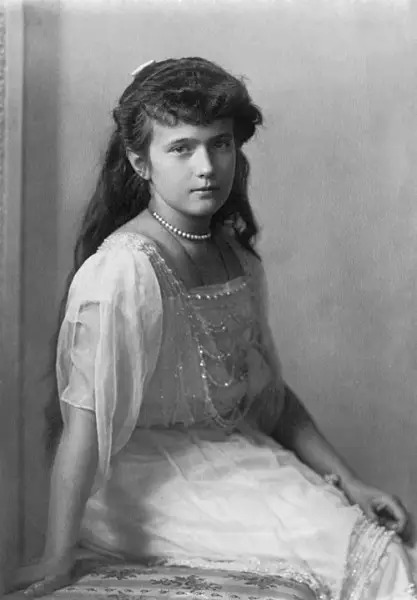
Grand Duchess Anastasia Nikolaevna of Russia, born 18 June 1901 at Peterhof Palace, was the youngest daughter of Tsar Nicholas II and Tsarina Alexandra Feodorovna, the fourth of their five children, the younger sister of Olga, Tatiana, and Maria, and the elder sister of Tsarevich Alexei. Raised with striking simplicity for an imperial child — camp cots, cold baths, needlework for charity — she grew into the family's celebrated comic spirit: lively, mischievous, and gifted as an actress, though her pranks often outran palace decorum. During the First World War she and Maria, too young to train as nurses, cheered wounded soldiers with games at a hospital at Tsarskoye Selo. The Revolution of 1917 turned her world into a prison: house arrest at the Alexander Palace, exile to Tobolsk in Siberia, and finally confinement with her family in the Ipatiev House at Yekaterinburg. There, on 17 July 1918, she was shot with her parents, her sisters, her brother, and their faithful servants. For decades her fate fed the most famous survival legend of the twentieth century, sustained by impostors such as Anna Anderson, until DNA testing proved conclusively that she died with her family. The Orthodox Church numbered her among the new martyrs, canonizing her in 1981 and again, as a passion bearer, in 2000.
The Complete Life
The Merry Little One of Peterhof
Anastasia arrived at Peterhof Palace on 18 June 1901, the fourth daughter born to Nicholas II and Alexandra — and the household received her with open disappointment, for the empire had been hoping for a boy to secure the succession. Her aunt Xenia exclaimed at the news of yet another girl; her father took a long solitary walk before he could bring himself to visit his wife and newborn. The disappointment did not last. Named for a fourth-century martyr, and nicknamed within the family Malenkaya, little one, or Shvybzik, merry little one, she became the clown and the spark of the nursery. The four sisters, signing themselves collectively OTMA from the letters of their names, slept on hard camp cots, took cold baths, and made needlework for charity bazaars; Anastasia and Maria, the Little Pair, shared a room and dresses. Tutors and ladies-in-waiting described her as lively, mischievous, and a gifted actress whose wit sometimes struck sore spots. Gleb Botkin judged that she held the family record for punishable deeds, a genius of naughtiness who rolled rocks into snowballs, climbed trees and refused to descend, and once ate chocolates at the opera without removing her long white gloves.
§ Early years
A Grand Duchess in Wartime
Whatever vocation meant for a daughter of the last Tsar, Anastasia lived it out in the idiom of service her parents imposed: simplicity, duty, and care for others dressed in plain clothes. When the First World War broke out, she and Maria were not yet old enough to train as Red Cross nurses alongside their mother and elder sisters, so they took the work they could: visiting wounded soldiers daily at a private hospital in the grounds of Feodorovsky Gorodok at Tsarskoye Selo, playing checkers and billiards with the men, and trying to lift their spirits. A wounded officer who knew her there remembered her laugh as being like a squirrel's and her quick, tripping walk. The work suited her temperament — performance, warmth, and fun deployed against pain — and it was the closest thing to a public career her short life contained. When the war widened into revolution, that same playful courage carried her family: in the last spring at Tobolsk she acted in plays that made the whole household howl with laughter, and even in the Ipatiev House she darned stockings, helped the cook bake bread, and whispered with the cleaning women when the guards were not watching.
§ Captivity during World War I and Russian Revolution
Cheering the Wounded, Lightening the Cell
Anastasia's mission, if the word may be used of a seventeen-year-old, was the ministry of cheer. At the soldiers' hospital she did what the solemn cannot: she made broken men laugh, and the wounded remembered her for it years afterward. One of the guards at Yekaterinburg recalled her as very friendly and full of fun, miming comic performances with the dogs as though in a circus; another called her a very charming devil, rarely tired, though a third found her provocative comments a source of tension in the ranks. In captivity she kept the family's morale alive by force of personality — playing, joking, and on one famous occasion sticking her tongue out at Yakov Yurovsky, commander of the guard, the moment his back was turned. Her letters from Tobolsk show the same deliberate brightness: describing a fall from a swing, she wrote that she had roared with laughter and could tell the story masses of times, that the weather was so fine one could simply shout with joy. The melancholy theme she composed for her English tutor on Browning's Evelyn Hope — a girl who died at sixteen, loved by a man who never told her — betrays what lay beneath the laughter: a frightened adolescent refusing to let fear win.
§ Captivity during World War I and Russian Revolution
Faith in the Shadow of Our Friend
Anastasia was raised in the Orthodox faith of her parents, and her short spiritual life cannot be separated from the figure of Grigori Rasputin, the peasant starets whom her mother relied upon and credited with saving the hemophiliac Tsarevich again and again. The children were taught to call him Our Friend; the four were presented to him in their nightgowns in the autumn of 1907, and an aunt recalled that they were completely at ease with him. Rasputin telegrammed the children counsels of love for God's creation, and his murder in December 1916 left the sisters visibly distraught; Anastasia attended his funeral with an icon signed by the family, and after the executions the girls were found to be wearing amulets bearing his picture and a prayer. Whatever judgment history passes on Rasputin, Anastasia's own faith showed itself most purely in her final summer. At a private church service in Yekaterinburg on 14 July 1918, the entire household, breaking with custom, sank to its knees at the prayer for the dead; the priests observed that the girls had sunk into despondency and hopelessness, no longer singing the responses, and one whispered to the other that something had happened to them. Three days later they were dead. Her name, meaning of the resurrection, was the family's quiet prophecy.
§ Association with Grigori Rasputin
From Tobolsk to the Ipatiev House
The last sixteen months of Anastasia's life were a single slow descent. In February 1917 the family was placed under house arrest at the Alexander Palace; Nicholas abdicated in March; and as the Bolsheviks closed in, Kerensky moved them to the Governor's Mansion at Tobolsk in Siberia. There Anastasia wrote her goodby to a friend — don't forget us — and studied her English tutor's chosen poem with its eerie fit to her own fate. In the spring of 1918 the family was transferred to the Ipatiev House at Yekaterinburg, the House of Special Purpose; witnesses remembered the grand duchesses stumbling through the rain under piles of luggage. Even there she found amusement, performing plays, joking with the guards, helping the servants. In July the end came quickly: at a church service on 14 July the family knelt at the prayer for the dead and would not sing; the next day the sisters in good spirits helped scrub the bedroom floor. On the night of 17 July 1918 the household was awakened, herded into a basement room, and shot. Diamonds sewn into the girls' corsets deflected the first bullets; Anastasia and Maria crouched against a wall covering their heads until they were shot down. She was seventeen years and one month old.
§ Death
Passion Bearer of Yekaterinburg
The Church's judgment on Anastasia came in two acts. In 1981 the Russian Orthodox Church Abroad, gathering the new martyrs of the Bolshevik terror, canonized the imperial family as holy martyrs. In 2000 the Moscow Patriarchate followed with its own canonization of the family as passion bearers — a distinct Orthodox title for those who faced death with Christ-like meekness and without resistance, imitating the patience of the Lord in his passion rather than dying expressly for the faith. Under either title her feast is kept on 17 July, the anniversary of the murders. Her major shrine is the Church on Blood, raised at Yekaterinburg on the site of the Ipatiev House. The Church's act completed what the earth had begun to reveal: the family whose execution no court had judged and whose bodies lay acid-stained in a mineshaft for three-quarters of a century were now honored at the altar. For Anastasia personally, the canonization also closed the strange second life of her legend — the impostors, the films, the novels — with the sober fact that the merry youngest daughter had gone to her death with her family and now intercedes with them as one of the passion bearers of Russia's twentieth-century catastrophe.
§ Sainthood
The Legend That Would Not Die
No member of the murdered imperial family cast so long a shadow as Anastasia, precisely because two of the bodies stayed missing for so long. The empty grave fed one of the twentieth century's great mysteries: no fewer than ten women came forward claiming to be her, the most famous being Anna Anderson, whose recognition case ran from 1938 to 1970, the longest in German judicial history, and whose cremated remains were shown by DNA testing in 1994 to be unrelated to the Romanovs — matching instead a missing Polish factory worker. Rumors of escapes, telegrams from the German government demanding news of the German-blooded princesses, and a 1997 animated film fixed the legend in the popular imagination. Science ended it. The family grave outside Yekaterinburg, excavated in 1991 after nearly a decade hidden from the Communists, yielded nine of eleven bodies; the interment of the remains at Saints Peter and Paul Cathedral followed on 17 July 1998, eighty years to the day after the murders. In August 2007 archaeologists found the burned remains of a boy and a girl at a bonfire site, and by 2009 international DNA testing had accounted for all five children. The girl of the legend was dead all along; the passion bearer of the Church remains.
§ Romanov graves and DNA proof
Timeline
- 18 Jun 1901
Born at Peterhof Palace, the last-born of the four daughters of Nicholas II and Alexandra.
§ Early years
- 1914
During the First World War, visited wounded soldiers with her sister Maria at a private hospital at Tsarskoye Selo, playing checkers and billiards to raise their spirits.
§ Captivity during World War I and Russian Revolution
- 21 Dec 1916
Attended the funeral of Grigori Rasputin, murdered six days earlier; she and her sisters later were found wearing amulets bearing his picture.
§ Association with Grigori Rasputin
- Feb 1917
Placed under house arrest with her family at the Alexander Palace in Tsarskoye Selo during the Russian Revolution.
§ Captivity during World War I and Russian Revolution
- 15 Mar 1917
Her father Nicholas II abdicated, ending the imperial life she had known.
§ Captivity during World War I and Russian Revolution
- 1917
On Kerensky's orders the family was moved to the Governor's Mansion at Tobolsk in Siberia.
§ Captivity during World War I and Russian Revolution
- 7 May 1918
Wrote from Tobolsk to her sister Maria a letter describing laughter on a swing amid loneliness and worry for the sick Alexei.
§ Captivity during World War I and Russian Revolution
- 1918
Moved with her family to the Ipatiev House, the House of Special Purpose, at Yekaterinburg.
§ Captivity during World War I and Russian Revolution
- 14 Jul 1918
At a private service held by local priests, the whole family knelt in prostration at the prayer for the dead, and the girls, sunk in despondency, no longer sang the replies.
§ Captivity during World War I and Russian Revolution
- 17 Jul 1918
Shot with her family and servants in the basement of the Ipatiev House by Bolshevik executioners.
§ Death
- 1981
Canonized as a holy martyr by the Russian Orthodox Church Abroad.
§ Sainthood
- 1991
The presumed family grave outside Yekaterinburg was excavated; nine of eleven expected sets of remains were found.
§ Romanov graves and DNA proof
- 17 Jul 1998
The remains of her parents and three sisters were interred at Saints Peter and Paul Cathedral in St Petersburg, eighty years after the murders.
§ Sainthood
- 23 Aug 2007
Russian archaeologists announced the discovery of the burned partial remains of a boy and a young woman near Yekaterinburg.
§ Romanov graves and DNA proof
- 2009
International DNA testing confirmed the remains were those of Alexei and one of his sisters, proving all five children died in 1918.
§ Romanov graves and DNA proof
In Their Own Words
We played on the swing, that was when I roared with laughter, the fall was so wonderful! Indeed! I told the sisters about it so many times yesterday that they got quite fed up, but I could go on telling it masses of times ... What weather we've had! One could simply shout with joy.
Goodby... Don't forget us.
The Record
- Major works
- Wartime visits and games with wounded soldiers at the Feodorovsky Gorodok hospital at Tsarskoye Selo·Needlework made for sale at charity events
- Canonization
- Canonized 1981 by the Russian Orthodox Church Abroad as a holy martyr; canonized 2000 by the Russian Orthodox Church as a passion bearer
Prayer
Bibliography
Show 7 sources
- Massie, Robert K. (1967). Nicholas and Alexandra. New York: Dell Publishing Co. ISBN 0-440-16358-7
- Massie, Robert K. (1995). The Romanovs: The Final Chapter. New York: Random House. ISBN 0-394-58048-6
- Rappaport, Helen (2014). Four Sisters: The Lost Lives of the Romanov Grand Duchesses. Macmillan. ISBN 978-0-230-76817-8
- King, Greg; Wilson, Penny (2003). The Fate of the Romanovs. Hoboken, New Jersey: John Wiley and Sons, Inc. ISBN 0-471-20768-3
- Radzinsky, Edvard (1992). The Last Tsar. New York: Doubleday. ISBN 0-385-42371-3
- Kurth, Peter (1983). Anastasia: The Riddle of Anna Anderson. Boston: Back Bay Books. ISBN 0-316-50717-2
- Coble, Michael D. et al. (2009). "Mystery Solved: The Identification of the Two Missing Romanov Children Using DNA Analysis". PLOS ONE. 4 (3) e4838
Profile text adapted from the Wikipedia article, licensed CC BY-SA 4.0.
Pray with this saint every day
Save St. Anastasia Nikolaevna to your favorites, read the full profile, and get feast-day reminders in the Saints app.
Get the Saints AppFree on the App Store for iPhone and iPad