
1899 – 1918·Feast July 17
St. Maria Nikolaevna
Third daughter of the last Tsar, passion bearer
Overview
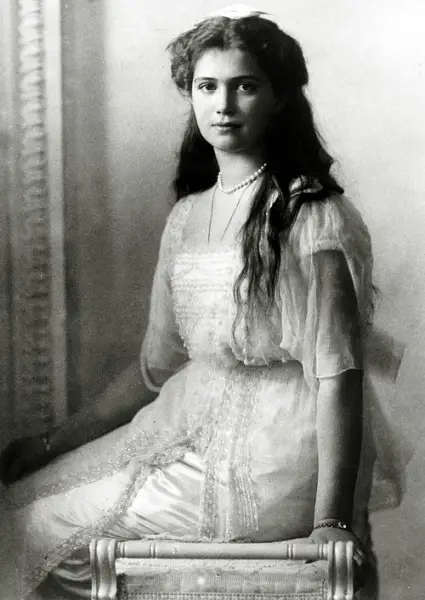
Grand Duchess Maria Nikolaevna of Russia, born 26 June 1899 at Peterhof Palace, was the middle of the five children of Tsar Nicholas II and Tsarina Alexandra Feodorovna, and their third daughter. Too young during the First World War to train as a Red Cross nurse like her mother and elder sisters, she served as patroness of a hospital and spent her days with wounded soldiers, playing games and listening to them; her interest in the men of the army ran from her earliest childhood and ripened into innocent crushes and dreams of marrying a Russian soldier and raising a large family. Observers remembered her as the beauty of the family, with enormous blue eyes and her grandfather Alexander III's startling strength, but above all as gentle: her governess declared she was born good, and the family called her the Amiable Baby. When revolution came, her warmth did not fail — she supported her mother in the dangerous streets of March 1917, and in captivity she learned her guards' names and their wives' stories, reproving coarseness with dignity while remaining friendly with the men. She followed her parents to Yekaterinburg in April 1918 and was shot with them in the Ipatiev House on 17 July 1918, aged nineteen. The Orthodox Church canonized her as a passion bearer among the Romanov new martyrs.
The Complete Life
The Amiable Baby of the Nursery
Maria was born on 26 June 1899, a sturdy baby of four and a half kilograms, and her arrival as a third daughter disappointed a country waiting for an heir — though her father insisted he was happy, writing to his wife of three little cherubs. Among the four OTMA sisters she belonged, with Anastasia, to the Little Pair, sharing a room and matching dresses with the sister who dominated her; when Anastasia tripped the servants or staged a scene, it was Maria who trailed behind offering apologies. Her nature was the counterweight to the nursery's high spirits. Her governess judged that she was born good, with the smallest trace of original sin imaginable, and her sisters teasingly called her their stepsister because she never got into trouble; when she once stole biscuits from the tea table, her relieved father joked that he had feared the wings were growing. Grand Duke Vladimir Alexandrovich named her the Amiable Baby. She adored her father, kissing his miniature portrait nightly during his typhoid fever, loved children and soldiers from her earliest years, possessed her grandfather Alexander III's strength — amusing herself by lifting her tutors off the ground — and drew skillfully with her left hand, though she found schoolwork tedious.
§ Early life
Patroness of Soldiers
Maria's vocation, in the narrow years the revolution allowed her, was the care of soldiers. Too young for nurse's training when the war began, she was made patroness of a hospital and, with Anastasia, went daily to the wards at Tsarskoye Selo, where the two teenagers played checkers and billiards with the wounded and tried to lift their morale. A convalescent named Dmitri signed her commonplace book with the affectionate nickname the famous Mandrifolie. She also visited a nurses' school to help tend children, writing to her father that she thought of him as she fed the little ones and cleaned the gruel from their chins. Her love of the army was lifelong and disarming: at four she had watched a regiment march past and cried out that she would like to kiss every soldier, and she grew up collecting guileless infatuations with the young men around her — an officer at the Tsar's headquarters at Mogilev whom she jokingly styled herself Mrs. Demenkov to write about, and even her cousin Louis Mountbatten, who kept her photograph by his bed until his own assassination in 1979. Had she not been a grand duchess, she said, she would have wed a soldier of Russia and brought up a houseful of children. The wish was the plainest statement of who she was: a girl made for ordinary love, not for a throne.
§ Early life
Gentleness as Apostolate
The revolution put Maria's gift to its hardest test, and it held. In March 1917, still well while her sisters lay sick with measles, she was her mother's mainstay, walking out with Alexandra on the night of 13 March to plead with the soldiers to stay loyal; shortly afterward she nearly died of measles and virulent pneumonia, asking in her delirium only to be up when Papa came home. In captivity she practiced what can only be called an apostolate of friendliness, learning her guards' names and details of their wives and children, showing them her photograph albums, and speaking of her hope for a new life in England. At the Ipatiev House a sentry remembered her as a girl who loved to have fun, opening conversations with a guessing game about the name of a dog. Her friendliness had limits drawn by conscience: when one guard forgot himself with an off-color joke, she faced him down with the words that a well-born woman cannot be wooed by shameful witticisms, and that they must be refined, respectable men before they could get along. She chose, with her parents, to be the one sent ahead to Yekaterinburg in April 1918 — a decision the sisters made among themselves, judging Olga too fragile, Tatiana needed at the invalid brother's side, and Anastasia too young.
§ Revolution and captivity
Our Friend and the Prayer for the Dead
Maria's religious formation was that of all the imperial children: Orthodox observance, and the strange, fateful presence of Grigori Rasputin in the family's devotional life. Her mother credited the wandering starets's prayers with saving the hemophiliac Tsarevich again and again, and the children were taught to treat him as Our Friend, sharing confidences with him. He wrote the nine-year-old Maria tender telegrams — My Dear Pearl M, I miss your simple soul — and charged her to carry her cross with wisdom and joy in Christ, telling her the world was like the day with evening already falling. The association scandalized a court fed by rumors, dismissed governesses, and pornographic cartoons; every account agreed his dealings with the children were wholly innocent, yet the whispers pursued the family to the end. Maria's own piety showed itself at the last. On 14 July 1918, when local priests came to the Ipatiev House for a private service, the family, breaking every custom, sank down on their knees at the prayer for the dead, as though the household already knew it was praying for itself. The next morning the sisters were in good spirits again, joking as they helped the cleaning women scrub the floor. Three days later she was dead, and the Church now counts her simple soul among the passion bearers.
§ Relationship with Rasputin
The Cellar at Yekaterinburg
Maria's final weeks passed under the wooden fence of the Ipatiev House, watching the family's world contract. She joked with the sentries, strolled the garden beside her father and sisters on the afternoon of 16 July, and ate her last dinner unaware while Yakov Yurovsky removed the kitchen boy Leonid Sednev from the house — a sign the family could not read but felt. Late that night the household was awakened, told that unrest in the town required their removal, and brought down to the basement carrying pillows; they paused to cross themselves before the stuffed bear on the landing. Yurovsky arranged them as a photographer might and read the sentence of execution. In the first volley the Tsar, the Empress, and two servants fell. Maria, who had stood behind her mother, turned and tried the rear doors, but they were nailed shut; the rattling drew the fire of the drunken commissar Peter Ermakov, whose bullet struck her thigh. She fell with Anastasia and the maid Demidova and lay moaning in the gun smoke until Ermakov returned to finish the wounded. What he did next is disputed in every detail — bayonet, scalp wound, shot in the head — but her skull bears no bullet wound, and one of the sisters may have regained consciousness screaming as the bodies were carried out. She was nineteen.
§ Death
Passion Bearer of the Romanovs
The Orthodox Church received Maria among the saints in the same double act as her family. In 1981 the Russian Orthodox Church Abroad canonized the murdered imperial household as holy martyrs; in 2000 the Moscow Patriarchate canonized them as passion bearers, the gentler title it uses for the Romanov saints — those who met a Christless death with meekness and forgiveness rather than dying, strictly speaking, for refusing to deny the faith. Her feast falls on 17 July, the day of the executions, and her major shrine is the Church on Blood at Yekaterinburg, built over the demolished Ipatiev House. For Maria the canonization carried a peculiar modern burden: for decades her remains were the object of scientific contention and conspiracy theory. Russian and American experts argued over which daughter was missing from the 1991 grave; when the 2007 bonfire remains were identified as Alexei and a sister, the laboratories disagreed over whether the sister was Maria or Anastasia. In September 2015 her remains and Alexei's were to be buried with the family, but the Russian Orthodox Church took custody of them that December, required further study, and has kept the forty-four bone fragments in a state repository since. The saint is honored; the sister is not yet at rest beside her parents.
§ Sainthood
Survivors Who Never Were
Because Maria's body was missing from the grave found in 1991, her name became a second focus of the Romanov survival legends, alongside Anastasia's. Conspiracy theorists pointed to the minutes when the bodies lay unattended, and to the guards sympathetic to the grand duchesses who were left with them. One Alex Brimeyer passed himself off as the drowned duchess's grandson under the style Alexis d'Anjou de Bourbon-Condé Romanov-Dolgoruky, inventing an escape to Romania and a granddaughter named Olga-Beata; a Belgian court sentenced him to eighteen months in prison after the Dolgoruky family sued him in 1971. Two young women presenting themselves as Maria and Anastasia were sheltered by a priest in the Urals in 1919; they lived out their lives as nuns, dying in 1964 and being buried under the sisters' names. As late as 2004 Gabriel Louis Duval published a book arguing his foster grandmother Granny Alina was Maria, though her exhumed DNA proved too degraded to settle anything. Science ended the speculation: the 2007 discoveries and the DNA work published in March 2009 accounted for every member of the family, exactly as historians had always insisted. What survives of Maria herself is quieter — three diaries, watercolors, letters signed Mrs. Demenkov — and the verdict of those who knew her: she was born good.
§ Claims of survival
Timeline
- 26 Jun 1899
Born at Peterhof Palace, the middle child and third daughter of Nicholas II and Alexandra Feodorovna.
§ Early life
- 1907
Presented with her sisters and brother in the nursery to Grigori Rasputin, whom the children were taught to call Our Friend.
§ Relationship with Rasputin
- Dec 1914
Hemorrhaged during a tonsil operation, leading her aunt to believe all four sisters were carriers of the hemophilia gene.
§ Relationship with Rasputin
- 1915
She and Anastasia visited wounded soldiers at the hospital in the village of Feodorovsky Gorodok, where all four of the OTMA sisters served daily during the war.
§ Early life
- 21 Dec 1916
Attended the funeral of Grigori Rasputin, murdered four days earlier; her family intended to erect a church at his resting place.
§ Relationship with Rasputin
- 13 Mar 1917
Accompanied the empress into the streets on the night of 13 March to beg the troops to stay true to the ruling house.
§ Revolution and captivity
- 1917
Fell ill with measles and virulent pneumonia after the abdication and nearly died, learning of her father's abdication only as she recovered.
§ Revolution and captivity
- Apr 1918
Burned most of her letters and diaries with Anastasia, fearing searches; she was chosen to accompany her parents to Yekaterinburg while the others stayed in Tobolsk.
§ Revolution and captivity
- 2 May 1918
Wrote to her siblings in Tobolsk of her unease at the tighter restrictions at the Ipatiev House.
§ Revolution and captivity
- 14 Jul 1918
At a private church service in Yekaterinburg, fell to her knees with her family during the prayer for the dead, contrary to custom.
§ Revolution and captivity
- 17 Jul 1918
Shot in the Ipatiev House basement with her family and servants in the early hours of 17 July 1918, aged nineteen.
§ Death
- 1981
Canonized as a holy martyr by the Russian Orthodox Church Abroad.
§ Sainthood
- 1991
The Romanov grave outside Yekaterinburg was exhumed and found to hold only nine of eleven expected sets of remains; Russian experts argued hers was among the missing.
§ Romanov graves and DNA proof
- 2000
Canonized as a passion bearer by the Russian Orthodox Church with her whole family.
§ Sainthood
- 23 Aug 2007
Discovery announced of burned partial remains of a boy and a young woman at a bonfire site near Yekaterinburg.
§ Romanov graves and DNA proof
- 2009
Published DNA results confirmed the 2007 remains belonged to Alexei and one of his sisters, proving the entire imperial family died in 1918.
§ Romanov graves and DNA proof
- 2015
A planned October burial of her remains alongside her family was postponed indefinitely after the Russian Orthodox Church took custody of them for further study.
§ Romanov graves and DNA proof
In Their Own Words
Why are you not disgusted with yourselves when you use such shameful words? Do you imagine that you can woo a well-born woman with such witticisms and have her be well disposed towards you? Be refined and respectable men and then we can get along.
Oh, how complicated everything is now... We lived so peacefully for eight months and now it's all started again.
Oh, I did so want to be up when Papa comes
The Record
- Major works
- Patroness of a hospital and daily visits to wounded soldiers at Tsarskoye Selo during the war·Care for children at a nurses' school during the war·Three surviving diaries (1912, 1913, and 1916) and watercolor sketches
- Canonization
- Canonized 1981 by the Russian Orthodox Church Abroad as a holy martyr; canonized 2000 by the Russian Orthodox Church as a passion bearer
Prayer
Bibliography
Show 7 sources
- Massie, Robert K. (1967). Nicholas and Alexandra. Dell Publishing Co. ISBN 0-440-16358-7
- Massie, Robert K. (1995). The Romanovs: The Final Chapter. Random House. ISBN 0-394-58048-6
- Rappaport, Helen (2014). The Romanov Sisters: The Lost Lives of the Daughters of Nicholas and Alexandra. St. Martin's Griffin. ISBN 978-1250067456
- King, Greg and Wilson, Penny (2003). The Fate of the Romanovs. John Wiley and Sons, Inc. ISBN 0-471-20768-3
- Azar, Helen and Hawkins, George (2019). Maria Romanov: Third Daughter of the Last Tsar, Diaries and Letters, 1908-1918. Westholme Publishing. ISBN 978-1594163227
- Kurth, Peter (1983). Anastasia: The Riddle of Anna Anderson. Back Bay Books. ISBN 0-316-50717-2
- Coble, Michael D. et al. (11 March 2009). "Mystery Solved: The Identification of the Two Missing Romanov Children Using DNA Analysis". PLOS ONE. 4 (3) e4838
Profile text adapted from the Wikipedia article, licensed CC BY-SA 4.0.
Pray with this saint every day
Save St. Maria Nikolaevna to your favorites, read the full profile, and get feast-day reminders in the Saints app.
Get the Saints AppFree on the App Store for iPhone and iPad