
1895 – 1918·Feast July 17
St. Olga Nikolaevna
Eldest daughter of the last Tsar, passion bearer
Overview
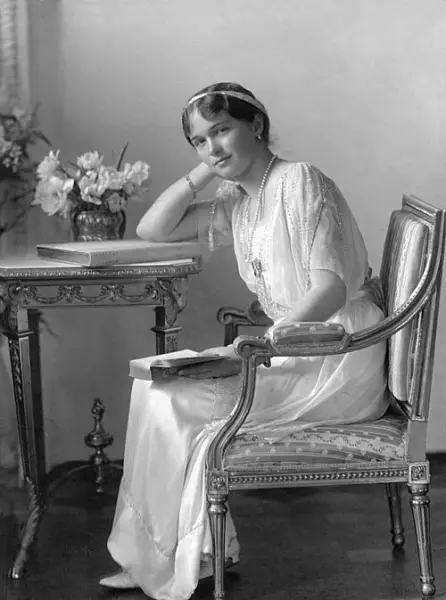
Grand Duchess Olga Nikolaevna of Russia, born 15 November 1895 at the Alexander Palace, was the first child of Emperor Nicholas II and Empress Alexandra Feodorovna and the eldest of the four sisters who signed themselves OTMA. Clever, musical, and direct, with what her French tutor called a remarkably quick brain and a gift for repartee, she was the family's thinker — courtiers judged that she grasped the empire's peril better than anyone, her parents included. Before the birth of her brother Alexei, rumors said her father might name her heir, and Europe speculated over her marriage for years; she answered that she hoped to wed one of her own people and never leave her homeland. During the First World War she trained as a Red Cross nurse, working beside her mother and sister Tatiana in a military hospital at Tsarskoye Selo until the sight of mangled men broke her health and she was moved to office duties and ward supervision. Arrested with her family in 1917, exiled to Tobolsk and then Yekaterinburg, she sank into a depression her guards could read in her face, yet her captivity notebooks filled with prayers for patience and the forgiveness of enemies. She was shot in the Ipatiev House on 17 July 1918, aged twenty-two, and the Orthodox Church numbers her among the passion bearers.
The Complete Life
Firstborn of the Last Emperor
Olga was born on 15 November 1895 after thirteen hours of labor, delivered with forceps, a robust baby of four and a half kilograms whom her father said did not look like a newborn. Unlike the arrivals of her younger sisters, her birth was met with joy: Nicholas declared that a girl belonged to her parents rather than to the people, and the empress called her simply a gift from God. Queen Victoria, one of her godmothers, pronounced the baby magnificent when the family toured Scotland, France, and Darmstadt in 1896, and French crowds shouted Vive la bebe at her. Her childhood was deliberately plain — camp cots, cold baths, servants addressing her as Olga Nikolaevna — and she grew up as half of the Big Pair with Tatiana, the sister to whom she was most often paired. In 1900, when her father lay near death with typhoid, her mother pressed unsuccessfully to alter the succession so that Olga, not her uncle Michael, would inherit the empire. Two deaths marked her early inner life: in November 1903 her little cousin Elisabeth died of typhoid at the family's Polish estate, and eight-year-old Olga, who asked whether God had sent for the child's body to keep Christmas with Him, began her lifelong fascination with heaven. She idolized her father and wore an icon of St. Nicholas against her chest.
§ Early life
The Red Cross Nurse
When war came in 1914, Olga, then eighteen, chose the hardest available work: she trained as a Red Cross nurse and, together with Tatiana and her mother, nursed wounded men at the military hospital attached to Tsarskoye Selo. It was an education in everything her sheltered upbringing had omitted — her first sight of gunshot wounds, her first friendships with ordinary Russian women whose children's names and family stories she came to know, and even, on one liberated afternoon, a failed attempt to buy something in a shop, for the imperial daughters had never handled money. The sisters received a small monthly salary and spent it on perfume and notepaper like any young women. But the operating theater exacted its price. The sensitive, moody Olga, who had already witnessed the assassination of the minister Stolypin from the imperial box at the Kiev Opera at fifteen, broke under the accumulating horror of dying men: in September 1915 she smashed window panes in a caprice, in a rage she destroyed items in a cloakroom, and on 19 October 1915 she was reassigned to office work, receiving the arsenic injections then used for nervous disorders. She gave up surgery and afterward only supervised the wards, having overtired herself into nervousness and anemia. Her vocation had been real; her strength, like the empire's, was not infinite.
§ Early adulthood and World War I
Compassion Without Calculation
Long before the war tested it, Olga's compassion showed itself as the trait all her observers noted first. As a small child she saw a girl weeping by the road and threw her own doll from the carriage window to comfort her. Baroness Buxhoeveden remembered that an appeal to Olga met with immediate response — she would say that poor so-and-so must somehow be helped, and that she must be the one to do it. At twenty she took charge of a portion of her considerable fortune and began giving independently: encountering a child on crutches whose parents could not afford treatment, she set aside a regular allowance to pay the medical bills. A court official judged that by young womanhood her disposition had become even and good, kindly to the point of the angelic. The kindness persisted past the point of prudence. Aboard the ship Rus in May 1918, exiled under guard toward her death, she saw a sentry slip from a ladder and hurt his foot, ran to him, explained that she had been a war nurse, and asked to examine the wound; he refused, and she fretted over her poor fellow all afternoon. At the Ipatiev House, while her own health failed, she took her turn amusing the bedridden Alexei and keeping her mother company.
§ Appearance and personality
Our Friend, and the Burden of Knowing
Olga's religious world, like her sisters', was shaped by the hemophilia of her brother and by the peasant starets Grigori Rasputin, whose prayers her mother credited with repeatedly saving the boy's life. Presented to him in the nursery in 1907 with the other children in their white nightgowns, she was taught to call him Our Friend and to confide in him. But Olga grew up, and her faith in Our Friend did not. As she matured she became less inclined to see Rasputin as a friend and more aware of what his closeness to her parents was doing to the stability of the country; she was the only one of the sisters, the record suggests, who measured him politically. When Rasputin was murdered in December 1916 by a circle that included her own cousin Grand Duke Dmitri Pavlovich, she wrote in her diary that she suspected Dmitri of killing Father Grigory, and she told her fellow nurse Chebotareva in February 1917 that while the killing might have been necessary, such horror was no way to carry it out — adding that she was ashamed the murderers were her relatives. After the executions, the Bolsheviks found that Olga, like her sisters, wore an amulet with Rasputin's picture and a prayer. Hers was an unillusioned piety: prayer without pretending, forgiveness without amnesia.
§ Relationship with Grigori Rasputin
The Gloom Before the End
The revolution struck Olga harder than any of her family, those who knew her agreed; all her bright spirits disappeared. Imprisoned with measles and then pleurisy at Tsarskoye Selo in 1917, she turned to paper: a poem for the mother with whom her relations had often been strained, telling her she was relentless only toward herself; a letter relaying her father's plea to remember that only love, not evil, conquers evil; and the notebook prayer asking God for patience in stormy days, strength to forgive, and the meekness to pray for enemies at the grave's threshold. Among her effects was Rostand's L'Aiglon, the story of a deposed emperor's loyal son — a deliberate emblem of her fidelity to her father. There was a report that Nicholas gave her a small revolver, hidden in a boot through the captivity at Tsarskoye Selo and Tobolsk, surrendered with reluctance to the family's sympathetic jailer before the transfer east. In the Ipatiev House she grew thin, pale, and deeply depressed, walking little and spending her hours with Alexei. On the night of 16-17 July 1918 the household was marched to the basement; as the sentence of execution was read, Olga and her mother tried to make the sign of the cross. She crouched against the rear wall clinging to Tatiana, and when the jewels sewn in their clothing turned the bayonets, a shot to the jaw ended her life at twenty-two.
§ Captivity and death
Passion Bearer of the Church on Blood
The Orthodox Church's verdict on Olga was rendered in two stages that framed her for two audiences. In 1981 the Russian Orthodox Church Abroad, the émigré church of those the revolution had scattered, canonized the imperial family as holy martyrs — a confession of faith made by exiles who saw in the regicide of 1918 the summit of the persecution that had driven them from Russia. In 2000 the Moscow Patriarchate, canonizing the same family after the fall of the Soviet Union, chose the title of passion bearers: saints who met violent death with the meekness of Christ, imitating his patience in passion, though not killed expressly for refusing to deny the faith. Olga's feast is kept on 17 July with her parents, sisters, brother, and servants; her major shrine is the Church on Blood at Yekaterinburg, raised on the site of the Ipatiev House. The Church's honor answered the testimony her final months had already given — the prayers for her enemies copied into her notebook, the attempted sign of the cross in the basement — and it made of the eldest daughter, the thinker who had seen the catastrophe coming more clearly than anyone, a patron for all who must face disaster without illusions and without despair. She had asked in her notebook for strength to forgive her neighbor's evil; the Church declares that the strength was given.
§ Sainthood
The Claimant on Lake Como and the Verdict of DNA
Because Olga was the eldest daughter and the one whose intelligence was most admired, the fantasy of her survival had its own career. A woman named Marga Boodts claimed for years to be the Grand Duchess, living in a villa on Lake Como and said to be supported by the former Kaiser Wilhelm II and even by Pope Pius XII; Prince Sigismund of Prussia, a nephew of the Empress, declared that he accepted her, though his mother did not. A defector named Michael Goleniewski went further, claiming the entire family had escaped. Historians dismissed them all, holding consistently that Olga died with her family, and the earth eventually confirmed them. Her remains were recovered with the others from the woods outside Yekaterinburg in 1991, identified through DNA comparison with maternal-line relatives including Prince Philip, and buried with state and church honors at Peter and Paul Cathedral on 17 July 1998, eighty years after the murders. The last two bodies, found burned at a bonfire site in 2007, were shown by the peer-reviewed DNA work published in March 2009 to be those of Alexei and a younger sister, closing the question of the whole family. What remains of Olga is her paper trail — diaries, the poem to her mother, the prayer for her enemies — the self-portrait of a mind that watched the flood rise and kept praying.
§ Romanov graves and DNA proof
Timeline
- 15 Nov 1895
Born at the Alexander Palace at Tsarskoye Selo after a difficult thirteen-hour labor, the first child of Nicholas II and Alexandra.
§ Early life
- 1896
Traveled with her parents to Scotland, France, and Darmstadt; Queen Victoria pronounced the baby magnificent and the French crowds cheered Vive la bebe.
§ Early life
- 1900
During her father's typhoid fever, her mother tried unsuccessfully to change the succession laws so that Olga could inherit the throne.
§ Early life
- Nov 1903
Her first cousin, Princess Elisabeth of Hesse, died of typhoid while visiting the family, and eight-year-old Olga first grappled with death and heaven.
§ Appearance and personality
- 1907
Met the starets Grigori Rasputin when her aunt was brought to the nursery; the children in their nightgowns seemed completely at ease with him.
§ Relationship with Grigori Rasputin
- 1910
Her governess Sofia Tyutcheva, horrified that Rasputin could visit the nursery, demanded he be barred; the Empress eventually dismissed her.
§ Relationship with Grigori Rasputin
- 1911
Watched from the imperial box at the Kiev Opera as the minister Pyotr Stolypin was assassinated before her eyes, aged fifteen.
§ Early adulthood and World War I
- Nov 1911
Livadia held a full dress ball marking her sixteenth birthday and her presentation to society, her hair put up for the first time.
§ Romances
- 1913
Lost her heart to Pavel Voronov, a young officer serving aboard the imperial yacht Standart, a hopeless attachment that ended with his engagement to a lady-in-waiting.
§ Romances
- Mar 1914
Met her prospective suitor, Crown Prince Carol of Romania, during his family's state visit to St Petersburg; neither showed any interest in the other.
§ Marriage prospects
- 1914
Trained as a Red Cross nurse and, alongside Tatiana and her mother, nursed wounded men at the military hospital within Tsarskoye Selo.
§ Early adulthood and World War I
- 19 Oct 1915
Assigned to office work at the hospital, no longer able to bear the operating theater; she received arsenic injections that month for her nerves.
§ Early adulthood and World War I
- 21 Dec 1916
Attended the burial of Grigori Rasputin, having written in her diary that she suspected Grand Duke Dmitri Pavlovich of the murder.
§ Relationship with Grigori Rasputin
- Apr 1917
Wrote her poem To My Beloved Mama while the family was imprisoned at Tsarskoye Selo after the revolution.
§ Captivity and death
- Apr 1918
The Bolsheviks moved her parents and Maria ahead to Yekaterinburg; Olga remained at Tobolsk with the hemophiliac Alexei and her other sisters.
§ Captivity and death
- May 1918
Boarded the ship Rus from Tobolsk to Yekaterinburg with her sisters, brother, and the remaining servants, after the parents and Maria had gone ahead.
§ Captivity and death
- 14 Jul 1918
At a private church service in the Ipatiev House, fell to her knees with her family during the prayer for the dead, contrary to custom.
§ Captivity and death
- 17 Jul 1918
Attempted the sign of the cross as the firing began in the Ipatiev House basement and was killed in the early hours of 17 July 1918, aged twenty-two.
§ Captivity and death
- 1981
Canonized as a holy martyr by the Russian Orthodox Church Abroad.
§ Sainthood
- 1991
A grave in woods near Yekaterinburg yielded remains that DNA testing would later identify as the Romanovs and their household.
§ Romanov graves and DNA proof
- 17 Jul 1998
Her remains, identified by DNA testing, were buried at Peter and Paul Cathedral in St Petersburg with those of her parents and two sisters.
§ Sainthood
- 2000
Canonized with her family as passion bearers by the Russian Orthodox Church.
§ Sainthood
- 23 Aug 2007
Russian archaeologists announced finding burned partial remains near Yekaterinburg matching her brother Alexei and one of his sisters.
§ Romanov graves and DNA proof
- 30 Apr 2008
Forensic scientists announced DNA testing confirmed the newly found remains belonged to Tsarevich Alexei and one of his sisters.
§ Romanov graves and DNA proof
- 2009
Final peer-reviewed DNA results confirmed the entire imperial family died together in 1918, ending all survival claims.
§ Romanov graves and DNA proof
In Their Own Words
Father asks to ... remember that the evil which is now in the world will become yet more powerful, and that it is not evil which conquers evil, but only love ...
Send us, Lord, the patience, in this year of stormy, gloom-filled days, to suffer popular oppression, and the tortures of our hangmen. Give us strength, oh Lord of justice, Our neighbor's evil to forgive ...
God grant him good fortune, my beloved ... It's sad, distressing.
The Record
- Major works
- Red Cross nursing service at the military hospital at Tsarskoye Selo during the First World War·Charitable giving from her own allowance, including the medical care of a poor child on crutches·Captivity poems and prayers, including To My Beloved Mama
- Canonization
- Canonized 1981 by the Russian Orthodox Church Abroad as a holy martyr; canonized 2000 by the Russian Orthodox Church as a passion bearer
Prayer
Bibliography
Show 8 sources
- Massie, Robert K. Nicholas and Alexandra, Dell Publishing Co., 1967, ISBN 0-440-16358-7
- Massie, Robert K. The Romanovs: The Final Chapter, Random House, 1995, ISBN 0-394-58048-6
- Rappaport, Helen. The Romanov Sisters: The Lost Lives of the Daughters of Nicholas and Alexandra. St. Martin's Griffin, 2014. ISBN 978-1250067456
- Rappaport, Helen. The Last Days of the Romanovs. St. Martin's Griffin, 2008. ISBN 978-0-312-60347-2
- King, Greg, and Wilson, Penny. The Fate of the Romanovs, John Wiley and Sons, Inc., 2003, ISBN 0-471-20768-3
- Azar, Helen. The Diary of Olga Romanov: Royal Witness to the Russian Revolution. Westholme Publishing, 2013. ISBN 978-1594161773
- Radzinsky, Edvard. The Last Tsar, Doubleday, 1992, ISBN 0-385-42371-3
- Buxhoeveden, Baroness Sophie. The Life and Tragedy of Alexandra Feodorovna
Profile text adapted from the Wikipedia article, licensed CC BY-SA 4.0.
Pray with this saint every day
Save St. Olga Nikolaevna to your favorites, read the full profile, and get feast-day reminders in the Saints app.
Get the Saints AppFree on the App Store for iPhone and iPad