
1897 – 1918·Feast July 17
St. Tatiana Nikolaevna
Second daughter of the last Tsar, passion bearer
Overview
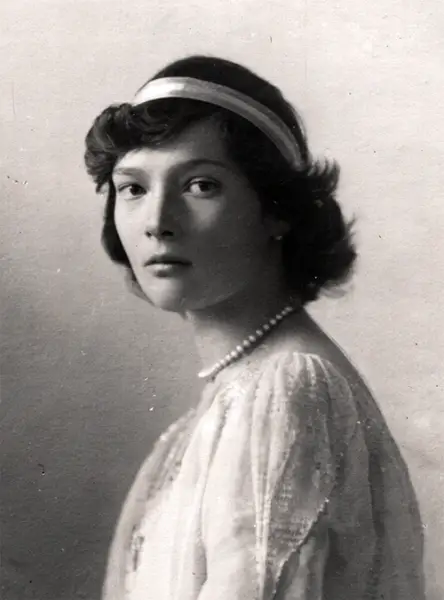
Grand Duchess Tatiana Nikolaevna of Russia, born 10 June 1897 at Peterhof Palace, was the second child of Tsar Nicholas II and Tsarina Alexandra Feodorovna, named for the heroine of Pushkin's Eugene Onegin. Contemporaries judged her the most beautiful of the four sisters and the most aristocratic in appearance — tall, slender, dark-haired, with wide-apart gray eyes — yet rank sat lightly on her: she kicked a baroness who addressed her as Your Imperial Highness, and introduced herself on the telephone as Sister Romanova the Second. Her siblings called her the Governess, for she was the practical, maternal organizer of the OTMA group, and of all the children she was closest to her mother, reading to her by the hour. As honorary colonel of the Vosnesensky Lancers and patron of the Tatiana Committee for war aid, she chaired charitable committees through the First World War and served from 1914 to 1917 as a Red Cross nurse at Tsarskoye Selo, tending wounded soldiers beside her mother and sister Olga. Arrested with her family in 1917, she became the level-headed manager of the household in exile, persuading her mother to make hard decisions and sewing jewels into the family's clothing. She was shot in the Ipatiev House at Yekaterinburg on 17 July 1918, aged twenty-one, and was canonized as a passion bearer by the Russian Orthodox Church.
The Complete Life
Named for a Poet's Heroine
Tatiana was born on 10 June 1897, a second daughter weighing 3.9 kilograms, delivered with forceps as her sister had been. The empress, waking from the chloroform to anxious faces, wept at what the nation would say of another girl, and the court's disappointment was general. Nicholas, however, took the name Tatiana from the sisters in Pushkin's Eugene Onegin, an homage the Grand Duke Konstantin Konstantinovich recorded within weeks of the birth. The child grew up under the Romanov children's deliberate austerity — camp beds, cold baths, embroidery sold at charity bazaars — sharing a room with Olga as the Big Pair, devoted to her from infancy. When typhoid struck Olga in the spring of 1901, little Tatiana was granted five minutes at the convalescent's bedside and, not recognizing the wasted child, wept and protested that this could not be her beloved sister; her governess could barely convince her that Olga would recover. A famous beauty from childhood — one British magazine in 1900 called her the flower of the flock for looks — she resembled her mother so closely that her father often remarked on it, and the resemblance ran deeper than features: she had Alexandra's serious, ardent nature and, in time, her reserved, deeply religious temperament as well.
§ Early life
Colonel, Committee Chair, Nurse
Tatiana's public vocation began in adolescence, when she received the rank of honorary colonel of the Vosnesensky Lancers and inspected her regiment regularly with Olga. When the war broke out in 1914 she took on work of a different kind: she chaired charitable committees, lent her name as patron to a war aid committee that bore her own name, the Tatiana Committee, and trained as a Red Cross nurse. From 1914 to 1917, with her mother and Olga, she nursed wounded men at the military hospital attached to Tsarskoye Selo, an occupation that her mother's friend Vyrubova said she filled almost as skillfully and devotedly as the empress herself, complaining only that youth spared her the most trying cases. The senior nurse Chebotareva learned not to spare her anything: when the older woman planned to boil silk while Tatiana rested, the grand duchess guessed the scheme and demanded to know why Chebotareva could breathe carbolic acid while she could not. Her patriotism was fierce and ingenuous — she once apologized to her German-born mother for disparaging Germans in her presence, having forgotten Alexandra had been born a German princess — and her letters burned with the wish to do more, grieving that she could be of no use and that she was not a man. This service ended only with the family's arrest in 1917.
§ Young adulthood and World War I
The Governess of the Family
Within the family, Tatiana's mission was organization and care, and it earned her the lifelong nickname the Governess. Eighteen months younger than Olga, she nonetheless led the sisterhood without complaint from anyone; when the four wanted a favor from their parents, they sent Tatiana as their representative. Baroness Buxhoeveden described her as the one who watched over the little ones and constantly helped the household, arranging that official duties should not clash with private engagements. Her practical leadership mattered most when everything was falling apart. In April 1918, when the Bolsheviks removed the Tsar and Tsarina to Yekaterinburg, it was Tatiana who coaxed her mother out of her torment and on to the journey — and Alexandra, in turn, judged that level-headed Tatiana must stay behind at Tobolsk to manage the household and nurse the hemophiliac Alexei through the attack that kept him from traveling. During that month of separation, she organized the sewing of the family's jewels into the clothing, following coded instructions about the medicines, as the letters called them — a concealment so successful that the executioners discovered the diamonds only when the bullets would not penetrate. Even in the Ipatiev House her steadiness served as the family's instrument: her parents sent her to question the guards about the rules, and she sat by the hour reading to her mother.
§ Captivity
A Notebook Full of Love
Of the four sisters, Tatiana was the most religiously serious — a girl who read her Bible frequently, studied theology, and wrestled in her own mind with suffering and pardon and man's end on earth, concluding that goodness is repaid with evil so long as evil holds sway in the world. Her religion passed through the strange channel her family's world provided: Grigori Rasputin. Taught to call the peasant starets Our Friend, the eleven-year-old Tatiana once wrote begging him to visit, confessing how hard she found it to watch her mother's illnesses, and adding, you know because you know everything. She kept a notebook of his sayings on love, copying out the words that love is light and has no end, that love is great suffering mixed with sin and yet it is better to love, that one must ask the Lord asking that the Lord teach a love luminous and bright, one that brings joy instead of torment, strong enough that no bullet can strike it down. Her English tutor judged that for her religion was something owed rather than felt with passion; those who knew her best saw the reserve as shyness mistaken for pride, hiding a poetical creature yearning for the ideal. At the last, her final notebook closed with words she had copied from Father Ioann of Kronstadt on joining one's grief to Christ's in Gethsemane.
§ Relationship with Grigori Rasputin
Level-Headed to the End
Captivity thinned Tatiana to a razor, her tutor Gibbes recalled, and made her seem haughtier and more inscrutable than ever, but her composure held. At Yekaterinburg she chatted with acceptable guards over tea, ran from the room pale as death when one told an off-color joke, and still nursed: at the end of June 1918 she gave Dr. Botkin an injection of morphine for his kidney pain. On 14 July, when local priests came for a private service, the household knelt in prostration at the prayer for the dead; the following day she joked with her sisters as they helped the cleaning women scrub the floor. On the afternoon of 16 July, her mother's diary records, she read the Biblical books of Amos and Obadiah aloud with Alexandra, and afterward mother and daughter sat and simply talked. That evening the kitchen boy Leonid Sednev was taken away, and it was Tatiana who went to Yurovsky's office to plead for his return — the last errand of her life as advocate for her family. Late that night the household was summoned to the basement; Yurovsky read the sentence of execution; and in the volleys that followed, the jewels sewn in her chemise turned the bayonet. Yurovsky's shot to the back of her head killed her instantly. She was twenty-one.
§ Death
Passion Bearer of Yekaterinburg
The Church's canonization of Tatiana followed the double path trodden for her whole family. In 1981 the Russian Orthodox Church Abroad enrolled the murdered imperial household among the holy martyrs, an act of the exile church that saw in the cellar at Yekaterinburg the consummation of Russia's twentieth-century passion. In 2000 the Moscow Patriarchate, canonizing the family after the Soviet collapse, chose the tenderer title of passion bearers — those who, like Christ before Pilate, went to a violent death with meekness and without resistance, even though they were not killed formally for refusing to deny the faith. Her feast is kept on 17 July, the anniversary of the executions, together with her parents, sisters, brother, and the servants who died with them; her major shrine is the Church on Blood at Yekaterinburg, standing where the Ipatiev House once stood. Of the four sisters, Tatiana's canonization has a peculiar fitness: she was the organizer, the one who held the family together in life, who read Scripture to her mother in the last afternoon, who copied into her final notebook the counsel to join her grief to the Savior's and find consolation. The Church's act declares that the composure which made her the Governess of her family was, all along, the patience of a saint in training.
§ Sainthood
Larissa Tudor and the Verdict of Science
Tatiana's share of the Romanov survival mythology was stranger than her sisters'. Because she was considered the family beauty, and because the collapse of 1918 left two bodies unaccounted for after the 1991 exhumation, conspiracy theorists kept her name in play long after the others' fates seemed settled. The most elaborate version came from the author Michael Occleshaw, who argued in his 1995 book The Romanov Conspiracies that Tatiana had been saved and smuggled to England, wed to a British officer, and passed under the name Larissa Tudor; the claim rested on the diaries of the British intelligence figure Richard Meinertzhagen, which hinted at the liberation of a grand duchess. Historians discounted the theory, as they discounted the dozens of impostors who claimed to be surviving Romanovs, and insisted that all of the Tsar's children, Tatiana included, were assassinated at Yekaterinburg. The 2007 discovery of burned remains at a bonfire site outside the city, and the DNA testing announced on 30 April 2008 that identified them as Alexei and one of his sisters, closed the question scientifically: every member of the family was accounted for. Her interment in St. Peter and Paul Cathedral followed on 17 July 1998, which was eighty years to the very day after the executions — and had already given her what the theories never could — a grave, a date, and the Church's enduring memory.
§ Romanov graves and DNA proof
Timeline
- 10 Jun 1897
Born at Peterhof Palace, the second child of Nicholas II and Alexandra, and named for the heroine of Pushkin's Eugene Onegin.
§ Early life
- 1901
When Olga lay recovering from typhoid fever, four-year-old Tatiana wept bitterly, refusing to believe the pale, thin child was her beloved sister.
§ Early life
- 1907
Met Grigori Rasputin with her siblings in the nursery, all in their white nightgowns, and was taught to regard him as Our Friend.
§ Relationship with Grigori Rasputin
- 8 Mar 1910
Twelve-year-old Tatiana wrote to her mother fearing the governess would speak ill of Rasputin, begging forgiveness for displeasing her.
§ Relationship with Grigori Rasputin
- 11 Jul 1911
Indignant when officers of the imperial yacht gave Olga a cut-out of Michelangelo's nude David for her name day, she wrote to her aunt calling them swine.
§ Young adulthood and World War I
- 1911
Witnessed the assassination of the minister Pyotr Stolypin from the imperial box at the Kiev Opera House; she sobbed and slept badly afterward.
§ Young adulthood and World War I
- Sep 1914
Put at the head of a war relief committee that bore her name, the Tatiana Committee; the same month, wounded cavalry officer Dmitri Malama gave her a French bulldog she named Ortipo.
§ Young adulthood and World War I
- 1914
Took up nursing as a Red Cross sister alongside her mother and Olga, tending wounded men in a hospital at Tsarskoye Selo.
§ Young adulthood and World War I
- 15 Aug 1915
Wrote to her mother lamenting that she could do nothing to help Russia in the war and that in such moments she was sorry not to be a man.
§ Young adulthood and World War I
- 21 Dec 1916
Attended the funeral of Grigori Rasputin, murdered six days earlier; afterward absurd rumors claimed she had witnessed the killing in disguise.
§ Relationship with Grigori Rasputin
- 16 Apr 1917
Wrote to her former nursing colleague Chebotareva that she pined without work and missed the morning change of bandages.
§ Captivity
- Apr 1918
Left behind at Tobolsk with Alexei when her parents and Maria were taken to Yekaterinburg; she and the others sewed jewels into their clothing for concealment.
§ Captivity
- May 1918
Traveled with her siblings and servants aboard the ship Rus from Tobolsk to Yekaterinburg, dragging luggage through the rain.
§ Captivity
- Jun 1918
Called upon her nursing skills to give Dr. Eugene Botkin an injection of morphine to ease his kidney pain.
§ Death
- 16 Jul 1918
Spent her last full afternoon reading the Biblical books of Amos and Obadiah with her mother, then talking quietly with her.
§ Death
- 17 Jul 1918
Killed by a shot to the back of the head in the Ipatiev House basement after the family's execution was read out, aged twenty-one.
§ Death
- 1981
Canonized as a holy martyr by the Russian Orthodox Church Abroad with her whole family.
§ Sainthood
- 17 Jul 1998
Her remains were interred at St. Peter and Paul Cathedral in St Petersburg with those of her parents and three sisters, eighty years after the murders.
§ Sainthood
- 30 Apr 2008
Russian forensic experts reported that genetic testing had established the 2007 remains as those of Alexei and one of his sisters, accounting for the entire family.
§ Romanov graves and DNA proof
In Their Own Words
I simply can't tell you how awfully sorry I am for you, my beloved ones. I am so sorry I can in no way help you or be useful. In such moments I am sorry I'm not a man.
Tatiana Nikolaevna ... Sister Romanova the Second
Why can you breathe carbolic acid and I can't?
The Record
- Major works
- Chairing charitable committees and patronage of the Tatiana Committee for war aid·Red Cross nursing service at the Tsarskoye Selo hospital, 1914-1917·Honorary colonelcy of the 8th Vosnesensky (Ascension) Lancers
- Patron of
- patron of the Tatiana Committee·honorary colonel of the Vosnesensky Lancers
- Canonization
- Canonized 1981 by the Russian Orthodox Church Abroad as a holy martyr; canonized 2000 by the Russian Orthodox Church as a passion bearer
Prayer
Bibliography
Show 8 sources
- Massie, Robert K. Nicholas and Alexandra. 1967. ISBN 0-575-40006-4
- Massie, Robert K. The Romanovs: The Final Chapter. 1995. ISBN 0-679-43572-7
- Rappaport, Helen. The Romanov Sisters: The Lost Lives of the Daughters of Nicholas and Alexandra. St. Martin's Griffin, 2014. ISBN 978-1250067456
- King, Greg and Wilson, Penny. The Fate of the Romanovs, 2003. ISBN 0-471-20768-3
- Maylunas, Andrei and Mironenko, Sergei (editors); Galy, Darya (translator). A Lifelong Passion: Nicholas and Alexandra: Their Own Story. 1997, Doubleday, ISBN 0-385-48673-1
- Azar, Helen & Nicholson, Nicholas B.A. Tatiana Romanov, Daughter of the Last Tsar: Diaries and Letters, 1913-1918. Westholme Publishing, 2015. ISBN 978-1594162367
- De Malama, Peter. "The Romanovs: The Forgotten Romance" in Royalty Digest. December 2004, p. 184
- Gilliard, Pierre. Thirteen Years at the Russian Court. ISBN 0-405-03029-0
Profile text adapted from the Wikipedia article, licensed CC BY-SA 4.0.
Pray with this saint every day
Save St. Tatiana Nikolaevna to your favorites, read the full profile, and get feast-day reminders in the Saints app.
Get the Saints AppFree on the App Store for iPhone and iPad