
mid-6th century·Feast December 19
St. Gregentios
Archbishop of Zafar in Himyar
Overview
Gregentios is the archbishop of Zafar, capital of the Himyarite kingdom in South Arabia, whose career is known almost entirely through a Greek hagiographical dossier put together in the tenth century. The compilation gathers three works that once circulated separately: a Life, a law code issued for the converted Himyarites, and a written disputation between the bishop and a Jew named Herban. Scholars regard the dossier as largely legendary, though scattered pieces of it preserve genuine historical information about sixth-century South Arabia. According to the Life, Gregentios was born in the late fifth century at Lyplianes in the Avar lands, wandered as an ascetic through Italy, Sicily, Rome, and Alexandria, and was finally consecrated bishop after the Ethiopian conquest of Himyar, which followed the massacre of the Christians of Najran in 523. He is said to have spent thirty years shepherding the new church, ordaining clergy and raising churches across the kingdom alongside the viceroy Abraha, before dying on 19 December. The debate text became the most popular component of the dossier and circulated on its own into the modern era, while the law code, though fictional in framework, preserves striking material on slavery, marriage, and cruelty to animals.
The Complete Life
A Childhood in the Avar Lands
The Life places Gregentios' birth in the late fifth century at Lyplianes, identified with modern Ljubljana, in territory under Avar control, and gives his birthday as 6 December. His father Agapios and mother Eusebia had him baptized under the name of a sage dwelling on a nearby mountain, and the unusual name Gregentios was reportedly given by a local holy man; puzzled later scribes repeatedly rewrote it as Gregorios. He began school at the age of seven. At ten, according to the hagiographer, a deer pushed him into a river, and after his miraculous rescue from drowning he withdrew to the desert, where a holy elder instructed him and foretold his future. When his mother died, the boy passed into the care of the married priest who had baptized him. During a barbarian assault the townspeople took refuge in the fortress of Korada, and Gregentios, caught outside in the vineyards, slipped in through the Rhomanesios gate while the siege was under way. After the attackers withdrew, both he and his foster mother received prophetic dreams, which an elder named Niketas interpreted to mean that he would one day bring a fourfold people to the faith. The episode of the raid, whatever else is legendary in it, may reflect genuine conditions in the northern Balkans in the later sixth century.
§ Early life in Avaria
The Long Road Through the West
From his homeland Gregentios undertook the travels that fill the middle chapters of his Life, moving through northern and central Italy, Sicily, and ultimately to Alexandria. The itinerary the hagiographer supplies is geographically and chronologically absurd, yet each station carries its own episode of discernment. With the desert elder he reached Moryne, identified with Murano, in a single day, then Antenora, or Padua, where Bishop Eulogios made him a deacon and lector. At Agrigento he prayed at the tomb of the hermit Eirene and heard a woman preaching from a balcony announce that he would go to Egypt and Himyar. In Milan he venerated the grave of St. Ambrose and began reading his works, taking as a disciple a fourteen-year-old boy named Leon, over whose early death Gregentios received a vision of the underworld. Carthage brought encounters with a woman called Philothea, whose supposed barking speech was revealed as a divine protection, and with a young Thracian named Pothetos, for whom Gregentios wrote sixteen homilies that led him briefly to regret his marriage before the saint sent him home reconciled. In Rome he freed a slave named Elizabeth from a molesting demon with a written formula, met Pope Felix IV, and climbed to the hermit Artados, who prophesied his conversion of four peoples: pagans, Jews, Himyarites, and Maurousians.
§ Travels
Archbishop in Himyar
The final stretch of the Life contains, in the judgment of modern scholars, the only clearly historical material in the whole dossier. In 523 the Himyarite king Dhu Nuwas massacred the Christian community of Najran and its leader Arethas. Emperor Justin I pressed the Ethiopian king Elesboam, the Caleb of the historians, to lead an expedition against the persecutor, and after the conquest of Himyar in 525 the Aksumite court asked the patriarch of Alexandria to send a bishop for the newly Christian kingdom. St. Mark was said to have designated Gregentios in a dream, and the patriarch consecrated him and dispatched him with the Ethiopian envoys. Passing through Aksum and the port of Maddaban, Gregentios reached Zafar and then Najran, where he consecrated the churches the king had built and installed clergy at Najran, Zafar, Bi'r Ali, Zufar, Lahj, Aden, and Mawza. He reportedly threatened the Himyarites with death for refusing baptism, after which the whole country accepted Christianity, a detail that tells more about hagiographical convention than about events. He remained in the kingdom for thirty years, helping Abraha, Elesboam's appointed viceroy, to build churches, and died on 19 December, shortly after Abraha's death and succession by his son Seridos. He was buried in the cathedral of Zafar.
§ Bishop in South Arabia
The Dossier and Its Afterlife
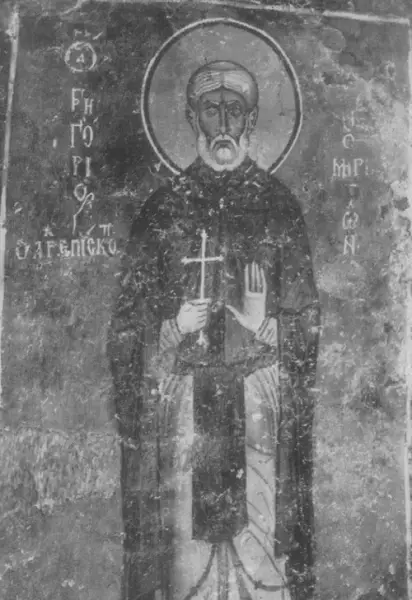
Gregentios' reputation rests less on reconstructible deeds than on the tenth-century dossier that bears his name. Its most popular component, the Dialexis, presents itself as the record of a debate with the Jew Herban held before the Himyarite royal court around 520 or 530, and claims to rest on notes by a notary named Palladios; in fact it betrays composition after the monothelite and iconoclast controversies and after the filioque dispute had arisen in Byzantium following 860. The Nomoi ton Homeriton, a law code framed as supernaturally promulgated to the district administrators of Najran, mixes possibly authentic South Arabian material with Byzantine provisions, prescribing mutilation for many offences yet, strikingly, forbidding wife-beating and cruelty to animals, matters on which Byzantine law was silent. J. B. Bury observed that these laws show the kind of legislation an unchecked ecclesiastical spirit would aim at. Since Cardinal Pitra's doubts of 1864, scholars have argued over the code's date, with a Constantinopolitan origin in the tenth century now widely favored. The saint's sole surviving image from the Byzantine world is a fresco of about 1110 to 1118 in the monastery of Koutsovendis on Cyprus, and his memory is fixed in the Synaxarion of Constantinople under 19 December.
§ Overview
Timeline
- 523
Himyarite king Dhu Nuwas massacres the Christians of Najran, killing their leader Arethas and triggering the invasion that brings Gregentios to Arabia.
§ Bishop in South Arabia
- 525
Following the Ethiopian conquest of Himyar, the patriarch of Alexandria consecrates Gregentios a bishop and dispatches him with the Ethiopian envoys.
§ Bishop in South Arabia
- 550
The Dialexis presents itself as a record written at about this time of his debate with the Jew Herban before the Himyarite royal court.
§ Dialexis
- 19 Dec 552
Dies on 19 December after some thirty years in Himyar and is buried in the cathedral of Zafar.
§ Bishop in South Arabia
- 1110
The sole Byzantine-period image of him, a fresco in the monastery of Koutsovendis on Cyprus, is painted during these years.
§ Name
- 1180
The oldest surviving witness to his works, a copy of the Bios, is made on Cyprus and now rests in Saint Catherine's Monastery at Sinai.
§ Bios
- 1487
A copy of the Nomoi is produced at Gaza, later serving as a witness to the law code attributed to him.
§ Content
- 1660
Letters ascribed to Gregentios are catalogued in the library of Denis Pétau, bought after his death by Queen Christina of Sweden, and are afterwards lost.
§ Letters
- 1864
Cardinal Jean-Baptiste-François Pitra becomes the first to question the authenticity of the Nomoi, opening a long scholarly controversy.
§ Date and authorship
- 1969
Nina Pigulevskaya argues that the Nomoi originated in sixth-century Byzantium and never actually took force in Himyar.
§ Date and authorship
The Record
- Major works
- Nomoi ton Homeriton (Laws of the Homerites), a law code attributed to him·Dialexis (Debate with Herban the Jew), a disputation attributed to him·Sixteen homilies recorded in the Bios
- Canonization
- Pre-congregation; commemorated in the Synaxarion of Constantinople on 19 December.
Prayer
Bibliography
Show 6 sources
- Berger, Albrecht, ed. (2006). Life and Works of Saint Gregentios, Archbishop of Taphar: Introduction, Critical Edition and Translation. Millennium Studies, 7. De Gruyter.
- Fiaccadori, Gianfranco (1991). "Gregentios". In Kazhdan, Alexander (ed.). The Oxford Dictionary of Byzantium. Oxford and New York: Oxford University Press.
- Christides, Vassilios (2009). "Review of Life and Works of Saint Gregentios, Archbishop of Taphar". Collectanea Christiana Orientalia. 6: 458-464.
- Fowden, Garth (1993). Empire to Commonwealth: Consequences of Monotheism in Late Antiquity. Princeton University Press.
- Insley, Sarah (2018). "Gregentius, Life of S.". In Oliver Nicholson (ed.). The Oxford Dictionary of Late Antiquity. Vol. 1: A-I. Oxford University Press. p. 683.
- Shahid, Irfan (1979). "Byzantium in South Arabia". Dumbarton Oaks Papers. 33: 23-94.
Profile text adapted from the Wikipedia article, licensed CC BY-SA 4.0.
Pray with this saint every day
Save St. Gregentios to your favorites, read the full profile, and get feast-day reminders in the Saints app.
Get the Saints AppFree on the App Store for iPhone and iPad