
559 – 630·Feast November 23
St. Gregory of Agrigento
Sicilian Bishop and Correspondent of Pope Gregory the Great
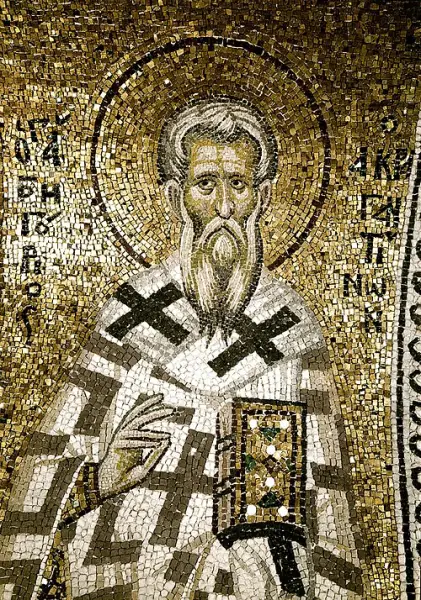
Overview
Gregory of Agrigento was a Sicilian prelate who governed the see of Agrigento from 590 until at least 603 and exchanged letters with Pope Gregory the Great. According to the semi-legendary biography written by Leontios of the Roman monastery of San Saba, he was born near Agrigento in 559, lost his father young, and at eighteen made a perilous pilgrimage to the Holy Land by way of Carthage and Tripoli, escaping an attempt to sell him into slavery. While in Jerusalem he was ordained deacon by Patriarch Makarios II, and after returning home through Constantinople and Rome he was chosen by the pope himself, over two rival candidates, to fill the vacant throne of Agrigento, discovering the reluctant man concealed in a monastic garden because he shrank from high office. His episcopate was quickly clouded: by 591 he had been falsely accused by Sabinus and Crescentius and imprisoned, and papal correspondence of 591 and 592 shows the case being pressed in Rome, though the pope still named him bishop in January 603. Some sources date his death to 630. A Greek commentary on Ecclesiastes is traditionally credited to him, counted among the finest ancient treatments of that book, though modern scholars debate whether its author was instead a later exegete writing under Justinian II.
The Complete Life
A Pilgrimage of Slavery and Providence
The life of Gregory opens on Sicily, where he was born near Agrigento in 559 to a family whose mother, Theodote, is the only parent the biography names. It records that he was given an education in the classics, in rhetoric, and in theology, and that he read the Life of Basil of Caesarea many times over together with the Passion of the Holy Maccabees. At the age of eighteen he set out on pilgrimage to the Holy Land, sailing by way of Carthage to Tripoli. The journey nearly ended in catastrophe when a ship-owner at Carthage tried to sell him into slavery, an episode the biographer narrates with a romantic color that later hagiography borrowed: the account of his travels appears to have influenced the tenth-century Life of Gregentios. Reaching Jerusalem, Gregory came to the attention of Patriarch Makarios II, who ordained him to the diaconate. Only then did he turn homeward, making his way back to Agrigento through Constantinople and Rome, a route that placed the young Sicilian deacon, almost by accident, in the very city where the fate of his native see was about to be decided.
§ Biography
Chosen from the Garden
In 590 the see of Agrigento stood vacant, and two factions of the local church each carried its own candidate to Rome for the pope's judgment. Pope Gregory the Great disappointed both parties: he bypassed their nominees altogether and consecrated Gregory of Agrigento, the Sicilian deacon who, out of reticence for high office, had to be found hiding in a monastic garden when the choice fell upon him. The episode became the best-known scene of his vita, and the last surviving reference to the previous bishop, Eusanius, is also from 590, fixing the date of the transfer securely. The biographer celebrates the new bishop as a preacher of Chrysostom's caliber, a second Chrysostom, and records that he expounded, at a bishop's bidding, the works of Gregory the Theologian before a group of deacons. The biography also claims startling sanctity for him: a miraculous grace enabled him to fast without interruption, and cures were wrought through his prayers. Whatever weight legend carries in these pages, the correspondence of Pope Gregory confirms that a bishop of this name truly held Agrigento at the turn of the seventh century.
§ Biography
Accusation and Vindication
Scarcely a year into his episcopate, Gregory's fortune reversed. By 591 he had been falsely accused of wrongdoing and imprisoned, his accusers being identified in the biography as a certain Sabinus and Crescentius. The papal register preserves the course of the affair: in August 591 a letter ordered Gregory to appear, alongside the bishops of Catania and Palermo, before Peter, a papal sub-deacon acting as the pope's agent. In November 592 the pope wrote to Bishop Maximian of Syracuse insisting that the accusers and their documentation be dispatched to Rome without delay, and in the same letter referred to a message he had sent to Gregory himself that has not survived. Some sources hold that he was deposed from his see by 594, yet in January 603 the pope's correspondence still names him as bishop of Agrigento, which suggests that he weathered the storm or was restored. The later biography embroiders the persecution considerably, depicting the emperor himself intervening with the pope to free him and painting the Sicilian episcopate as his defenders against Rome, an anti-papal coloring that Morcelli traced to pamphlets circulating in Rome against Gregory the Great after his death.
§ Biography
The Making of a Sicilian Saint
Gregory's memory owes its survival to a substantial Greek biography composed by Leontios of the monastery of San Saba in Rome, a narrative account of the blessed bishop's life and of the church of Agrigento and rendered into Latin by Stefano Antonio Morcelli in the eighteenth century. When it was written is disputed: Albrecht Berger places it between 750 and 828 because it relies on the Donation of Constantine and presumes Greek monasteries in Rome, while John Martyn argues from its echoes of the papal letters for a date near 640, and Leontios' reported death in 688 would give an outer limit. Berger judges the work legendary in large part though historical at its core, doubting that the central figure was the bishop at all; Martyn counters that it is an important contemporary document and one of very few seventh-century sources on Sicily. A second life by Niketas David Paphlagon supplied the text that Simeon Metaphrastes inserted, unaltered, into his tenth-century collection, one of only fourteen he did not rework. The Orthodox East celebrates him on 23 and 24 November, and Cardinal Caesar Baronius later placed his name in the Roman Martyrology under the former date; the abundance of surviving mosaics and icons, from the Menologion of Basil II to the Pammakaristos Church, measures the reach of his cult.
§ Hagiography
The Commentary on Ecclesiastes
A Greek commentary on Ecclesiastes has traveled through the centuries under Gregory's name, and it is by this work, if by anything, that he lives among the exegetes. Tradition assigns the bishop of Agrigento the authorship, and the hagiography itself supplies a list of his writings, including a treatise dedicated to Saint Andrew, styled chief of the apostles. Modern scholarship has complicated the picture: since the earliest manuscripts of the commentary belong to the eighth or ninth centuries, its author can only securely be placed in the seventh, and some scholars argue the exegete was in fact writing in the time of Emperor Justinian II, a century after the bishop's death. On that reading there were two distinct Gregories of Agrigentum, the bishop who flourished around 600 and the commentator who flourished around 700. What is not disputed is the quality of the work, counted among the best ancient commentaries on Ecclesiastes, a book whose meditations on vanity, labor, and the fear of God suited a prelate who had known exile, slander, and the fragility of human favor. Whether the bishop or a shadow namesake wrote it, the commentary has kept Gregory's name in the company of the church's early interpreters of Scripture.
§ Commentary on Ecclesiastes
Timeline
- 559
Born near Agrigento on Sicily; his mother's name was Theodote.
§ Biography
- 590
Consecrated Bishop of Agrigento by Pope Gregory the Great, who bypassed two rival factions and found the reluctant candidate hiding in a monastic garden.
§ Biography
- 591
Falsely accused of wrongdoing by Sabinus and Crescentius and imprisoned.
§ Biography
- Aug 591
A papal letter ordered him to appear before the papal agent Peter together with the bishops of Catania and Palermo.
§ Biography
- Nov 592
Pope Gregory wrote to Bishop Maximian of Syracuse demanding that Gregory's accusers and supporting documents be sent to Rome without delay.
§ Biography
- 594
Some sources place him as deposed from his see by this year, though the evidence is disputed.
§ Biography
- Jan 603
Named still bishop of Agrigento in a letter of Pope Gregory, despite the earlier accusations.
§ Biography
- 630
According to some sources, died in this year after a long life that reached from the age of Justinian into the seventh century.
§ Biography
The Record
- Major works
- Commentary on Ecclesiastes (Explanatio super Ecclesiasten libri I-X), traditionally attributed·A work dedicated to Saint Andrew, listed in his hagiography
- Canonization
- Pre-congregation; his cult was established in the East and introduced to the Roman Martyrology by Cardinal Caesar Baronius on 23 November.
Prayer
Bibliography
Show 8 sources
- Martyn, John R. C., ed. (2004). The Letters of Gregory the Great. Vol. 1: Books 1-4. Pontifical Institute of Mediaeval Studies.
- Kazhdan, Alexander (1991). "Gregory of Akragas". In Kazhdan, Alexander (ed.). The Oxford Dictionary of Byzantium. Oxford and New York: Oxford University Press.
- Kazhdan, Alexander (1999). A History of Byzantine Literature (650-850). Athens.
- Cross, F. L.; Livingstone, E. A., eds. (2009). "Gregory, St (late 6th cent.), Bp. of Agrigentum (Girgenti) in Sicily". The Oxford Dictionary of the Christian Church (3rd rev. ed.). Oxford University Press.
- Hogel, Christian (2002). Symeon Metaphrastes: Rewriting and Canonization. Museum Tusculanum Press.
- Demacopoulos, George E. (2013). The Invention of Peter: Apostolic Discourse and Papal Authority in Late Antiquity. University of Pennsylvania Press.
- Van Pelt, Julie (2020). "Disguised Identity and Recognition in the Life of Gregory of Agrigento (BHG 707)". Greek, Roman and Byzantine Studies. 60 (2).
- Ferguson, Everett (1999). "Gregory of Agrigentum". In Everett Ferguson (ed.). Encyclopedia of Early Christianity (2nd ed.). Routledge. p. 491.
Profile text adapted from the Wikipedia article, licensed CC BY-SA 4.0.
Pray with this saint every day
Save St. Gregory of Agrigento to your favorites, read the full profile, and get feast-day reminders in the Saints app.
Get the Saints AppFree on the App Store for iPhone and iPad