
before 797 – 842·Feast November 20
St. Gregory of Dekapolis
Byzantine Wanderer Monk and New Miracle-Worker
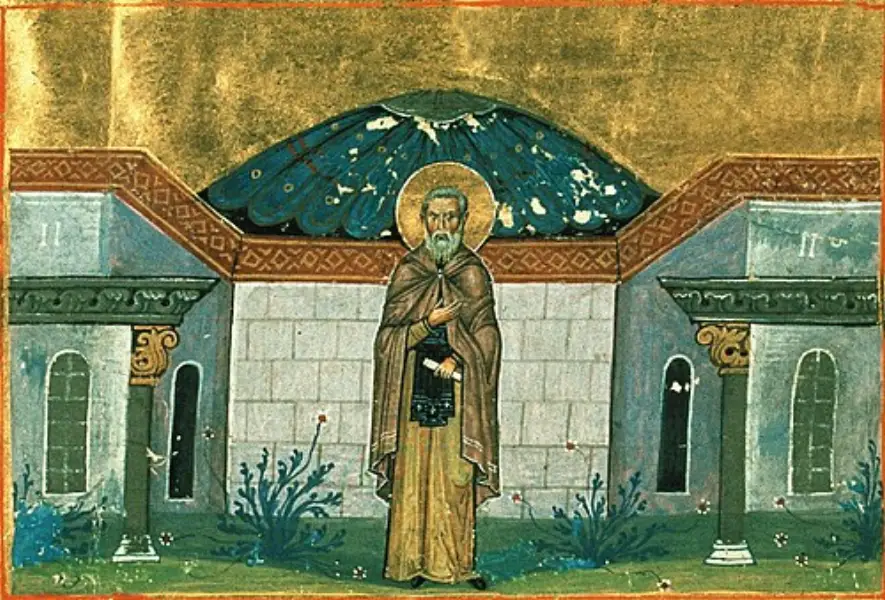
Overview
Gregory of Dekapolis was a ninth-century Byzantine monk whose tireless journeys across the Byzantine world and reputation for wonders earned him the surname the New Miracle-Worker. Born in the late eighth century at Irenopolis in the Isaurian Dekapolis, the district that gave him his name, he was the son of Sergios and Maria and a kinsman of the future Patriarch Euthymius of Constantinople. When his parents pressed him toward marriage around 815, he fled to the mountains, met the exiled former bishop of Irenopolis, a victim of the renewed Iconoclasm, and took the monastic habit in his brother's monastery, later moving to that of his uncle Symeon, where he spent fourteen years before withdrawing as a hermit. Around 832 he received what his life calls a divine command to wander, and for years he moved from Ephesus by sea to Prokonnesos, Ainos, and Christoupolis, then overland to Thessalonica and Corinth, and onward to Rome, Syracuse, and back to Thessalonica, where he taught pupils including Joseph the Hymnographer. After settling at Constantinople, he endured epilepsy and dropsy and died on November 20 in 842 or somewhat earlier. A sermon on the conversion of a Muslim is the only writing of his that survives, and his cult rests chiefly on his fame as a worker of miracles.
The Complete Life
A Flight from Irenopolis
Gregory was born in the late eighth century at Irenopolis, a town of the Isaurian Dekapolis from which he took his name. Francis Dvornik dated his birth to the years 780-790, while Cyril Mango argued that he cannot have been born later than 797. Sergios and Maria were his parents; one brother is known to us only namelessly, a later kinsman of the family rose to the patriarchal throne of Constantinople as Euthymius in the early tenth century. His hagiography relates that he began elementary schooling at the age of eight, but his boyhood was interrupted when his parents resolved to marry him off around 815 or 816. Rather than accept the match, he ran away to the mountains, where he met the former bishop of Irenopolis, a man driven from his own see for resisting the empire's renewed adoption of Iconoclasm. Receiving the exiled bishop's blessing, and acting on the counsel of his mother, he joined the house in which his brother had already taken the habit. The house, however, was led by an abbot sympathetic to Iconoclasm, and Gregory soon broke with him, transferring instead to the monastery of his maternal uncle Symeon.
§ Life
Fourteen Years and a Hermit's Cave
At his uncle's monastery Gregory settled into the long patience that forms a monk. He remained there fourteen years, and around 830 he asked and received permission to withdraw into a cave and live as a hermit. It was in this solitude that his life records the experiences that marked him as a man of the Spirit: a vision of the Tabor light, the uncreated radiance of the Transfiguration, and a strange encounter with a woman who set him free from carnal appetite through a wondrous surgical intervention, an episode that modern readers take as a possible allusion to Gregory's being a eunuch. The ascetic peace could not last indefinitely. Around 832 or 833, perceiving what his biographer calls a divine command, he abandoned the eremitic life and set out upon the journeys that gave him his reputation, wandering first to Ephesus and then by sea and road through Prokonnesos, Ainos, Christoupolis, Thessalonica, and Corinth, carrying the monastic ideal from Asia Minor to Greece, Italy, and Sicily and back again.
§ Life
The Wanderings of the Miracle-Worker
The itinerary preserved in Gregory's life reads like a map of the ninth-century Byzantine oikoumene. From Corinth he took ship for Rome, calling at Rhegion and Naples, and remained three months in a cell in the holy city before moving on to Syracuse in Sicily, where he practiced contemplative isolation in a tower in the harbor. Returning toward Greece by way of Otranto, he was arrested as an Arab spy and mistreated, around 834, one of the small perils his biography records with detail. At Thessalonica he paused long enough to gather pupils, among them the young Joseph, who would become known to the Church as Joseph the Hymnographer. A few years later, probably around 836 or 837, Gregory traveled on to Constantinople, Joseph accompanying him according to the hymnographer's own life. In the capital he lodged at the Antypas Church or at the Church of Saints Sergius and Bacchus, and he visited the monastic community of Mount Olympus in Bithynia, linking the wandering ascetic to the great centers of Byzantine monasticism. Though he lived through the second Iconoclasm as a convinced iconophile, he was never himself persecuted.
§ Life
Illness, Death, and Translation
Gregory's last years in Constantinople were shadowed by sickness, first epilepsy and then dropsy, the accumulation of fluid that finally drained his strength. He died on a November 20, in the year 842 by the usual reckoning, though other interpretations of the sources propose 841 or a still earlier date. Within a few years his cult had taken root: around 850 his remains were translated to a monastery founded by his pupil Joseph the Hymnographer, situated near the grave of John Chrysostom in the Church of the Holy Apostles, the most illustrious burial ground available to a Byzantine churchman. The placing of his relics beside Chrysostom's, in a house built by the disciple he had formed at Thessalonica, closed the circle of a life that had always been sustained by spiritual friendship. He is remembered in the synaxaria under the title the New Miracle-Worker, and his feast is kept on November 20 in the Eastern Orthodox Church and the Roman Catholic Church alike.
§ Life
The Saint, His Life, and His Sermon
The hagiography on which Gregory's story depends is attributed to Ignatios the Deacon, the prolific writer of the early ninth century, though the attribution is disputed. As a record of contemporary events it is a poor source, but it provides abundant evidence for administrative and legal practice in middle Byzantium, which is why prosopographers have mined it so carefully. Gregory's own literary remains are slight: a single sermon concerning the conversion of a Muslim to Christianity, an episode scholars consider likely historical, preserves his voice and makes him a witness to Christian-Muslim encounter in the age of the Abbasids. His images are rare; where they occur he appears as a bearded monk whose white beard is closely rounded, as in the miniature of the Menologion of Basil II painted around 985. Above all he was remembered as a wonder-worker, and the epithet the New Miracle-Worker attached itself to his name precisely because the church of his century, having older thaumaturges to compare him with, judged his wonders worthy of the succession.
§ Hagiography and veneration
Timeline
- 815
Ran away to the mountains rather than accept the marriage his parents had arranged for him, and met the former bishop of Irenopolis, deposed for opposing the renewal of Iconoclasm.
§ Life
- 830
After fourteen years in his uncle Symeon's monastery, obtained leave to withdraw to a cave as a hermit, where he experienced a vision of the Tabor light.
§ Life
- 832
Obeying a divine command, began his wanderings, sailing from Ephesus to Prokonnesos, Ainos, and Christoupolis before journeying overland to Thessalonica and Corinth.
§ Life
- 834
Returning to Thessalonica by way of Otranto, was taken for an Arab agent and roughly handled, then settled at Thessalonica to teach pupils including Joseph the Hymnographer.
§ Life
- 836
Journeyed on to Constantinople, accompanied by Joseph, lodging either at the Antypas Church or at Saints Sergius and Bacchus, and paid a visit to the Bithynian community of Mount Olympus.
§ Life
- 20 Nov 842
Died at Constantinople on a November 20, after years of illness marked first by epilepsy and then by dropsy.
§ Life
- 850
His relics were moved to a monastery that Joseph the Hymnographer had founded, beside the tomb of Chrysostom within the Church of the Holy Apostles.
§ Hagiography and veneration
The Record
- Major works
- Sermon on the conversion of a Muslim to Christianity, his only extant writing
- Symbols
- Depicted as a monk with a trim round white beard
- Canonization
- Pre-congregation; venerated in the Eastern Orthodox and Roman Catholic Churches, with his feast on November 20.
Prayer
Bibliography
Show 6 sources
- Kazhdan, Alexander; Sevcenko, Nancy Patterson (1991). "Gregory of Dekapolis". In Kazhdan, Alexander (ed.). The Oxford Dictionary of Byzantium. Oxford and New York: Oxford University Press. p. 880.
- Winkelmann, Friedhelm; Lilie, Ralph-Johannes; et al. (2000). "Gregorios Dekapolites (#2486)". Prosopographie der mittelbyzantinischen Zeit: I. Abteilung (641-867), 2. Band. Walter de Gruyter. pp. 96-99.
- Sahas, Daniel J. (2009). "Gregory Dekapolites". In Thomas, David; Roggema, Barbara (eds.). Christian-Muslim Relations: A Bibliographical History, Volume 1 (600-900). Leiden and Boston: BRILL. pp. 614-617.
- Dvornik, Francis, ed. (1926). La vie de saint Gregoire le Decapolite et les Slaves macedoniens au IXe siecle. Paris: Champion.
- Makris, Georgios; Chrontz, Michael, eds. (1997). Ignatios Diakonos und die Vita des heiligen Gregorios Dekapolites. Byzantinisches Archiv. Vol. 17. Stuttgart and Leipzig: Teubner.
- Sahas, D. J. (1986). "What an infidel saw that a faithful did not. Gregory Dekapolites (d. 842) and Islam". Greek Orthodox Theological Review. 31: 50-62.
Profile text adapted from the Wikipedia article, licensed CC BY-SA 4.0.
Pray with this saint every day
Save St. Gregory of Dekapolis to your favorites, read the full profile, and get feast-day reminders in the Saints app.
Get the Saints AppFree on the App Store for iPhone and iPad