
c. 950 – 1003/1011·Feast February 27
St. Gregory of Narek
Armenian Mystic Poet and Doctor of the Church
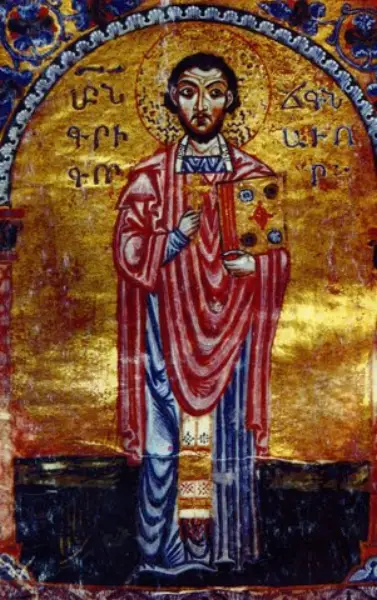
Overview
Gregory of Narek was an Armenian monk, theologian, and mystical poet who spent nearly his whole life at the monastery of Narek on the southern shore of Lake Van, in the medieval Kingdom of Vaspurakan. Born around the middle of the tenth century to Khosrov Andzevatsi, a bishop of the Andzevatsik diocese, he lost his mother in childhood and was sent with his elder brother to the monastery founded by their great-uncle Anania Narekatsi. Ordained a priest in 977, he taught at the monastery school until his death around 1003 or 1010. His masterpiece, the Book of Lamentations, completed near the end of his life, is a confessional poem of ninety-five prayers addressed to God, treasured by Armenians almost as much as the Bible and credited with healing power. He also produced a commentary on the Song of Songs, hymns, panegyrics, and roughly two dozen lays considered the first documented religious poems in Armenian letters. Scholars rank him as the most beloved figure of the Armenian Christian tradition, a writer who shaped and enriched the classical language itself. In 2015 Pope Francis named him the first Armenian Doctor of the Church, and in 2021 an optional memorial was added to the General Roman Calendar for 27 February.
The Complete Life
A Bishop's Son Given to the Monastery
Gregory came into the world around the middle of the tenth century in a village on the southern shore of Lake Van, in the Kingdom of Vaspurakan, a medieval Armenian realm celebrated for its high culture and remembered as part of the cradle of Armenian civilization. His father, Khosrov Andzevatsi, belonged to the circle of the Artsruni royal family and served as a bishop. Gregory's mother died while he was still small. Khosrov, after being widowed, received ordination as a bishop and was made primate of the diocese of Andzevatsik, yet his career was shadowed by suspicion: he was accused of holding pro-Byzantine Chalcedonian views alien to the Armenian Apostolic Church, and Catholicos Anania Mokatsi eventually excommunicated him for undermining the Armenian Church, charging him with lowering the rank of Catholicos to that of a bishop on the authority of Pseudo-Dionysius the Areopagite. The father's disgrace shaped the son's future. Gregory and his elder brother Hovhannes were dispatched to Narekavank — literally, the monastery of Narek — where their maternal great-uncle Anania Narekatsi, a celebrated scholar and the community's founder, took charge of their religious education. In that intellectual and spiritually intense environment the boy grew into the writer whom Armenian tradition would prize above nearly every other.
§ Life and background
Ordained at Narek
Gregory remained at Narek Monastery for the rest of his life, and there his vocation unfolded. He was ordained a priest in 977, the same year in which he produced his commentary on the Song of Songs, written at the bidding of Gurgen-Khachik Artsruni, prince of Vaspurakan. In that commentary Gregory leaned heavily on the Letters on the Song of Songs of Gregory of Nyssa, and he condemned the marriage and sexual practices of the Tondrakians, an Armenian sect branded heretical by the Armenian Apostolic Church; it has been suggested that the prince commissioned the work precisely to counter such teachings. From that point onward he taught theology in the monastery school until his death, forming students in the tradition he had inherited from his great-uncle. Whether he lived as a recluse became a matter of debate among Armenian scholars: some, like Arshag Chobanian and Manuk Abeghian, pictured a secluded ascetic, while Hrant Tamrazyan argued that Gregory knew the secular world of his time intimately, understood both peasants and princes, and could not have sustained his literary ecstasy in isolation. Either way, his horizons were wide, and the monastery on the shore of Lake Van became one of the great centers of Armenian thought.
§ Commentary on the Song of Songs
Defender of Orthodoxy Against the Tondrakians
A recurring task of Gregory's career was the defense of Armenian orthodoxy against the Tondrakians, a Paulician-derived movement that rejected the sacraments and the veneration of the cross. He composed a treatise against them in the 980s, quite possibly to clear himself of accusations that he sympathized with their cause, for suspicion of heterodoxy had touched his family before him; his great-uncle Anania had himself been condemned over alleged Tondrakian beliefs. In the treatise Gregory set out some of his own theological positions. Although he never mentions the sect in the Book of Lamentations, some readers have found anti-Tondrakian undertones in certain chapters, while others point out that the book's sustained emphasis on baptism, reconciliation, and the Eucharist constitutes a direct answer to Tondrakian depreciation of the sacraments. His festal panegyrics served the same polemical end: the History of the Holy Cross of Aparank, which commemorates how the Byzantine rulers Basil II and Constantine VIII donated a relic of the True Cross to Aparank monastery, and its companion piece, the Encomium on the Holy Cross, together answered the sect's rejection of material objects of devotion. In everything he wrote for the Church, Gregory cast himself as a guardian of sacramental faith.
§ Outlook and philosophy
Salvation by Grace from the Depths of the Heart
At the center of Gregory's teaching stands the conviction that eternal salvation rests solely upon faith and divine grace rather than upon the institutions of the church, a stance that led some earlier scholars to see him as a forerunner of the Protestant Reformation, an interpretation more recently disputed. His thought was profoundly marked by Neoplatonism, and the Narek school played a decisive part in implanting Christian Neoplatonism in Armenian theology, with its notions of divinization, of spiritual vision purified through penitence, and of symbolic exegesis. He may also have drawn on Pseudo-Dionysius the Areopagite, though that influence has been questioned. The tone of his great book has been likened to Augustine's Confessions, and later readers have compared his worldview to that of the Sufi poets Rumi and Yunus Emre, or to Dostoevsky. The scholar Michael Papazian described him as the fruit of crossing Augustine with James Joyce, steeped likewise in the unadorned piety of the desert ascetics and bearing a trace of St. Francis, a synthesis of many strands of Christian tradition. Above all, his Book of Lamentations dramatizes the conflict between the desire for perfection and the certainty of unworthiness, resolved only by the all-forgiving mercy of God.
§ Outlook and philosophy
The Book Completed and a Tomb Within the Walls
Gregory brought the Book of Lamentations to completion toward the end of his life, around 1002 or 1003, leaving behind a work of ninety-five chapters and more than ten thousand lines in which nearly every chapter bears the heading of words unto God from the depths of the heart. He died at Narek at about the age of sixty, with scholars placing his death in 1003, in 1003 or 1011, or, in Robert Thomson's judgment, probably in 1010. He was buried inside the monastery walls, and a rectangular chapel-mausoleum rose over his tomb, becoming the community's chief shrine. That building endured for more than nine centuries, outliving the kingdom of Vaspurakan and the medieval world entire, until tragedy overtook it in the twentieth century: after the Armenian genocide the monastery was abandoned, and the Turkish authorities destroyed it in the mid-1900s, later replacing it with a mosque. A relic of the saint nonetheless survives, preserved at the Treasury Museum of the Mother See of Holy Etchmiadzin, where it has been brought out for great liturgical occasions, including the feast of the Holy Translators in 2012 and the Holy Thursday ceremonies of 2020.
§ Life and background
From Armenian Vardapet to Doctor of the Church
The exact date of Gregory's canonization by the Armenian Church is unknown, but his sanctity was taken for granted by 1173, when Nerses of Lambron wrote a life of him for the earliest surviving manuscript of the Book of Lamentations; his own contemporary, the historian Ukhtanes, had already hailed him as a universal vardapet. In the fifteenth century the Catholicosate of Aghtamar even claimed that Gregory had founded its line. His path into the Catholic Church's calendar ran through the Mekhitarist movement toward reunion with Rome, which drew on Gregory and Nerses Shnorhali as the only post-Chalcedon Armenian theologians suitable for its publishing apostolate at San Lazzaro in Venice. Pope John Paul II praised him repeatedly, and the revised Roman Martyrology of 2001 officially recognized him. In 2014 the Armenian Catholic patriarch Nerses Bedros XIX Tarmouni appointed Archbishop Levon Zekiyan as postulator for the doctorate, and on 23 February 2015 Pope Francis declared Gregory a Doctor of the Church, proclaiming the title formally on the centennial of the Armenian genocide that April. He is the thirty-sixth doctor, the first Armenian, the second from the Eastern Church, and the only doctor who was never in communion with Rome during his lifetime.
§ Doctor of the Church
The Book the Armenians Kept Beside the Bible
Gregory's influence on Armenian literature is virtually without limit. Manuk Abeghian judged his imprint on Armenian Christian letters comparable to Homer's among the Greeks and Dante's among the Italians, and his direct literary successor was Grigor Magistros Pahlavuni, followed by medieval poets such as Hovhannes Imastaser, Nerses Shnorhali, and Frik, and in modern times by Sayat-Nova, Tumanyan, Varoujan, Siamanto, Charents, and Sevak. He is credited with coining some two and a half thousand new Armenian words. The Book of Lamentations itself has lived a life of popular devotion: kept in Armenian homes, read over the sick in expectation of a cure, regarded by Patriarch Malachia Ormanian as a potent talisman against every kind of danger, and described by scholars as second to the Bible among holy works. It has been translated into English, Russian, French, Arabic, Persian, and other languages, and Alfred Schnittke set a Russian version to music in 1985. His name survives in the common Armenian first name Narek, in a village in Ararat Province, in churches, schools, a UCLA professorship, and statues in Yerevan and the Vatican Gardens. Critics like Shahan Shahnour have blamed the book for fatalism, but its hold on the nation has never loosened.
§ Legacy
Timeline
- 950
Born in a village on Lake Van's southern shore; his father, the future bishop Khosrov Andzevatsi, belonged to the royal Artsruni kin.
§ Life and background
- 977
Ordained a priest at Narek Monastery and wrote his Commentary on the Song of Songs at the request of Prince Gurgen-Khachik Artsruni.
§ Commentary on the Song of Songs
- 985
In the 980s composed a treatise against the Tondrakian sect, possibly to dispel suspicions of sympathy toward the movement.
§ Outlook and philosophy
- 1003
Completed the Book of Lamentations toward the end of his life, around 1002-1003; his death is placed in 1003 or, more probably, in 1010-1011.
§ Book of Lamentations ( Narek )
- 1173
Nerses of Lambron included a life of Gregory in the earliest surviving manuscript of the Book of Lamentations, attesting his established cult.
§ Armenian Apostolic Church
- 1673
Voskan Yerevantsi attempted the first printing of the Book of Lamentations at Marseille, but the edition was censored by the Vatican.
§ Book of Lamentations ( Narek )
- 1745
The first complete commentary on the Book of Lamentations was published at Constantinople.
§ Book of Lamentations ( Narek )
- 1987
In his encyclical Redemptoris Mater, Pope John Paul II praised Gregory as one of Armenia's outstanding glories.
§ Catholic Church
- 1989
John Paul II established the Armenian Catholic Eparchy of Saint Gregory of Narek in Buenos Aires, named in his honor.
§ Catholic Church
- 2001
Gregory was officially recognized in the revised Roman Martyrology, and the Feast of the Holy Translators became a national holiday in Armenia.
§ Armenian Apostolic Church
- 23 Feb 2015
Pope Francis proclaimed Gregory a Doctor of the Church, the thirty-sixth doctor and the first Armenian.
§ Doctor of the Church
- 12 Apr 2015
The doctorate was formally proclaimed at St. Peter's Basilica during a Mass marking the centennial of the Armenian genocide.
§ Doctor of the Church
- 5 Apr 2018
A two-meter bronze statue of Gregory was unveiled in the Vatican Gardens in the presence of Pope Francis and Armenian leaders.
§ Doctor of the Church
- 2021
The Congregation for Divine Worship established an optional memorial of Gregory on 27 February in the General Roman Calendar.
§ Doctor of the Church
In Their Own Words
What is most striking about him is the universal solidarity of which he is an interpreter.
One of the outstanding glories of Armenia.
The Record
- Major works
- Book of Lamentations (Narek), 95 prayers completed c. 1002-1003·Commentary on the Song of Songs (977)·Commentary on chapters 38-39 of the Book of Job·Treatise against the Tondrakians (980s)·Encomium on the Holy Virgin and the triptych with the History of the Holy Cross of Aparank and Encomium on the Holy Cross·Panegyric on St. Jacob of Nisibis and Encomium on the Holy Apostles·About two dozen tagher (lays) and spiritual songs (gandz), including the chant Havun Havun
- Symbols
- Book of Lamentations·Armenian monastic habit
- Canonization
- Pre-congregation; venerated as a saint in the Armenian Apostolic Church by 1173, formally listed in the revised Roman Martyrology of 2001, and declared a Doctor of the Church by Pope Francis on 23 February 2015.
Prayer
Bibliography
Show 7 sources
- Ervine, Roberta (2007). The Blessing of Blessings: Gregory of Narek's Commentary on the Song of Songs. Cistercian Publications. ISBN 978-0-87907-215-5.
- Hacikyan, Agop Jack; Basmajian, Gabriel; Franchuk, Edward S.; Ouzounian, Nourhan (2002). "Grigor Narekatsi". The Heritage of Armenian Literature: From the sixth to the eighteenth century. Detroit: Wayne State University Press. pp. 274-279. ISBN 978-0-8143-3023-4.
- La Porta, Sergio (2016). "Monasticism and the construction of the Armenian intellectual tradition". In Murzaku, Ines Angeli (ed.). Monasticism in Eastern Europe and the Former Soviet Republics. Routledge. pp. 330-350. ISBN 978-1-317-39105-0.
- Nersessian, Vrej (2018). "Grigor Naregatsi, mystic and poet: The soul's search for immediacy with God". Sion. 90 (7-9). Armenian Patriarchate of Jerusalem: 236-258.
- Papazian, Michael (2019). The Doctor of Mercy: The Sacred Treasures of St. Gregory of Narek. Collegeville, Minnesota: Liturgical Press. ISBN 978-0-8146-8501-3.
- Terian, Abraham (2016). The Festal Works of St. Gregory of Narek: Annotated Translation of the Odes, Litanies, and Encomia. Collegeville, Minnesota: Liturgical Press. ISBN 978-0-8146-6318-9.
- Thomson, R. W. (1983). "Gregory of Narek's 'Commentary on The Song of Songs'". The Journal of Theological Studies. 34 (2). Oxford University Press: 453-496. doi:10.1093/jts/34.2.453.
Profile text adapted from the Wikipedia article, licensed CC BY-SA 4.0.
Pray with this saint every day
Save St. Gregory of Narek to your favorites, read the full profile, and get feast-day reminders in the Saints app.
Get the Saints AppFree on the App Store for iPhone and iPad