
c. 335 – c. 394·Feast January 10
St. Gregory of Nyssa
Cappadocian Father and Mystic Bishop of Nyssa
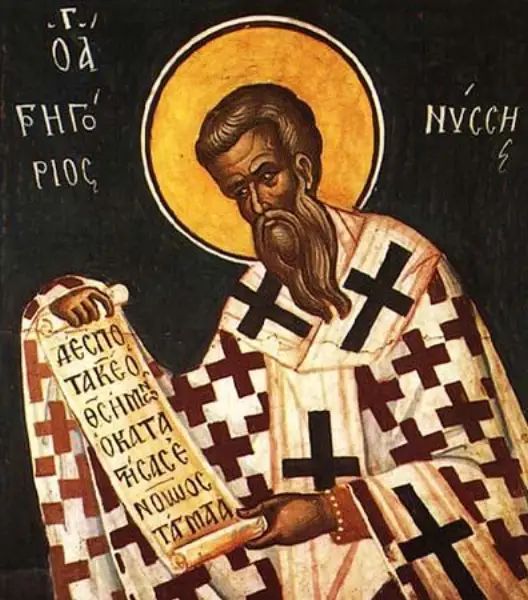
Overview
Gregory of Nyssa — Gregory Nyssen, as he is often called — was a theologian of the early church who held the Cappadocian bishopric of Nyssa during 372-376 and again from 378 until his death, which came around 394. He forms, together with his older brother Basil of Caesarea and their mutual friend Gregory of Nazianzus, the trio honored as the Cappadocian Fathers. Born into an aristocratic Christian family around 335, probably at Neocaesarea in Pontus, he grew up amid the memory of persecution: his grandparents had suffered for the faith, and his mother Emmelia and sister Macrina supervised his early education. He first pursued a secular career as a rhetorician and married a woman named Theosebia before his election in 372 to lead the newly founded church of Nyssa. Turbulence marked that episcopate: tried on contested charges at Ancyra, deposed by a synod in 376, and restored in 378, he went on to play a significant part in the First Council of Constantinople in 381 and in missions to Arabia and Jerusalem. As a theologian he made lasting contributions to the doctrine of the Trinity, was among the first to argue for the infinity of God, and became the first writer in recorded history to condemn all forms of slavery as inherently sinful.
The Complete Life
Born into a Family of Confessors
Gregory's birth came around 335, most likely at or close to Neocaesarea in Pontus, within a Christian family of the Cappadocian Greek aristocracy. According to Gregory of Nazianzus, his mother was Emmelia of Caesarea, while his father, a rhetorician, has been identified as either Basil the Elder or a man named Gregory. The couple's children included several future saints: Macrina the Younger, Naucratius, Peter of Sebaste, and Basil of Caesarea, the future bishop and monastic legislator; the precise number of siblings was disputed in antiquity because one son died in infancy. Martyrdom shadowed the household. Gregory's paternal grandmother, Macrina the Elder, is herself revered as a saint, and his maternal grandfather died a martyr, as Gregory wrote, killed by imperial wrath under the persecution of Maximinus II. His parents had their goods confiscated for confessing Christ, though between the 320s and early 340s the family rebuilt its fortunes, the father practicing as an advocate and rhetorician at Neocaesarea. Gregory, remembered as quiet and meek in contrast to his forceful brother Basil, was first taught at home by his mother and sister Macrina, and later pursued studies at Caesarea in classical literature, philosophy, and perhaps medicine, claiming that his only true teachers were Basil, the Apostles, and the prophets.
§ Early life and education
From Rhetorician to Bishop of a New See
While his brothers Basil and Naucratius withdrew to the hermit's life from around 355, Gregory at first took a different road, pursuing a secular career as a rhetorician, though he served the church as a lector. In this period he married a woman named Theosebia, whom some writers identify with the saintly Theosebia the Deaconess and others with one of his own sisters. His ecclesiastical destiny arrived with an imperial reorganization: in 371 Emperor Valens divided Cappadocia into two new provinces, and the resulting reshuffling of church boundaries created several new bishoprics. Gregory's election to the newly founded bishopric of Nyssa followed in 372, evidently at the instance of Basil, who as metropolitan of Caesarea required dependable suffragans. The appointment did not make him Basil's echo. His early policies frequently diverged from his brother's: where Basil branded the Sabellianist party around Marcellus of Ancyra heretical, Gregory seems to have worked for their reconciliation with the church. Opposition soon gathered against him within Nyssa itself, and in 373 Amphilochius of Iconium found it necessary to come to the town and quiet the discontent, an early sign of the storms that would soon drive him from his see.
§ Episcopate
Deposition, Restoration, and the Council of 381
The attacks on Gregory culminated in deposition. A synod met at Ancyra in 375, convened by Desmothenes of Pontus, to put Gregory on trial for embezzling church funds and for ordaining bishops irregularly; imperial troops arrested him in the winter of that year, though he contrived to escape to an unknown place. In the spring of 376 a synod convened at Nyssa formally deposed him. Fortune turned with the empire: in 378, perhaps through an amnesty granted by the new emperor Gratian, Gregory regained his see, and in the same year Basil died, leaving him to shoulder many of his brother's responsibilities throughout Pontus. There followed a decade of councils and missions. At the Synod of Antioch in April 379 he failed to reconcile the followers of Meletius with those of Paulinus, and on his way home he stopped at Annisa to see his sister Macrina on her deathbed. In 380 he went to Sebaste in Armenia to support a pro-Nicene candidate and found himself elected to the see instead, an honor he escaped only after several months in a country whose un-Hellenized ways he disliked. In 381 he attended the First Council of Constantinople, perhaps delivering his famous sermon In suam ordinationem and eulogizing the dying Meletius, before being dispatched on unsuccessful missions to Arabia and Jerusalem, where his own orthodoxy came under suspicion.
§ Episcopate
The Infinite God and the Soul's Endless Ascent
Gregory's theology centers on a God who cannot be bounded by any creaturely concept. With Basil he taught a Trinity of one essence in three persons, the identical formula that the Council of Constantinople would adopt in 381, and in Against Eunomius he defended the consubstantiality of the Trinity against Eunomius's Aristotelian separation of the Father's unengendered substance from the Son's. He stood among the earliest theologians to claim that God is infinite: because divine goodness knows no limit and belongs to God's essence, God too must be without limit, and therefore essentially incomprehensible to created minds. In the Life of Moses he warns that every concept formed from a comprehensible image becomes an idol of God, and he describes three stages of spiritual growth, from the initial darkness of ignorance through illumination to the mystic darkness of contemplating the incomprehensible. Because the finite can never exhaust the infinite, the soul is marked by epektasis, a perpetual progression toward a God who is always beyond what has been grasped. His thought ran close to the Neoplatonism of Plotinus, though he never names a Neoplatonist philosopher, and Orthodox writers dispute the depth of the debt. He also taught, following Origen, that God will ultimately be all in all, with even the furthest sinners purified, though his Great Catechism ties salvation to baptism and purifying fire in ways scholars still debate. Above all he taught that every human being bears the image of God, a conviction that made him the first writer in history to condemn slavery itself as inherently sinful.
§ Theology
The Last Years at Nyssa
After the great council of 381 Gregory returned to the routine, and the strife, of his small Cappadocian see. His later episcopate at Nyssa was marred by conflict with his metropolitan, Helladius, a reminder that even the most revered theologians of the age fought bitter jurisdictional battles. He remained in demand, however, whenever the churches needed a voice: in 394 he was present at a synod convened at Constantinople to consider the continued dispute over the see of Bostra, where two rival claimants, Agapius and Badagius, had divided the city ever since his own unsuccessful mission there after the council of 381. No record fixes the year of his death, though scholarly consensus places it in 394, when he was about fifty-nine, having outlived both Basil of Caesarea and Gregory of Nazianzus's period of prominence. He left behind the great body of writing on which his fame rests: the treatises against Eunomius, the Life of Moses with its allegory of the soul's ascent, the Great Catechism, the homilies on Ecclesiastes and the Song of Songs, the dialogue on the soul and resurrection, the life of his sister Macrina, and the treatise on virginity that stands among the earliest Christian works of its kind.
§ Episcopate
Father of Fathers on the Calendars of East and West
Gregory is revered as a saint across the divided churches of Christianity: the Eastern Orthodox Church, the Catholic Church, the Oriental Orthodox Churches, Anglicanism, and Lutheranism all keep his memory. Unlike his fellow Cappadocians, however, he was never named a Doctor of the Church, and his cult has always been strongest in the East. In 787 the Second Council of Nicaea, seventh and final among the early ecumenical councils, paid him solemn honor, placing Gregory with the venerable doctors of the church and her indomitable champions, and recording for him the title father of fathers. His feast has moved between dates: the Eastern churches commemorate him on 10 January, while the Latin Church, following the pre-conciliar Roman Martyrology and the Episcopal Church's calendar, remembered him on 9 March, the date of his death; post-2000 editions of the Martyrology list him under 10 January, as do the Eastern Catholic Churches and the Lutheran Church–Missouri Synod, and the Church of England keeps a lesser festival with his sister Macrina on 19 July. His relics remained in the keeping of the Vatican until the year 2000, when a portion was transferred to the Greek Orthodox church of St. Gregory of Nyssa in San Diego, California, a small modern echo of the veneration of fifteen centuries.
§ Feast day
From Obscurity in the West to Modern Acclaim
For centuries the West barely read Gregory. The theologian Natalie Carnes observes that one reason he never entered the Western theological mainstream was the scarcity of Latin translations, and she credits John Scotus Eriugena, who translated On the Making of the Human in the ninth century, with whatever influence Gregory did exert. As late as 1942 Hans Urs von Balthasar could describe his work as virtually unknown, and he was long treated as a minor figure beside Basil and Gregory of Nazianzus. Yet his ideas traveled by hidden channels: Dionysius Exiguus's sixth-century Latin version of De opificio hominis circulated widely in the Middle Ages, and Renaissance translators brought the Life of Moses, the Life of Macrina, On the Soul and the Resurrection, and the Lord's Prayer homilies into Latin between 1446 and about 1473, feeding the anthropology of Nicholas of Cusa and Pico della Mirandola. Henry Fairfield Osborn even credited him with a partly naturalistic account of creation, in which the universe's completed forms emerged by degrees out of chaotic matter. Since the mid-twentieth century, thanks to Balthasar and Jean Daniélou, a critical edition of his works, and the International Colloquium on Gregory of Nyssa, he has become a central figure of patristic scholarship, praised by Anthony Meredith as the first Christian writer to make darkness an apt symbol for speaking of God, and by J. Kameron Carter as a fourth-century abolitionist intellectual whose equal would not be seen for fifteen centuries.
§ Legacy
Timeline
- 335
Born around this year, probably in or near Neocaesarea in Pontus, into an aristocratic Christian family of Cappadocian Greeks.
§ Early life and education
- 355
From about this year he pursued a secular career as a rhetorician, served as a lector, and married a woman named Theosebia.
§ Early life and education
- 372
Chosen as first bishop of the new see of Nyssa, evidently at the instance of Basil, now metropolitan of Caesarea.
§ Episcopate
- 373
Amphilochius, bishop of Iconium, had to come to Nyssa to calm unrest directed at Gregory's episcopate.
§ Episcopate
- 375
Tried by a synod at Ancyra convened by Desmothenes of Pontus on charges of embezzling church funds and irregularly ordaining bishops; arrested by imperial troops in the winter, he escaped.
§ Episcopate
- 376
Deposed from his see by a synod convened at Nyssa in the spring.
§ Episcopate
- 378
Regained his see, perhaps through an amnesty of the new emperor Gratian; his brother Basil died the same year, leaving Gregory many of his responsibilities in Pontus.
§ Episcopate
- Apr 379
Attended the Synod of Antioch, failed to reconcile the partisans of Meletius and Paulinus, visited his dying sister Macrina at Annisa, and returned to Nyssa in August.
§ Episcopate
- 380
Traveled to Sebaste in Armenia Prima to back a pro-Nicene candidate for its bishopric, was unexpectedly elected there himself, and after several months returned home to write Against Eunomius.
§ Episcopate
- 381
Took part in the First Council of Constantinople, preached at the funeral of Meletius, and was sent on missions to Arabia and Jerusalem, where his attempted mediations failed.
§ Episcopate
- 394
Present at a synod in Constantinople on the contested see of Bostra; he is generally accepted to have died in this year.
§ Episcopate
- 787
The Second Council of Nicaea honored Gregory, ranking him with the venerable doctors of the church and her indomitable champions, and recorded for him the title father of fathers.
§ Commentary on Gregory
- 1446
George of Trebizond produced a Latin translation of Gregory's Life of Moses during the Renaissance recovery of Greek patristic texts.
§ Legacy
- 2000
A portion of the relics that had rested in Rome passed in this year to a Greek Orthodox parish in San Diego that bears his name.
§ Legacy
In Their Own Words
If [man] is in the likeness of God, ... who is his buyer, tell me? Who is his seller? To God alone belongs this power; or rather, not even to God himself.
Let us then, consider who were the venerable doctors and indomitable champions of the Church [including] Gregory Primate of Nyssa, who all have called the father of fathers.
Evil will come to nought and will be completely destroyed. The divine, pure goodness will contain in itself every nature endowed with reason; nothing made by God is excluded from his kingdom once everything mixed with some elements of base material has been consumed by refinement in fire.
Every concept that comes from some comprehensible image, by an approximate understanding and by guessing at the Divine nature, constitutes an idol of God and does not proclaim God.
God's name is not known; it is wondered at.
If we truly think of Christ as our source of holiness, we shall refrain from anything wicked or impure in thought or act and thus show ourselves to be worthy bearers of his name. For the quality of holiness is shown not by what we say but by what we do in life.
People who look down from some high peak on a vast sea below, probably feel what my mind has felt, looking out from the sublime words of the Lord as from a mountain-top at the inexhaustible depth of their meaning.
The Record
- Major works
- Against Eunomius·Life of Moses (De vita Moysis)·Great Catechism·On the Making of the Human (De opificio hominis)·Homilies on Ecclesiastes·Homilies on the Song of Songs·On the Soul and the Resurrection (De anima et resurrectione)·Life of Macrina (De vita Macrinae)·On Virginity (De virginitate)·In suam ordinationem
- Symbols
- Bishop's vestments and omophorion
- Canonization
- Pre-congregation; venerated as a saint in the Eastern Orthodox, Catholic, Oriental Orthodox, Anglican, and Lutheran churches.
Prayer
Bibliography
Show 6 sources
- Jaeger, Werner, ed. (2002). Contra Eunomium libri I et II. Gregorii Nysseni Opera Vol. 1. Brill. ISBN 978-90-04-03007-7.
- Callahan, John F., ed. (2009). Opera exegetica In Exodum et Novum Testamentum, pars 1. Gregorii Nysseni Opera Vol. 7/1. Brill. ISBN 978-90-04-00747-5.
- Langerbeck, H., ed. (1986). In Canticum Canticorum. Gregorii Nysseni Opera Vol. 6. Brill. ISBN 978-90-04-08187-1.
- Meredith, Anthony (1999). Gregory of Nyssa (The Early Church Fathers). Routledge.
- Balthasar, Hans Urs von (1988). Presence and Thought: An Essay on the Religious Philosophy of Gregory of Nyssa.
- Hall, Stuart George; Moriarty, Rachel, trs. (1993). Homilies on Ecclesiastes. De Gruyter (New York).
Profile text adapted from the Wikipedia article, licensed CC BY-SA 4.0.
Pray with this saint every day
Save St. Gregory of Nyssa to your favorites, read the full profile, and get feast-day reminders in the Saints app.
Get the Saints AppFree on the App Store for iPhone and iPad