
died 24 December 304·Feast December 24
St. Gregory of Spoleto
Priest and Martyr of the Diocletianic Persecution
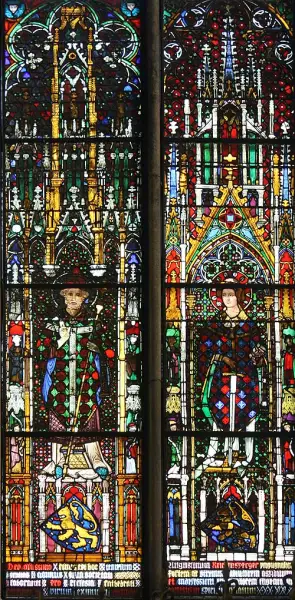
Overview
Gregory of Spoleto was a priest and martyr of the Umbrian city of Spoleto who died during the persecutions ordered at the close of the third century's great crisis. When Flaccus, a general of the imperial forces, arrived at Spoleto carrying an order from Emperor Maximian to punish all the Christians, an informer laid information before him accusing Gregory of drawing many away from the worship of the gods and the emperors. Soldiers came for him at once, and the accused priest was brought in fetters before the tribunal. Torture was drawn out at length before the sword finally fell on 24 December 304. Tradition, pious rather than documentary, tells that his remains were destined for the beasts kept for the public games, until a Christian woman whose name has not survived paid a heavy price to recover them and saw to their honorable burial. His cult spread north with his relics: at the request of the emperor Otto I his body was taken to Cologne together with those of Saints Felix and Nabor, and in 993 Bishop Egbert transferred some of his relics to the cathedral of Trier. The Roman Martyrology keeps his feast on 24 December, with local commemorations on other days in Cologne, Spoleto, and Trier.
The Complete Life
Accused, Tortured, and Beheaded at Spoleto
The account of Gregory's passion belongs to the storm of imperial persecution that struck the Italian churches at the beginning of the fourth century. Gregory served as a priest at Spoleto, and his ministry there drew the attention of the authorities when Flaccus, a general of the forces, reached the city bearing an order from Emperor Maximian directing punishment of all the Christians. A denunciation reached the general, alleging that Gregory's preaching had won many away from the cult of the gods and the honor paid to the emperors, the usual accusation against those who undermined the civic religion. The response was immediate: soldiers were dispatched to arrest him and bring him bound before the tribunal. What followed was not a swift execution but a lengthy period of torture, endured to the end without surrender. Finally, on 24 December 304, he was beheaded. Tradition adds a final indignity matched by a final mercy: the body was to be thrown to the beasts kept for the games, yet a Christian woman whose name is unrecorded ransomed it at a heavy cost and arranged its burial with due care, leaving the Spoleto church in possession of her martyr's relics.
§ Gregory of Spoleto
Relics on the Rhine and Feasts in Three Cities
Gregory's cult did not remain confined to Umbria. Centuries after his martyrdom, at the request of the Holy Roman Emperor Otto I, his body was sent north to Cologne in Germany together with the relics of Saints Felix and Nabor, joining the great collection of relics for which the Rhineland metropolis was famed. In 993 a further translation took place when Egbert, bishop of Trier, transferred some of Gregory's relics to the cathedral in that city, giving the oldest German see a share in the martyr's remains. The memory of the saint is accordingly kept on differing days in the places that honor him: the Roman Martyrology lists his feast on 24 December, the very day of his beheading, while Cologne keeps it on 23 December, Spoleto on 22 December, and Trier on 2 January. The modern critical apparatus of hagiography notes that the account of his life rests on the old martyrologies and on Alban Butler's account, and that some details, such as the ransoming of his body by a pious woman, are handed down by pious tradition rather than contemporary record; the substance of his martyrdom at Spoleto, however, has been commemorated without interruption.
§ Gregory of Spoleto
Timeline
- 24 Dec 304
Beheaded at Spoleto on the eve of Christmas, after a long course of torture, under Maximian's order to punish all Christians.
§ Gregory of Spoleto
- 993
Egbert, bishop of Trier, brought a portion of the martyr's relics to his cathedral, adding the oldest German see to his cult.
§ Gregory of Spoleto
The Record
- Symbols
- Sword or axe (instrument of beheading)·Palm of martyrdom
- Canonization
- Pre-congregation; martyred during the persecution under Emperor Maximian and listed in the Roman Martyrology.
Prayer
Bibliography
Show 2 sources
- Butler, Alban. "St. Gregory of Spoleto, Priest and Martyr", The Lives of the Saints vol. XII. 1866.
- Holweck, F. G., A Biographical Dictionary of the Saints. 1924.
Profile text adapted from the Wikipedia article, licensed CC BY-SA 4.0.
Pray with this saint every day
Save St. Gregory of Spoleto to your favorites, read the full profile, and get feast-day reminders in the Saints app.
Get the Saints AppFree on the App Store for iPhone and iPad