
c. 538 – 594·Feast November 17
St. Gregory of Tours
Bishop and Father of French History
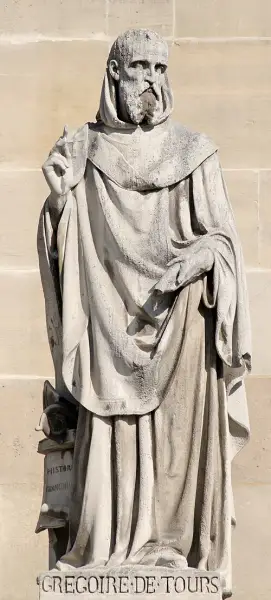
Overview
Gregory of Tours, whose baptismal name was Georgius Florentius, was a Gallo-Roman historian who governed the see of Tours throughout the Merovingian age and is honored as the father of French history. Born on 30 November around 538 at Clermont in the Auvergne, he belonged to the highest stratum of Gallo-Roman society, related to senators and saints and claiming kinship with thirteen of the eighteen bishops of Tours who preceded him. Orphaned young, he was educated by his uncle St. Gallus, bishop of Clermont, and received the clerical tonsure from him; a serious illness cured at the tomb of St. Martin turned him toward the clerical life, and he was ordained deacon by Avitus. Chosen bishop of Tours by clergy and people, he was consecrated on 22 August 573 by Giles of Rheims at the age of thirty-four. From Tours, the pilgrimage center of the cult of St. Martin and the crossroads of Frankish and Gallo-Roman culture, he watched and recorded the violent world of the Merovingian kings Sigebert I, Chilperic I, Guntram, and Childebert II. His Ten Books of Histories, known as the History of the Franks, remains the primary source for the age, and his hagiographies preserve the religious world of sixth-century Gaul. He died at Tours on 17 November 593 or 594.
The Complete Life
A Son of the Gallo-Roman Senatorial Class
Gregory first saw the light at Clermont, in central Gaul's Auvergne region, as a member of the topmost rank of Gallo-Roman society, at a moment when the old Roman aristocracy was adapting itself to Frankish rule. His father was Florentius, Senator of Clermont, and his mother Armentaria II was a niece of Bishop Nicetius of Lyon and a granddaughter both of the senator Florentinus of Geneva and of St. Gregory of Langres. The family's hold on the Gallic episcopate was astonishing: at the hour of his birth, kin of his governed the sees of Tours, Lyon, and Langres, and Gregory asserted that he counted thirteen of the eighteen preceding bishops of Tours among his relatives. Piety ran in the bloodline as well as power, for his paternal grandmother Leocadia III descended from Vettius Epagathus, the celebrated martyr of Lyon. Gregory's father died while the boy was still young, and his widowed mother removed to Burgundy, where she owned property, leaving the child to the care of the church. He was entrusted to his father's brother, St. Gallus, who shepherded Clermont, and in that household, and later under Gallus's successor St. Avitus, that the future historian of the Franks received the whole of his education.
§ Biography
Healed at the Tomb of St. Martin
Gregory received the clerical tonsure from his uncle Gallus, but the decisive turn of his life came through suffering. When a grave sickness struck him down, he made a pilgrimage of devotion to St. Martin's tomb at Tours, Gaul's most famous shrine. Upon his recovery he resolved on the clerical career he would follow for the rest of his life, and Avitus ordained him deacon. When St. Euphronius, bishop of Tours, died, the clergy and people of the city, charmed by Gregory's piety, learning, and humility, chose him as their bishop. The reluctant elect had to be pursued: Tours' deputies caught up with him at the court of Sigebert of Austrasia, and only when compelled, sorely against his wishes, did he give way. On August 22, 573, Giles of Rheims consecrated him, a man of thirty-four, taking in honor of the wonder-working saint of his shrine the name Gregory by which history knows him. Except for such duties as assisting at the council of Paris in 577, he spent the remainder of his career at Tours, governing a see poised between the collapsing culture of late antiquity and the emerging world of the early Middle Ages.
§ Biography
Bishop at the Crossroads of Two Worlds
Tours placed its new bishop at one of the vital points of Merovingian Gaul. The town lay on the Loire, five Roman roads converged upon it, and whoever held it held the principal highway linking the Frankish north with Aquitania and, further on, Spain; there the influences of the Franks and of the old Gallo-Roman south met and mingled. Above all, Tours was the center of the popular cult of St. Martin, drawing pilgrims, sustaining a hospital, and serving as a political sanctuary to which the great men of the kingdom fled when Merovingian violence overtook them. Gregory was thus well placed to hear and meet the powerful figures of his world, and he struggled through personal dealings with four Frankish kings in succession, Sigebert I, Chilperic I, Guntram, and Childebert II, personally knowing most of the leading Franks of the age. His Ten Books of Histories record that world in unflinching detail: the division of Clovis's realms among his sons, the feud of queens Brunhilda and Fredegund, regencies, treaties such as the Treaty of Andelot of 587, and the violence of court life, which he marked with the admission that many evil things were done in those years. From Books V onward his account becomes contemporary history, reaching the year 591.
§ Biography
Zeal for the Saints Against Heresy
Gregory's writing was inseparable from his faith. He composed in Late Latin that had already drifted from classical usage, yet his purpose was wholly religious: his hagiographies, from the twenty lives of holy men collected in the Life of the Fathers to the martyrs' glories he set down in writing from 587 onward and the books on the virtues of St. Martin, aimed, as he declared, to fire others with the enthusiasm by which the saints deserved to be honored. This zeal had practical stakes for the bishop of Tours, where devotion to Martin was intense and the shrine drew pilgrims from every quarter. It also armed him against the heresies that circulated in sixth-century Gaul. As a specimen of his orthodoxy the History of the Franks preserves a formal declaration of faith in which Gregory professes belief in God the Father omnipotent and in Jesus Christ his only Son, our Lord, a creed set against the teachings he judged false. Even his observations on ordinary life carry a moral coloring: his writings are full of references to wine and vineyards, and he argued that wine drinking, a staple of his world, carried dangers that moderation alone could restrain. Spirituality, for Gregory, meant recording the miraculous works of God amid the crimes of kings.
§ Fighting heresy
The Last Books and a Death at Tours
The final decade of Gregory's life saw the completion of the work for which he is remembered. The last part of his great history, Books VII through X, carries his increasingly personal narrative of the Frankish kingdoms down to the year 591, and the tenth book closes with the naming and description of the eighteen bishops of Tours and a summary of his own writings, an author's colophon written as his strength failed. In these years he witnessed the regency of Fredegund for her son Clothar II, the treachery of the young Childebert toward Guntram who had protected him, the treaty sealed at Andelot in 587, and disturbances at the Martin shrine itself, including the episode of Basina, daughter of Chilperic, who led nuns out of her convent. Gregory died at Tours on 17 November 593 or 594, having governed the see for some twenty years and having preserved for posterity nearly all that is known of the age. He was buried among his people as a confessor, and his feast came to be kept on the day of his death, 17 November, in both the Catholic and Eastern Orthodox churches.
§ History of the Franks
Confessor of the Church
Gregory was never formally canonized by any congregation, for he belonged to the age before such processes existed; the church of both East and West received him as a saint by continuous tradition, ranking him among confessors, those who confessed Christ by a holy life rather than by martyr's blood. The Catholic Church and the Eastern Orthodox Church venerate him, keeping his feast on 17 November, the anniversary of his death at Tours. His cult grew naturally from the see he had governed and from the religious world his own books did so much to map: a bishop who had written the lives of the fathers, catalogued the glories of the martyrs, and recorded the miracles of St. Martin at the very shrine where he had himself been healed as a young man was certain to be remembered among the saints of Gaul. Modern scholarship has cautiously noted that his history was shaped to protect him from the political turbulence of the Merovingian courts, and that his narrative sometimes favors one royal house over another; these are the honest qualifications of historians, not the verdicts of hagiographers, and they have not dimmed his standing as one of the great bishop-saints of the early medieval church.
§ Legacy
Father of French History
The History of the Franks stands as a historical record of the first importance: it is the central source for the Merovingian period and, as one modern historian observed, the only source covering the beginnings of the Franks in the decaying Roman world of its age. Gregory has often been compared to Herodotus for his curiosity about every kind of event, and his detailed interest in earthquakes, weather, and natural phenomena makes him a witness for disciplines far beyond history, including the study of Gallican liturgy and chant, for which his writings provide valuable evidence. His Latin was poor by the standards of earlier centuries, a fact he acknowledged himself, yet that very roughness preserves the living speech of sixth-century Gaul and the memory of a world in transition from antiquity to the Middle Ages. His hagiographies likewise yield anecdotes and stories essential to the modern understanding of religious life in his time. Readers have sometimes retained chiefly his anecdotes of violence, but careful interpreters have shown that he structured his narrative deliberately to shield himself from the politics he recorded. From the MGH critical edition of his histories to modern translations into English, German, Spanish, and French, his work remains foundational, and his title as the father of French history has never been disputed.
§ Legacy
Timeline
- 30 Nov 538
Born Georgius Florentius on 30 November at Clermont in the Auvergne, son of the senator Florentius and Armentaria II.
§ Biography
- 22 Aug 573
Consecrated to the Tours episcopate at Rheims by its bishop Giles on August 22, being then thirty-four, after the city's clergy and people had elected him.
§ Biography
- 577
Assisted at the council of Paris while carrying out his episcopal career at Tours.
§ Biography
- 587
Opened his Liber in gloria martyrum, honoring the glories of the martyrs, a leading work among his hagiographies.
§ Hagiographies
- 591
Brought his personal narrative of the Frankish kingdoms down to this year in the final books of the Ten Books of Histories.
§ Analysis
- 17 Nov 594
Died at Tours on 17 November, in 593 or 594 according to differing sources, having completed an epilogue to his histories in his final year.
§ Biography
In Their Own Words
Many evil things were done at this time
As I am about to describe the struggles of kings with the heathen enemy, of martyrs with pagans, of churches with heretics, I desire first of all to declare my faith so that my reader may have no doubt that I am Catholic.
The Record
- Major works
- Decem Libri Historiarum (Ten Books of Histories), also known as the Historia Francorum·Life of the Fathers, twenty hagiographies·Liber in gloria martyrum (Book of the Glories of the Martyrs), begun 587·Glory of the Confessors·De virtutibus sancti Martini episcopi (On the Virtues of St. Martin)·Liber de passione et virtutibus sancti Iuliani martyris
- Symbols
- Bishop's crozier·Book of histories
- Canonization
- Pre-congregation; venerated as a confessor in the Catholic and Eastern Orthodox Churches.
Prayer
Bibliography
Show 7 sources
- Krusch, Bruno and Levison, Wilhelm, eds. Gregorii episcopi Turonensis. Libri Historiarum X. MGH SS rer. Merov. 1,1. Hannover.
- Gregory of Tours (1974). Radice, Betty (ed.). The History of the Franks. Penguin Classics. Translated by Lewis Thorpe. London: Penguin Books. ISBN 978-0-14-044295-3.
- The History of the Franks (transl. M. Dalton), Oxford University Press, 1927.
- Van Dam, Raymond (ed. and transl.). Glory of the Martyrs, 2nd edition. Translated Texts for Historians 3. Liverpool.
- James, Edward (ed. and transl.). Life of the Fathers, 2nd edition. Translated Texts for Historians series.
- Burrow, John (2007). A History of Histories: Epics, Chronicles, and Inquiries from Herodotus and Thucydides to the Twentieth Century.
- Wallace-Hadrill, J. M. (1989) [1952, 1957, 1967]. The Barbarian West: 400-1000 (3rd revd. ed.). Cambridge University Press.
Profile text adapted from the Wikipedia article, licensed CC BY-SA 4.0.
Pray with this saint every day
Save St. Gregory of Tours to your favorites, read the full profile, and get feast-day reminders in the Saints app.
Get the Saints AppFree on the App Store for iPhone and iPad