
c. 700 – 776·Feast August 25
St. Gregory of Utrecht
Abbot of Utrecht and Missionary Companion of Boniface
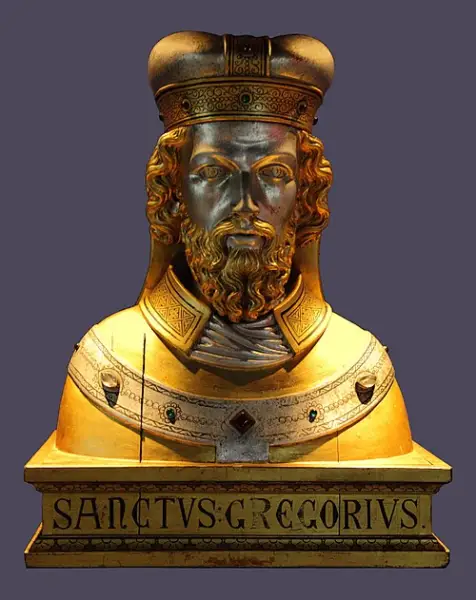
Overview
Gregory of Utrecht was a Frankish churchman of the eighth century who devoted his adult life to the missionary church founded among the Frisians. Born to a noble family of Trier around the year 700, he was educated at the convent of Pfalzel, where his grandmother Addula served as abbess. As a boy of about fifteen he met the missionary Boniface and resolved to follow him, studying first at the monastery of Ohrdruf and then accompanying Boniface on his journeys, including a visit to Rome in 738. Around 750 Boniface installed him as abbot of St. Martin's monastery at Utrecht, and after Boniface's martyrdom in 754 Gregory was charged by Pope Stephen II and Pippin the Younger with administering the diocese of Utrecht, though he never accepted episcopal consecration. For over twenty years the school of his abbey trained missionaries from across the Germanic world, and among his pupils was Ludger, later first bishop of Münster. Gregory died at Maastricht on 25 August 776.
The Complete Life
A Noble Boy of Trier
Gregory was born around the year 700 into the aristocracy of Trier, one of the old imperial cities of the Rhineland. Alberic, his father, was himself the child of Addula, a widowed woman who served as abbess of the convent of Pfalzel near Trier, and it was in her household that the boy received his first schooling. Later writers, misled by a similarity of names and by a forged will, identified Addula with St. Adela of Pfalzel, a daughter of King Dagobert II, and so credited Gregory with Merovingian royal blood — an identification now recognized as unfounded. The decisive moment of his childhood came in 722, when Boniface, travelling from Frisia toward Hesse and Thuringia, lodged at Pfalzel. The abbess called on her fifteen-year-old grandson to read the Scriptures at table, and Boniface's exposition of them and praise of the apostolic life fired the boy with the desire to go with him. When his grandmother saw that he would not be turned from this purpose, she equipped him with servants and horses and let him go.
§ Life
Disciple of Boniface
Gregory became one of Boniface's own disciples, a member of the small company of clergy and monks on whom the great missionary depended for the planting of the church east of the Rhine. To complete his formation, Boniface sent him to the monastery of St. Michael at Ohrdruf for further study. Gregory then returned to the missionary circuit and accompanied his master on his journeys, gathering experience of the work among the Frisians, Hessians, and Thuringians that no school could teach. The year 738 brought Boniface's third Roman pilgrimage, and Gregory traveled in his company, seizing the chance to collect many valuable additions to his library, an early sign of the scholarly temperament that would later shape Utrecht. The bond between master and disciple endured to the end: in 754 Gregory was ready to share Boniface's final expedition, but the aging missionary chose Eoban for that last journey into Frisia, where both Boniface and Eoban were killed. Gregory was thus left behind, in God's providence, to carry the work forward alone.
§ Abbot
The Missionary Seminary at Utrecht
Willibrord, the first bishop of Utrecht, had died in 744 without a named successor, and Boniface had taken charge of the see, appointing Eoban as administrator. Around 750 Gregory was made abbot of St. Martin's at Utrecht, and when Boniface fell in 754, charge of the diocese was laid upon Gregory by Pope Stephen II and by Pippin the Younger, a responsibility he shouldered for the following twenty-two years. For this reason he is sometimes styled bishop of Utrecht, though he never received episcopal consecration — indeed, in 767 he sent Alubert, an Englishman who had come to help his mission, to York to be consecrated rather than accept orders himself. Under him the Martinsstift became a kind of missionary seminary and a centre of learning for many nations: Franks, Frisians, Saxons, Bavarians, and Swabians studied there, and even England, rich in schools of its own, sent scholars. He also welcomed Lebuinus of Ripon and entrusted to him the mission of Overijssel on the Westphalian border, giving him Marchelm, a disciple of Willibrord, as his companion.
§ Abbot
Virtues Recorded by His Pupil
The fullest picture of Gregory's character comes from his pupil Ludger, later the first bishop of Münster, who wrote a life of his master and described his virtues: contempt of riches, sobriety, a forgiving spirit, and deeds of alms. One striking illustration of that forgiveness survives. Gregory's two half-brothers had been murdered, and by the custom of the age the punishment of the assassins lay with the kindred of the dead. When the civil magistrates accordingly sent the murderers to Gregory, to suffer whatever death he should think fit, he clothed every one of them with a suit of garments, granted each an alms besides, and sent them away with sound counsel. It was the mercy of the Gospel enacted where the law of the day expected blood. The same spirit marked his refusal of high office: a man who declined consecration as bishop while administering a whole diocese understood authority as service rather than rank. At the approach of death, paralyzed and failing, he asked to be carried into the church, and there he died.
§ Abbot
Last Illness and Death
About three years before the end, paralysis struck Gregory's left side and slowly spread through his whole body. He bore the long weakening with the patience his pupil Ludger praised, and he continued to direct the diocese and the missionary school that depended on him. When he felt death approaching he had himself carried into the church, and there, on 25 August 776, at Maastricht, he ended his life where he had spent it. His nephew Alberic, prior of St. Martin's, succeeded him in the government of the Utrecht church, continuing the line of leadership that ran from Willibrord through Boniface's administrators to the settled episcopate that followed. Gregory had held no official title during those final decades — no consecration, no mitre — only an order from pope and mayor of the palace to look after a shepherdless flock, and he had obeyed it faithfully until his body could no longer carry him to the altar.
§ Abbot
Veneration
Gregory was numbered among the saints by the tradition of the church itself, long before any formal process existed: he is a pre-congregation saint, venerated in both the Roman Catholic and Orthodox Churches, with his feast kept on 25 August. His relics remained at Utrecht and were examined at episcopal visitations in 1421 and 1597, in the way of medieval and early modern verification of sacred remains. A large portion of his head found its way to the church of St. Amalberga at Susteren, where the relics kept there were formally inspected on 25 September 1885, with the bishop of Roermond presiding over the rite; that church is named as his major shrine. His memory was preserved not only in liturgy but in letters: a letter written to Gregory by St. Lullus, bishop of Mainz, is still extant, one of the few surviving texts addressed to him. The oldest account of his life, however, remains the one composed by his own pupil.
§ Veneration
Legacy
Gregory's legacy is the mission he kept alive. When Boniface died in 754 the future of the Frisian mission was genuinely uncertain, and it was Gregory's quiet administration at Utrecht that held the church together across the generation before a new bishop could be secured. The school of the Martinsstift sent forth missionaries from every Germanic people touched by the eighth-century mission, and its most famous pupil, Ludger, became the first bishop of Münster and the author of the Life of Gregory — a work that is both the chief source for Gregory's life and a monument to the formation he received at Utrecht. Gregory also stands as a type of the unlaureled administrator: a man who did a bishop's work for over twenty years and deliberately declined the bishop's office, content to serve under obedience. That his relics were examined and honored from the fifteenth century onward, and are still venerated at Susteren, shows that the church never forgot the debt.
§ Abbot
Timeline
- 700
Born at Trier into a noble Frankish family
§ Life
- 722
Meets Boniface at the convent of Pfalzel and resolves to join his missionary band
§ Life
- 738
Accompanies Boniface on his third journey to Rome, acquiring books for his library
§ Abbot
- 750
Appointed abbot of St. Martin's monastery at Utrecht
§ Abbot
- 754
Ordered by Pope Stephen II and Pippin the Younger to administer the diocese of Utrecht after Boniface's death
§ Abbot
- 767
Sends Alubert of England to York for episcopal consecration rather than accepting orders himself
§ Abbot
- 25 Aug 776
Dies at Maastricht, carried into church as death approached
§ Abbot
- 1421
His relics at Utrecht are examined during an episcopal visitation
§ Veneration
- 1597
The relics are examined a second time at an episcopal visitation
§ Veneration
- 25 Sep 1885
A portion of his head is officially recognized at Susteren under the Bishop of Roermond
§ Veneration
The Record
- Canonization
- Pre-congregation; venerated in the Roman Catholic and Orthodox Churches from early times
Prayer
Bibliography
Show 7 sources
- Butler, Alban. "Saint Gregory, Abbot and Confessor". Lives of the Fathers, Martyrs, and Principal Saints 1866. CatholicSaints.Info. 9 August 2014.
- Monks of Ramsgate. "Gregory of Utrecht". Book of Saints 1921. CatholicSaints.Info. 26 July 2013.
- Mershman, Francis. "St. Gregory of Utrecht." The Catholic Encyclopedia Vol. 7. New York: Robert Appleton Company, 1910.
- Garver, Valerie L. Women and Aristocratic Culture in the Carolingian World. Cornell University Press, 2012. p. 127. ISBN 9780801460173.
- Walsh, Michael J. A New Dictionary of Saints: East and West. Liturgical Press, 2007. p. 247. ISBN 9780814631867.
- Kennedy, Thomas. "St. Lebwin." The Catholic Encyclopedia Vol. 9. New York: Robert Appleton Company, 1910.
- Mershman, Francis. "St. Ludger." The Catholic Encyclopedia Vol. 9. New York: Robert Appleton Company, 1910.
Profile text adapted from the Wikipedia article, licensed CC BY-SA 4.0.
Pray with this saint every day
Save St. Gregory of Utrecht to your favorites, read the full profile, and get feast-day reminders in the Saints app.
Get the Saints AppFree on the App Store for iPhone and iPad