
1864 – 1922·Feast Sunday before the Exaltation of the Holy Cross (September 7–13)
St. Gregory Orologas
Metropolitan of Kydonies and Ethno-Hieromartyr
Overview
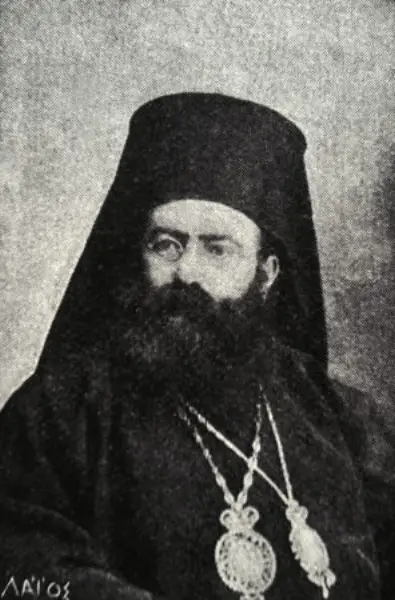
Gregory Orologas was a Greek Orthodox metropolitan bishop of the early twentieth century who shepherded flocks in Ottoman Macedonia and on the Anatolian coast before dying at the hands of the Turkish Army at the close of the Greco-Turkish War. Born Anastasios Orologas or Saatsoglou at Manisa in 1864, he studied at the Theological School of Halki, took the name Gregorios at his ordination, and served as a deacon, preacher, archimandrite, and protosyngellos in several dioceses, gaining a reputation as one of the first clergy to preach in Demotic Greek. Appointed Metropolitan of Strumica in 1902, he endured assassination attempts by the Bulgarian Revolutionary Committee before Ottoman pressure forced his transfer to the newly established see of Kydonies, modern Ayvalik, in 1908. There he expanded schools and charitable institutions, interceded for imprisoned Greeks under martial law, and stood trial twice for treason during the First World War, spending 1917 in prison. When the Turkish Army retook the region in 1922, he urged the evacuation of the civilian population, negotiated with the American Red Cross to ship some 20,000 women and children to safety in Lesbos, and refused to abandon his priests. Arrested on September 30, 1922, he died on October 3 during his removal to execution. The Church of Greece canonized him in 1992 as an Ethno-Hieromartyr.
The Complete Life
From Manisa to Halki
The future bishop was born at Manisa in Anatolia in 1864 under the secular name Anastasios Orologas or Saatsoglou. In 1882, aided by Agathangelos, Metropolitan of Ephesus, he gained admission to the Theological School of Halki, the principal seminary of the Ecumenical Patriarchate, and at his entrance translated his family name from Saatsoglou to Orologas. He proved an outstanding student and concluded his studies in 1889 with a dissertation arguing that the Holy Evangelists never disagreed over the date of the Lord's last Passover. Following the custom of the school, he received ordination in his final year, becoming a deacon and adopting the monastic name Gregorios. His early ministry took him through Thessaloniki, Serres, and Drama, where he worked successively as deacon and instructor of religion, then as archimandrite, protosyngellos, and preacher. He earned particular note as one of the first Orthodox preachers to proclaim his sermons in Demotic Greek, the living language of the people, rather than in the learned register most clergy preferred. These years formed a pastor equally at home in the pulpit, the classroom, and the chancellery, a combination that would define his episcopate in Macedonia and Anatolia.
§ Early life
Metropolitan in Troubled Macedonia
On October 12, 1902, Gregory was elevated to the important Metropolis of Strumica in Macedonia, a posting that placed him at the center of the national and ecclesiastical struggle between Greeks and Bulgarians in Ottoman territory. There he contended not only with Ottoman officialdom but above all with the Bulgarian Revolutionary Committee, whose adherents made repeated attempts on his life in 1905. He held the see for six years, until July 22, 1908, when the Ecumenical Patriarchate, compelled by pressure from the Ottoman government, transferred him to the newly erected Diocese of Cydoniae on the western Anatolian coast, the area having previously belonged to the Metropolitanate of Ephesus. The move was in substance an exile, since his presence in Strumica had become intolerable to the authorities, but it gave the church of Ayvalik a shepherd of unusual energy. In his first years there he championed the growth of the region's schools and charitable foundations, strengthening the communal institutions through which the Greek Orthodox population sustained itself under Ottoman rule.
§ Metropolitan of Strumica
War, Prison, and Persecution
Gregory's years at Kydonies coincided with the final crisis of Ottoman Christianity. When local authorities imposed martial law on the city from July to August 1909 amid Greek patriotic manifestations, many Orthodox inhabitants were persecuted and jailed; the metropolitan's protests to the Ottoman officials won the release of several prisoners, though others languished in the Halicarnassus prison after martial law ended. During the First World War he was accused of high treason and tried twice before a military tribunal at Smyrna; the charges were never proven, yet he was convicted and imprisoned in 1917, returning to his diocese only after the Ottoman capitulation, on October 16, 1918. In May 1919 the Greek army occupied the region with the approval of the Great Powers, and Cydoniae fell within the Smyrna Occupation Zone; Gregory often clashed with Aristeidis Stergiadis, the Greek High Commissioner, over the conduct of affairs. As the Greco-Turkish War turned against Greece, the civil and military authorities withdrew in August 1922. Foreseeing massacre, the metropolitan convened the council of elders and urged the immediate evacuation of the civilian population, but his counsel was not heeded.
§ Metropolitan of Kydonies
The Good Shepherd of 1922
Violence overtook Ayvalik in August 1922 as irregular Turkish forces entered the city and martial law was declared. The men of the city were seized and marched out under guard toward Freneli, and on that road they were cut down by machine guns. Gregory interceded with the Turkish authorities for the remaining Christians and was humiliated for his trouble. After the slaughter of some six thousand inhabitants of Moschonesia, among them Metropolitan Ambrosios, he secretly approached the American Red Cross, which secured ships from Lesbos; with Turkish consent, Greek vessels sailing under the American flag evacuated the women and children, so that about twenty thousand of the city's thirty-five thousand Orthodox inhabitants were saved. He urged every priest of the city to depart, but refused to leave himself. On September 30, 1922, as the clergy stood assembled on the waterfront ready to embark, Turkish officers arrested them along with the metropolitan, and all were taken to the prison by the city hospital and tortured. On October 3 the clergy were led out of town for execution; according to witnesses, Gregory's heart failed as the soldiers prepared to bury him alive. A decade later his congregation's survivors in Mytilene raised a statue to him inscribed with the words of John 10:11.
§ Initiatives during the Greco-Turkish War
Among the New Martyrs of Asia Minor
In a unanimous decision of November 4, 1992, the Church of Greece enrolled Gregory of Kydonies among its saints under the title Ethnomartyr, joining him to Chrysostomos of Smyrna and three other hierarchs who perished in the catastrophe of 1921 and 1922: Ambrosios of Moschonision, Euthymios of Zela, and Procopius of Iconium. All five keep a common commemoration on the Sunday that precedes the Exaltation of the Holy Cross, a movable observance landing each year somewhere between September 7 and 13. Their enrollment in the choir of the saints was formally announced to the Church in Encyclical 2556, issued by the Holy Synod on July 5, 1993. Gregory is honored under the title Ethno-Hieromartyr, a martyr of the nation and of the priesthood, a designation the Greek Church reserves for clergy who died in the upheavals that ended two and a half millennia of Greek Christian life in Asia Minor. In Mytilene, where many of his fugitive parishioners settled, the statue raised in 1932 still displays the Gospel verse about the shepherd who dies for his flock, John 10:11, together with the date of his martyrdom.
§ Notes
Timeline
- 1864
Born at Manisa (Magnesia) in the Ottoman Empire, given the secular name Anastasios Orologas or Saatsoglou.
§ Early life
- 1882
Admitted to the Theological School of Halki with the support of Agathangelos, Metropolitan of Ephesus, and hellenized his surname to Orologas.
§ Early life
- 1889
Completed his studies with a dissertation on the Holy Evangelists and the Lord's last Passover, having been ordained deacon under the name Gregorios.
§ Early life
- 12 Oct 1902
Appointed Metropolitan Bishop of the Metropolis of Strumica in Macedonia.
§ Metropolitan of Strumica
- 1905
Survived repeated attempts by members of the Bulgarian Revolutionary Committee to assassinate him.
§ Metropolitan of Strumica
- 22 Jul 1908
Transferred by the Ecumenical Patriarchate, under Ottoman government pressure, to the newly established Diocese of Cydoniae at Ayvalik.
§ Metropolitan of Kydonies
- 1909
During martial law in the city, protested to the Ottoman authorities on behalf of persecuted Greek Orthodox prisoners and secured several releases.
§ Metropolitan of Kydonies
- 1917
Convicted of high treason after two trials before a military tribunal at Smyrna and imprisoned, though the accusations were never proven.
§ Metropolitan of Kydonies
- 16 Oct 1918
Released from prison after the capitulation of the Ottoman Empire and returned to his flock at Cydoniae.
§ Metropolitan of Kydonies
- 30 Sep 1922
Arrested by Turkish authorities together with the clergy of the city as they waited on the waterfront to depart, and tortured in prison.
§ Initiatives during the Greco-Turkish War
- 3 Oct 1922
Died outside the town as Turkish troops moved to execute the clergy; witnesses report his heart gave out as they prepared to bury him alive.
§ Initiatives during the Greco-Turkish War
- 1932
A statue of the martyred metropolitan was erected at Mytilene at the initiative of Metropolitan Iakovos of Dyrrachion, where many of his flock had found refuge.
§ Initiatives during the Greco-Turkish War
- 4 Nov 1992
Declared a saint and Ethnomartyr by the Holy Synod of the Church of Greece, for commemoration with Chrysostomos of Smyrna and other Asia Minor hierarchs.
§ Notes
The Record
- Canonization
- Canonized November 4, 1992 by the Holy Synod of the Church of Greece, together with Chrysostomos of Smyrna and other hierarchs of Asia Minor; formally announced in Encyclical 2556 of July 5, 1993.
Prayer
Bibliography
Show 5 sources
- Great Synaxaristes: "Ho Hagios Gregorios ho Ethnoieromartyras". MEGAS SYNAXARISTES. 12 Septembriou.
- Stamatopoulos, Dimitrios. "Gregorios of Cydoniae". Transl. Velentzas, Georgios. Encyclopaedia of the Hellenic World, Asia Minor. 5/22/2002.
- Kiminas, Demetrius (2009). The Ecumenical Patriarchate: A History of Its Metropolitanates with Annotated Hierarch Catalogs. Wildside Press LLC.
- Clark, Bruce (2006). Twice a Stranger: The Mass Expulsion That Forged Modern Greece and Turkey. Cambridge, Massachusetts: Harvard University Press.
- Tsiri, Theodorou (2008). He Prosphora tes Ekklisias kai tou Hierou Klerou ste Mikra Asia 1912-1922. Thessaloniki: University of Thessaloniki, Department of Theology.
Profile text adapted from the Wikipedia article, licensed CC BY-SA 4.0.
Pray with this saint every day
Save St. Gregory Orologas to your favorites, read the full profile, and get feast-day reminders in the Saints app.
Get the Saints AppFree on the App Store for iPhone and iPad