
c. 1296 – 1359·Feast November 14; also the Second Sunday of Great Lent
St. Gregory Palamas
Archbishop of Thessalonica and Pillar of Orthodoxy
Overview
Gregory Palamas was a Byzantine Greek theologian and monk of Mount Athos who became Archbishop of Thessalonica and the great defender of hesychast spirituality, who taught the uncreated character of the Transfiguration's radiance and drew his celebrated line between God's essence and God's operations. Born in Constantinople around 1296 to a courtly family, he forsook the imperial career Emperor Andronikos II had planned for him and withdrew to the Holy Mountain at about twenty years of age. Ordained a priest in 1326 at Thessaloniki, he served briefly as abbot of Esphigmenou and guided hermits at Veria. Between 1336 and 1355 his teaching took shape through three great controversies: against the Calabrian Barlaam, against the monk Gregory Akindynos, and against the philosopher Nikephoros Gregoras. He defended the Jesus Prayer and the experiential knowledge of God in his Triads and the Hagioritic Tome, and was vindicated by a series of Constantinopolitan councils, decisively at the synod of May 1351. Four years of imprisonment, consecration to the throne of Thessalonica, and a year of captivity among Ottoman pirates marked his final decades. He died on 14 November 1359, was glorified in 1368, and is commemorated on the Second Sunday of Great Lent as the triumph of Orthodoxy's continuation. His theology, known as Palamism, shaped Eastern Orthodox thought permanently.
The Complete Life
A Courtier's Son Who Chose the Desert
Gregory was born in Constantinople around 1296 into a family close to the imperial court. His father Constantine served Emperor Andronikos II Palaiologos but died while Gregory was still a child, and the Emperor himself oversaw the boy's upbringing and education, hoping the gifted youth would enter government service. Gregory was educated at Constantinople's university, where Aristotle figured among his subjects, a proficiency he later displayed before the scholar Theodore Metochites and the Emperor himself. Palace ambition, however, held no attraction for him. He resolved on the monastic life, and his decision proved contagious within his household: his mother Kalloni and his siblings Theodosios, Makarios, Epicharis, and Theodoti all in time embraced monasticism as well. In a remarkable postscript to the family's story, the Ecumenical Patriarchate of Constantinople canonized the entire family in 2009, honoring a household that had given itself wholly to the ascetic tradition the young Gregory would one day defend with his pen.
§ Early life
Formation on the Holy Mountain
In 1316, barely twenty-one years old, Gregory renounced the career the Emperor had imagined for him and withdrew to Mount Athos, entering the monastery of Vatopedi as a novice under the Elder St. Nicodemos. Tonsured a monk, he persevered in ascetic discipline, and after his first elder's repose he spent eight further years of spiritual struggle under a second guide, Nicephorus. When that elder too fell asleep, Gregory moved to the Great Lavra of St. Athanasius the Athonite, where he served the brotherhood in the refectory and sang in church. Longing for still deeper prayer, he joined the skete of Glossia, where he taught and practiced the ancient mental prayer of the heart known as hesychasm. In 1326 the danger of Turkish invasion drove him and his brethren to the walls of Thessaloniki, where he received priestly ordination. Balancing ministry to the people with his own pursuit of holiness, he gathered a little colony of hermits in the countryside of Veria. A term as abbot of Esphigmenou Monastery ended in 1335, when discontent over the severity of his administration obliged him to resign, leaving him free for the controversy that soon consumed his life.
§ Monastic life
The Triads and the Defense of Quietude
The quarrel with Barlaam of Calabria drew from Gregory his most enduring writings. Barlaam, trained in Western scholastic theology, mocked the hesychasts as navel-souled men and laid the ancient heresy of Messalianism at their door, while rejecting as polytheistic their belief that the light seen by the apostles on Tabor is uncreated. Gregory answered with nine treatises arranged in three sets of three, the Triads for the Defense of Those Who Practice Sacred Quietude, composed in stages through the late 1330s and beyond. The first triad drew on his personal exchanges with Barlaam without naming him; the second quoted his opponent directly and provoked Barlaam's open attack; the third dismantled the charge of Messalianism by showing that the hesychasts neither despised the sacraments nor claimed to behold God's essence with bodily eyes. Against Barlaam's agnosticism about the procession of the Holy Spirit, Gregory insisted in his Apodictic Treatises that the Spirit proceeds from the Father alone, demonstrably and not merely as an article of blind assent. His teaching on the divine energies, the Taboric light, and theosis became the foundation of Byzantine mystical theology, and the Athos synod of 1340-1341, meeting under his inspiration, gave his doctrine the authority of the Hagioritic Tome.
§ Triads
Six Councils and the Triumph of His Doctrine
The irreconcilable dispute over hesychasm was placed before the bishops in a series of six patriarchal councils at Constantinople: on 10 June 1341, in August 1341, on 4 November 1344, on 1 February 1347, on 8 February 1347, and on 28 May 1351. Orthodox Christians have received these gatherings collectively as having ecumenical rank. At the first synod, presided over by Emperor Andronicus III, Barlaam was condemned and recanted; the patriarch ordered his writings burned, and Barlaam soon departed for Calabria, where he joined the Roman Church as Bishop of Gerace. His supporter on the throne died five days after the synod ended. Gregory Akindynos then emerged as the chief critic, was condemned in August 1341, and briefly prevailed in 1344, when a council excommunicated Palamas and the patriarch jailed him for four years. Fortune reversed with the civil war's end: in 1347 Gregory was freed and raised to the metropolitan throne of Thessalonica, and in May 1351 the final council exonerated him conclusively, defrocked the Metropolitans of Ephesus and Ganos, pronounced anathemas on Barlaam and Akindynos, and acclaimed Gregory and his doctrine. Nikephoros Gregoras alone refused submission and was confined in a monastery for two years.
§ Fifth Council of Constantinople
Thessalonica and Captivity
The last decade of Gregory's life tested everything his theology preached. Slander from his opponents had already cost him four years in prison; in 1347, when Patriarch Isidore ascended the Ecumenical Throne, he was released and consecrated Metropolitan of Thessalonica. The city itself, still divided by the controversy he had come to embody, would not receive him, and for some years he lived a wandering and precarious existence until 1350, when he finally took his seat. In 1354, while voyaging toward Constantinople, his vessel was seized by Turkish corsairs. He endured beatings and confinement, then languished a full year among the Ottomans at their court, where dignity won him decent treatment, until a ransom freed him to rejoin his flock. His final three years were given to the archiepiscopal office, and he fell asleep on 14 November 1359, exhorting those about him with his last breath toward the heights. His relics now rest in the Church of St. Gregory Palamas in Thessaloniki, the city that had once refused him and now keeps him as its glory.
§ Later years
Glorification and Two Feasts
Nine years after his death, Gregory was formally enrolled among the saints. Patriarch Philotheos I, who had campaigned vigorously for Palamist doctrine throughout the Eastern patriarchates, convened a synod against the recalcitrant anti-Palamite Prochoros Kydones in April 1368; when Kydones would not submit and was excommunicated, the long synodal tome drawn up for the occasion closed with a decree canonizing the archbishop who had died in 1357 or 1359. Philotheos himself wrote Gregory's Vita and composed the service chanted in his honor. Two observances recall him annually: 14 November, on which he died, and the Second Sunday of Great Lent, a placement dating from the Ottoman era, which presents his triumph over Barlaam as the continuation of the Triumph of Orthodoxy celebrated the Sunday before. In most Eastern Catholic churches the Lenten feast is kept as well, though its status is disputed in some, and within the Ukrainian Greek Catholic Church his office was deliberately excluded from the seventeenth century onward, a ban never formally lifted. Gregory numbers among the authors Pope John Paul II praised on several occasions as a great theological writer, and since 1971 the Melkite Greek Catholic Church has kept him on its calendar of saints.
§ Death and canonization
From Controversy to Common Inheritance
The acceptance of Gregory's teaching outlived every synod that condemned his enemies. Patriarch Kallistos I and his successors pressed the Palamist doctrine upon the eastern patriarchates and their metropolitan sees, overcoming stubborn resistance: the Metropolitan of Kiev answered the patriarchal tomes with a refutation, Antioch long regarded the teaching as an innovation before embracing it by the close of the fourteenth century, and Latin-ruled sees and the Church of Cyprus raised similar objections. In time opposition withered, and it became the custom for each new ecumenical patriarch to profess the Palamite doctrine on taking possession of his throne. Martin Jugie observed that Latin hostility to the doctrine only hastened its adoption, since among many Orthodox, Latinism and anti-Palamism became one and the same. The liturgical memory of Gregory spread through the Slavic churches by way of the reforms of Petro Mohyla and later Nikon, though communities that rejected those reforms never kept his Lenten feast. Aristeides Papadakis could summarize the scholarly judgment simply: every major Orthodox scholar who has studied Palamas receives his teaching as an authentic witness within Orthodox tradition, and the essence-energies distinction he articulated remains the grammar of Orthodox mystical theology.
§ Gradual acceptance of the Palamist doctrine
Timeline
- 1296
Born at Constantinople, son of Constantine, a courtier of Emperor Andronikos II Palaiologos.
§ Early life
- 1316
Withdrew at barely twenty-one years of age to Mount Athos, becoming a novice at the monastery of Vatopedi under Elder Nicodemos.
§ Monastic life
- 1326
Retreated with his brethren from the threat of Turkish invasion to Thessaloniki, where he was ordained a priest.
§ Monastic life
- 1335
Forced to resign as Abbot of Esphigmenou Monastery because of discontent over the austerity of his administration.
§ Monastic life
- 1336
Received Barlaam's treatises against the Latins and answered them with the Apodictic Treatises, opening the first controversy.
§ Early conflict between Barlaam and Palamas
- 10 Jun 1341
A synod at Constantinople, presided over by Emperor Andronicus III, condemned Barlaam, who recanted and soon left for Calabria.
§ Fifth Council of Constantinople
- 1341
The monastic communities of Mount Athos composed the Hagioritic Tome under his supervision, a systematic statement of his teaching.
§ Triads
- 4 Nov 1344
A council in Constantinople gave Akindynos and his party a brief victory, excommunicating Palamas, and Patriarch John XIV imprisoned him for four years.
§ Fifth Council of Constantinople
- 1347
Released from prison under Patriarch Isidore and consecrated Metropolitan of Thessalonica, though the city at first refused to receive him.
§ Later years
- 1350
At last able to occupy the episcopal chair of Thessalonica after the turmoil of the civil war subsided.
§ Later years
- 28 May 1351
The last of the six patriarchal councils conclusively exonerated him, condemned his opponents, and pronounced acclamations in favor of his doctrine.
§ Fifth Council of Constantinople
- 1354
Captured by Turkish pirates during a voyage to Constantinople; beaten and detained for a year at the Ottoman court before his ransom was paid.
§ Later years
- 14 Nov 1359
Died at Thessalonica after three final years as archbishop; his dying words were an exhortation to the heights.
§ Death and canonization
- 1368
Canonized by Patriarch Philotheos of Constantinople, who also composed his Vita and the liturgical service sung in his honor.
§ Death and canonization
In Their Own Words
To the heights! To the heights!
As the separation of the soul from the body is the death of the body, so the separation of God from the soul is the death of the soul. And this death of the soul is the true death.
The soul completely dominated by its desire for spiritual instruction is never sated.
Anyone who considers himself guilty before God and repents must believe that the reproach and contempt of others towards him is just and to be endured.
How can someone have the freedom to choose and the power to act freely, unless he were able to be evil, should he so wish?
Anybody who thinks he is something great, even before God, is rightly abandoned by God, as one who thinks that he does not need His help.
The Record
- Major works
- Triads for the Defense of Those Who Practice Sacred Quietude·Hagioritic Tome·Apodictic Treatises·The One Hundred and Fifty Chapters·Treatise on the Spiritual Life·Homilies·Dialogue Between an Orthodox and a Barlaamite·Writings collected in the Philokalia, Volume 4
- Symbols
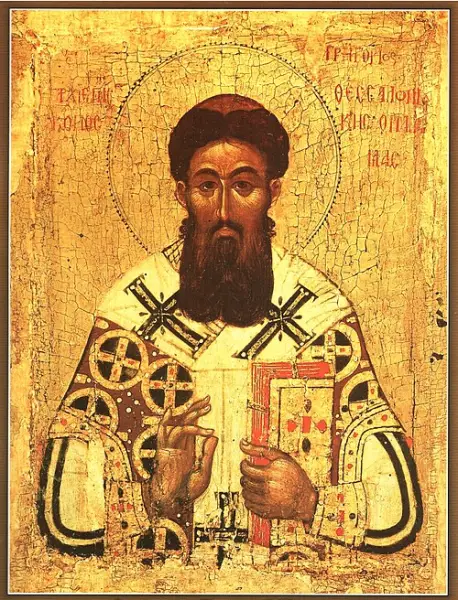
- Long, tapering dark beard·Vestments of a bishop·Gospel Book or scroll·Right hand raised in benediction
- Canonization
- Canonized in 1368 in Constantinople by Patriarch Philotheos of Constantinople, in the decree concluding the synodal tome against Prochoros Kydones.
Prayer
Bibliography
Show 7 sources
- Russell, Norman (2019). Gregory Palamas and the Making of Palamism in the Modern Age. Oxford University Press.
- Meyendorff, John (1964). A Study of Gregory Palamas. Translated by George Lawrence.
- Kazhdan, Alexander, ed. (1991). "Gregory Palamas". The Oxford Dictionary of Byzantium. Vol. 3. New York: Oxford University Press. p. 1560.
- Treadgold, Warren (1997). A History of the Byzantine State and Society. Stanford, California: Stanford University Press.
- Runciman, Steven (1986). The Great Church in Captivity: A Study of the Patriarchate of Constantinople from the Eve of the Turkish Conquest to the Greek War of Independence. Cambridge University Press.
- Palamas, Saint Gregory; Meyendorff, John (1983). Gregory Palamas. Paulist Press.
- Calvario, Patricia (2025). Gregory Palamas' Metaphysics of Light: The 'Absorption' of the Body by the Spirit. Brill.
Profile text adapted from the Wikipedia article, licensed CC BY-SA 4.0.
Pray with this saint every day
Save St. Gregory Palamas to your favorites, read the full profile, and get feast-day reminders in the Saints app.
Get the Saints AppFree on the App Store for iPhone and iPad