
c. 213 – c. 270·Feast November 17
St. Gregory Thaumaturgus
Bishop of Neocaesarea and Wonder-Worker
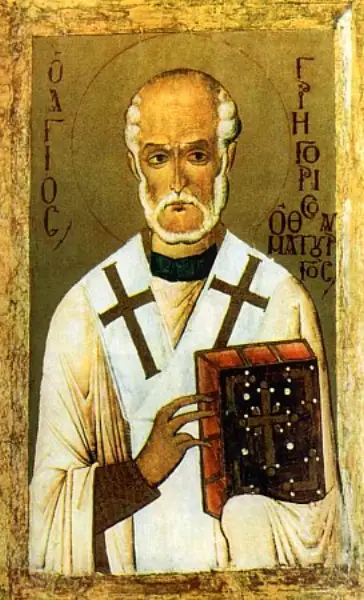
Overview
Gregory Thaumaturgus, the Miracle-Worker, was a third-century Christian bishop of Neocaesarea in Pontus whose life stands where documented history meets sanctified legend. First named Theodore, he came into the world about the year 213 into a prosperous pagan household, he encountered Christianity at fourteen after his father's death and was won over to the faith while preparing to study law at Berytus, when a chance detour to Caesarea in Palestine brought him under the teaching of Origen. He spent seven years in that master's school, from 231 to 238 or 239, studying philosophy first and theology afterward, and departed with a public panegyric in Origen's honor that ranks as the earliest attempt at biography in Christian literature. Returning to Pontus intending to practice law, he instead accepted consecration as bishop of his native city from Phoedimus of Amasea while still about forty years old. The Christian community he received numbered only seventeen souls; an ancient source records that when he died around 270, only seventeen pagans remained in the whole town. His episcopate of thirty years, his creed of the Trinity, and the miracles that earned his title made him one of the most consequential figures of the early Asian church, Among bishops of the third century, few lives rest on such well-authenticated testimony.
The Complete Life
Theodore of Neocaesarea
The future wonder-worker was born around AD 213 in Neocaesarea, the capital of Pontus in Asia Minor, into a family of wealth that practiced the old pagan religion. He was first named Theodore, meaning gift of God, though this was not yet an exclusively Christian name. Left fatherless in childhood, he was brought to the Christian faith by his mother at the age of fourteen. A brother named Athenodorus shared his upbringing, and the two young men, urged on by one of their tutors, set their hearts on legal studies at Berytus in Beirut, then counted among the four or five celebrated schools of the Hellenic world. Providence intervened through family duty: their brother-in-law was named legal counsel to the Roman governor of Palestine, and the brothers escorted their sister as far as Caesarea. There they learned that Origen, head of the Catechetical School of Alexandria, was living in the town. Curiosity drew them to hear the great teacher, and soon both had forgotten Beirut and Roman law entirely, giving themselves up to the Christian master who gradually brought them to the faith. Gregory later described in writing how Origen converted by persuasive candor, evident sincerity, ardent conviction, and an argumentative skill deployed unexpectedly rather than by bare reasoning alone.
§ Biography
Seven Years with Origen and a Bishop's Consecration
Gregory stayed in Palestine from 231 to 238 or 239, seven years of formation in Origen's intellectual and moral school. Philosophy came first in his studies and theology was added afterward, yet his mind stayed inclined to philosophy all his life; as a young man he even hoped one day to prove the Christian faith the sole philosophy both true and good. There is no solid reason to think the persecutions of Maximinus interrupted his studies, and the alleged journey to Alexandria of that period is probably legendary. Before leaving, he delivered in Origen's presence the public farewell oration that survives as the Oratio Panegyrica, at once a tribute to his master's pedagogy and the first biography in Christian literature. He returned to Pontus with the intention of practicing law, but the plan was set aside when Phoedimus, Bishop of Amasea and metropolitan of Pontus, consecrated him bishop of his native Neocaesarea. The dignity came to a man of about forty, and it illustrates the primitive church's willingness to give even a tiny community its own bishop: the flock entrusted to Gregory numbered just seventeen souls, and ancient canons allowed a bishop for as few as ten Christians.
§ Biography
Thirty Years Over a Growing Church
Gregory ruled the see of Neocaesarea for thirty years, and though little is known of his pastoral methods, the growth of his church testifies to his zeal. An ancient source preserves the striking symmetry with which his episcopate is remembered: he began with seventeen Christians, and at his death only seventeen pagans remained in the whole town of Caesarea. People came to him for counsel, and his wisdom drew a population accustomed to religions that joined solemnity with festivity; to attract them to the feasts of the martyrs he even organized public amusements that might appeal to pagan taste. His reputation for miracles, the source of his title Thaumaturgus, presumably belongs to these years. It might have been expected that his name would appear among the bishops at the First Council of Antioch against Paul of Samosata, and he probably took part in the second council held against the same heresiarch, since its letter is signed by a bishop named Theodore, his original name. Tradition, recorded by Gregory of Nyssa from the memory of his grandmother Macrina the Elder, tells that before his consecration Gregory withdrew into solitude, received an apparition of the Blessed Virgin and St. John the Apostle, and was given by the Evangelist a formula of faith whose autograph was still preserved at Neocaesarea a century later.
§ Historicity of life
A Creed Before Nicaea
The most precious witness to Gregory's mind is the Exposition of the Faith, a theological document whose authenticity and dating, between 260 and 270, scholars regard as settled. Caspari demonstrated that this confession develops the premises laid down by Origen, yet it advances far beyond them. Its closing confession admits nothing created within the Trinity, allows no measure of greater or lesser among the divine Persons, permits nothing superadded, grants the Father no being apart from the Son nor the Son apart from the Spirit, and confesses the whole immutable through all ages. By proclaiming the eternity, equality, and perfection of all three Persons alike, the formula advances distinctly beyond Origen's theories and anticipates the vocabulary of Nicaea. The same concern for the divine unity, absorbed from his reading of the philosophers under Origen, runs through his other writings: the Tractatus ad Theopompum on the passability and impassibility of God, the lost Dialogus cum Aeliano, from which Sabellians later quoted his formula that the Father and the Son are two in intelligence but one in substance, and the Epistola Canonica, which reveals both the church order of Pontus under his influence and the absorbing weight of a bishop's charge in an age of Gothic invasion and imperial persecution.
§ Exposition of the Faith
Miracle-Worker of Pontus and Patron of Bosnia
Gregory's afterlife in the memory of the church is a study in how sanctity travels. The principal ancient sources, the Life and Panegyric by Gregory of Nyssa, Rufinus' Historia Miraculorum, a sixth-century Syriac account, and St. Basil's testimony in De Spiritu Sancto, all show legendary accretion, yet Basil repeatedly attests the Thaumaturgus' orthodoxy and defends him even against the Sabellians who claimed his formula. His iconography shows a bishop driving demons from a temple and presenting a mitre to St. Alexander the Charcoal Burner, and he is invoked against earthquakes, floods, and every kind of desperate and impossible cause. In the thirteenth century his cult took a political turn: as the Catholic see withdrew from Bosnia to Djakovo, the autonomous Bosnian Church embraced Sveti Grgur as patron of the ruling Kotromanic dynasty and of the kingdom itself, a confessional choice unrecognized by the papacy until Pope Pius II confirmed it in 1461. The patronage lasted until August 26, 1752, when, at the petition of Bishop Pavao Dragicevic and with the approval of Pope Benedict XIV, St. Elijah took his place, chosen perhaps because the prophet was venerated by Catholics, Muslims, and Orthodox alike.
§ Patronage
Timeline
- 213
Born at Neocaesarea in Pontus to a prosperous pagan family and originally named Theodore, meaning gift of God.
§ Biography
- 231
Began seven years of study under Origen at Caesarea in Palestine, taking up philosophy first and theology afterward.
§ Biography
- 238
Finished his studies and delivered a public farewell oration thanking Origen before departing Palestine for Pontus.
§ Oratio Panegyrica
- 260
Composed the Exposition of the Faith, a Trinitarian creed whose date scholars place between 260 and 270.
§ Exposition of the Faith
- 270
Died in Pontus after about thirty years shepherding the diocese, leaving just seventeen pagans in the whole town.
§ Biography
- 1461
Pope Pius II formally recognized the Miracle-Worker as patron of the Bosnian Kingdom and its ruling Kotromanic dynasty.
§ Patronage
- 26 Aug 1752
Saint Elijah replaced him as patron of Bosnia and Herzegovina at Bishop Pavao Dragicevic's request, with papal confirmation.
§ Patronage
In Their Own Words
A wild nation deserved a wild patron.
Since the hour when Christ despoiled Hades, men have danced in triumph over death.
There is one God, the Father of the living Word, who is His subsistent Wisdom and Power and Eternal Image.
There is nothing either created or in servitude in the Trinity; nor anything superinduced, as if at some former period it was non-existent.
The soul is free, and cannot be coerced by any means, not even though one should confine it and keep guard over it in some secret prison-house.
For men who lie on earth there is but one salvation, that their souls acknowledge and wing their way to Him by whom they have been made.
The Record
- Major works
- Oratio Panegyrica in honor of Origen·Epistola Canonica·Exposition of the Faith·Epistola ad Philagrium·Tractatus ad Theopompum·Dialogus cum Aeliano (lost)·Canones paenitentiales·Paraphrase of Ecclesiastes (Metaphrasis eis ton Ekklesiasten)·Treatise on the Soul
- Patron of
- Against earthquakes·Against floods·Against desperate causes·Against forgotten causes·Against impossible causes·Against lost causes
- Symbols
- Bishop driving demons out of a temple·Presenting a bishop's mitre to Saint Alexander the Charcoal Burner
- Canonization
- Pre-congregation; venerated as a saint in the Catholic, Eastern Orthodox, and Oriental Orthodox Churches from antiquity.
Prayer
Bibliography
Show 6 sources
- Baynes, T. S.; Smith, W. R., eds. (1880). "St Gregory Thaumaturgus". Encyclopaedia Britannica. Vol. 11 (9th ed.). New York: Charles Scribner's Sons. p. 181.
- Herbermann, Charles, ed. (1910). "St. Gregory of Neocaesarea". Catholic Encyclopedia. Vol. 7. New York: Robert Appleton Company.
- "St. Gregory Thaumaturgus, Bishop of Neocesarea". Vatican News Service.
- Lovrenovic, Dubravko (2008). "Sv. Grgur cudotvorac - zastitnik Kotromanica i srednjovjekovne Bosne". In Karamatic, Fra Marko (ed.). Zbornik o Marku Dobreticu. Sarajevo: Franjevacka teologija. pp. 9-32.
- Duvnjak, Stjepan (2008). "Sveti Ilija i sveti Juraj - zastitnici Bosne". In Karamatic, Fra Marko (ed.). Zbornik o Marku Dobreticu. Sarajevo: Franjevacka teologija. pp. 33-47.
- Skoko, Iko (21 August 2012). "Sveti Ilija - zastitnik Bosne i Hercegovine". Vecernji list.
Profile text adapted from the Wikipedia article, licensed CC BY-SA 4.0.
Pray with this saint every day
Save St. Gregory Thaumaturgus to your favorites, read the full profile, and get feast-day reminders in the Saints app.
Get the Saints AppFree on the App Store for iPhone and iPad