
c. 257 – c. 331·Feast September 30
St. Gregory the Illuminator
Apostle of Armenia and First Catholicos of All Armenians
Overview
Gregory the Illuminator, known in Armenian as Grigor Lusavorich, established the Armenian Apostolic Church and served as its first rightful head; the missionary who brought Christianity to the Armenian kingdom in the early fourth century. By the standard account of the fifth-century writer Agathangelos, his father was Anak, a Parthian lord whose dagger felled the Arsacid king of Armenia; the infant Gregory escaped the destruction of his family and was raised a Christian in Caesarea of Cappadocia. As an adult he returned to Armenia and entered the service of King Tiridates III, who tortured him and then confined him to the deep pit of Khor Virap for many years after learning whose son he was. Delivered after a vision seen by the king's sister, Gregory healed Tiridates of the madness hagiography ascribes to his sins and converted him. The king's baptism brought the royal court and the Armenian people to Christianity — a conversion customarily set in 301, whereby Armenia earned the distinction of being history's first officially Christian state — and Gregory was consecrated bishop at Caesarea. He spent his last years as a hermit in the cave of Manē, dying in seclusion around 331.
The Complete Life
The Assassin's Son
The standard life of Gregory rests on the fifth-century history attributed to Agathangelos, supplemented by the later historian Movses Khorenatsi. According to this tradition Gregory was the son of Anak, a Parthian nobleman of the house of Suren, who at the urging of the Sasanian king Ardashir I gained the confidence of the Arsacid king Khosrov of Armenia and murdered him, with the promise of his former domains as his reward. The Armenian nobles took vengeance by putting Anak to death with his entire family, but the boy Gregory escaped through his nurse, whom Khorenatsi names as Sophy, sister of a Cappadocian notable. She carried the child to Caesarea in Cappadocia, inside the Roman Empire, and there he received an entirely Christian upbringing. Modern scholars have handled the story with caution: Josef Markwart doubted the traditional account and placed Gregory's upbringing nearer the Roman-Armenian frontier, while Nicholas Adontz judged that two independent traditions about Gregory's origins were later fused in Agathangelos's version. Jean-Michel Thierry described him as a man of Cappadocian culture and religion, one who brought Greek civilization to Armenia. According to Khorenatsi, when Gregory came of age he married Mariam, a Christian's daughter, and had two sons, Aristaces and Vrtanes.
§ Early life
The Pit of Khor Virap
After the birth of his sons, the marriage of Mariam and Gregory was ended by mutual separation, and he traveled to Armenia to join the court of King Tiridates III, heir of the ruler his father had killed. His vocation came to a head in an act of conscience: ordered to sacrifice to the goddess Anahit, he refused, and the king had him imprisoned and put to many tortures. When Tiridates discovered that this stubborn Christian was the son of his father's murderer, his fury turned geological — he had Gregory lowered into the deep pit of Khor Virap near Artaxata, a dungeon from which no one was expected to return. There Gregory remained for thirteen or fifteen years, by the varying reckonings of the sources, sustained, the tradition says, beyond all natural hope. Deliverance came through a vision: Tiridates' sister Khosrovidukht saw that the prisoner in the pit was the only remedy for her brother, whom Agathangelos describes as reduced to bestial frenzy because of his wicked deeds. Gregory was drawn up from the pit, healed the king, and received the confession of the court. Tiridates and his nobles accepted Christianity, and Armenia became the first state to adopt the faith officially — a conversion traditionally placed in 301, though many modern scholars prefer a date around 314.
§ Christianization of Armenia
The Christianization of Armenia
Freed from the pit, Gregory preached through the length of Armenia, sometimes in the king's company. On a spot shown to him in a vision at Vagharshapat he raised shrines for the martyred virgins Gayane and Hripsime; that site grew into the mother church of Armenian Christianity, called Ejmiatsin — the descent of the only-begotten — in memory of his vision. With armed resistance from the pagan priests overcome, he dismantled the temples of the old religion, and on the ruins of the sanctuary of Vahagn at Ashtishat he built the church that remained the original center of Armenian Christianity until after the partition of 387. Accompanied by a retinue of Armenian princes he traveled to Caesarea, where Bishop Leontius consecrated him bishop of Armenia, beginning an arrangement by which Gregory's successors were confirmed at Caesarea until the late fourth century. Near Bagavan he baptized King Tiridates, the army, and the people in the waters of the Euphrates. He founded schools for the Christian instruction of children in Greek and Syriac, established the ecclesiastical structure of the country, and daringly consecrated as bishops some of the children of the displaced pagan priests. A reported joint embassy with Tiridates to Constantine the Great is dismissed as fiction by the scholar Robert W. Thomson.
§ Christianization of Armenia
Into the Cave of Manē
Having remade the religious life of a kingdom, Gregory did what few founders have done: he walked away from it. Some time after the conversion of Armenia he passed the patriarchate to Aristaces, the younger of his boys, and withdrew to practice austerity within the cave called Manē, set in Daranali, a district of Upper Armenia, exchanging the patriarchal throne for solitude and prayer. Khorenatsi records that he did not remain wholly invisible at first — he sometimes came out of his hermitage and traveled about the country — that is, until Aristaces came home from the Council of Nicaea in 325; from then on Gregory remained wholly unseen. He died in that seclusion, and the account of his burial carries a deliberate poverty: shepherds found the body and buried it nearby without knowing whose it was. The man who had baptized a nation ended as an unnamed corpse tended by herdsmen, which his tradition plainly intended as a final commentary on his soul. The pattern of his spirituality — penance endured in the pit, mission discharged in the open, and contemplative disappearance at the end — has made him the model of Armenian holiness, and the church that bears his name is still called lusavorchakan, of the Illuminator.
§ Retirement and death
Death and the Hereditary Church
Gregory's death followed not long after the Council of Nicaea; the historian Cyril Toumanoff places it in 328, while the infobox tradition gives about 331, and he died in the district of Daranali, at modern Kemah in Erzincan province of Turkey. His body was later removed to the village of Thodanum, modern Doğanköy. The patriarchate he abandoned passed to his son Aristaces, and after him to Vrtanes, and so the office of Patriarch of Armenia became in effect a hereditary possession of Gregory's house, the Gregorids, held with some interruptions until the death of Patriarch Isaac in the fifth century. By the time of Gregory's descendant Nerses I, according to Faustus of Byzantium, the family's domains comprised fifteen districts — a reminder of how completely the church's endowment and the apostle's lineage were woven together in the Armenian order he founded. All the sources agree that his death came within a few years of Nicaea, closing a life that had run from a murdered grandfather-king, through the pit at Khor Virap, to the baptism of a kingdom and the silence of a cave.
§ Retirement and death
Relics and Veneration
Venerated since antiquity without any formal process, Gregory is honored across nearly the whole Christian world. His right arm survives in arm-shaped reliquaries claimed by the four ancient Armenian sees — Holy Etchmiadzin, the Catholicosate of Cilicia, and the Patriarchates of Jerusalem and Constantinople — and every seventh year the sees of Etchmiadzin and Cilicia employ the arm in the consecration of the Holy Myron. Relics were scattered in the reign of Emperor Zeno, and fragments rest at the Karakallou and Iviron monasteries on Mount Athos, while Gregoriou Monastery claims his skull. In the eighth century nuns fleeing the iconoclast decrees carried his relics to Naples, founding San Gregorio Armeno; from there Pope John Paul II returned a femur and the manacles of his torture to Catholicos Karekin II, and they are now enshrined at the cathedral of Yerevan. At Nardò, Italy, his statue alone survived the earthquake of 20 February 1743, and the city keeps three days of feasting yearly. The Armenian Church marks his deliverance from the pit, his descent into it, and the discovery of his relics; the Orthodox, Catholic, Syriac, and Coptic churches keep his feast on September 30 or nearby days, and the Anglican Communion on March 23.
§ Relics and veneration
Legacy
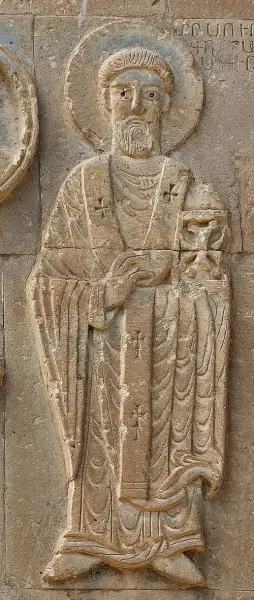
Gregory's legacy is a nation's faith. Armenia's adoption of Christianity — whether in 301 or, as most modern scholarship holds, around 314 — made it the first Christian state, and the church Gregory founded remains the central institution of Armenian identity. The philologist and first president of Armenia, Levon Ter-Petrosyan, ranks Gregory with Mesrop Mashtots as the two most influential figures in Armenian history, and James R. Russell sees in both men the same program: visionary zeal, royal patronage, a westward and Hellenic orientation, the education of the pagan priests' children, and disciples gathered to spread the faith through learning. His memory is carved and painted across Armenian art from a seventh-century stele at Talin to the tenor-century reliefs of Aghtamar and the sixteen scenes of his life at the church of Tigran Honents in Ani. In the Byzantine world veneration flourished from the reign of Basil I, a mosaic of Gregory stood in Hagia Sophia, and a chapel of Moscow's St. Basil's Cathedral bears his name. In 2005 a marble statue of the apostle of Armenia was raised in the Vatican's St. Peter's Basilica, and in 2008 Pope Benedict XVI dedicated the surrounding courtyard in his honor.
§ Historical assessment
Timeline
- 257
Born around this time, son of the Parthian nobleman Anak
§ Early life
- 288
Traditional beginning of his tenure as Catholicos of All Armenians, which the succession lists run to 325
§ Introduction
- 301
Traditional date of Armenia's adoption of Christianity as the state religion under King Tiridates III
§ Christianization of Armenia
- 325
His son Aristaces returns from the Council of Nicaea, after which Gregory withdraws from all public appearance
§ Retirement and death
- 331
Dies in seclusion in the cave of Manē in Daranali; Cyril Toumanoff gives 328 as the year
§ Retirement and death
- 20 Feb 1743
An earthquake spares Nardò's statue of the saint, beginning an annual three-day devotion in the Italian city
§ Italy and the Roman Catholic world
- 13 Nov 2000
Pope John Paul II returns relics of the saint to Catholicos Karekin II for enshrinement in Yerevan
§ Italy and the Roman Catholic world
- Jan 2005
A marble statue of Gregory is inaugurated by Pope John Paul II at St. Peter's Basilica in the Vatican
§ Italy and the Roman Catholic world
- Feb 2008
Pope Benedict XVI dedicates the St. Gregory the Illuminator Courtyard in the north courtyard of the Vatican basilica
§ Italy and the Roman Catholic world
The Record
- Major works
- Foundation of the Armenian Apostolic Church·Shrines of the martyrs Gayane and Hripsime at Vagharshapat·Church of Ashtishat, built on the site of the temple of Vahagn·Schools of Christian education taught in Greek and Syriac
- Patron of
- Armenia·Nardò, Italy
- Canonization
- Pre-congregation; venerated as the apostle and first patriarch of Armenia across the Oriental Orthodox, Eastern Orthodox, Catholic, and Anglican traditions
Prayer
Bibliography
Show 8 sources
- Agathangelos (2020). History of St. Gregory and the Conversion of Armenia.
- Garsoïan, Nina (1997). "The Aršakuni Dynasty". In Hovannisian, Richard G. (ed.). The Armenian People from Ancient to Modern Times. Vol. 1. New York: St. Martin's Press. ISBN 0-312-10169-4.
- Thomson, Robert W. (1976). Agathangelos, History of the Armenians. Albany: SUNY. ISBN 0-87395-323-1.
- Thomson, Robert W. (1978). Moses Khorenats'i, History of the Armenians. Cambridge, Massachusetts: Harvard University Press. ISBN 0-674-39571-9.
- Toumanoff, Cyril (1969). "The Third-Century Armenian Arsacids: A Chronological and Genealogical Commentary". Revue des études arméniennes. 6: 233-281.
- Terian, Abraham (2005). Patriotism and Piety in Armenian Christianity: The Early Panegyrics On Saint Gregory. St Vladimir's Seminary Press. ISBN 978-0-88141-293-2.
- Maranci, Christina (2018). The Art of Armenia: An Introduction. Oxford University Press. ISBN 978-0-19-026900-5.
- Fortescue, Adrian. "Gregory the Illuminator." The Catholic Encyclopedia. Vol. 7. New York: Robert Appleton Company, 1910.
Profile text adapted from the Wikipedia article, licensed CC BY-SA 4.0.
Pray with this saint every day
Save St. Gregory the Illuminator to your favorites, read the full profile, and get feast-day reminders in the Saints app.
Get the Saints AppFree on the App Store for iPhone and iPad