
1899 – 1942·Feast December 6
St. Grigol Peradze
Georgian Hieromartyr, Patristics Scholar, and Auschwitz Victim
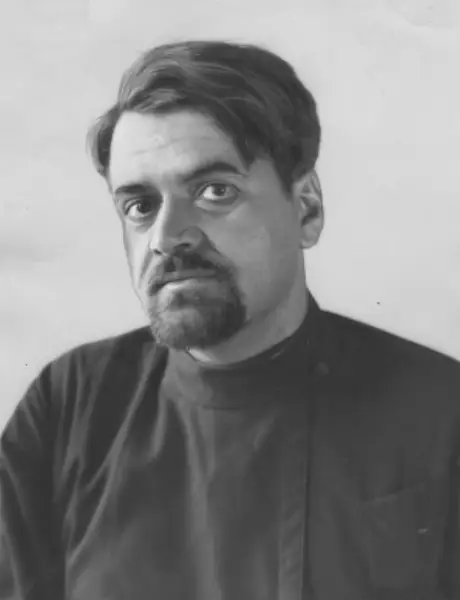
Overview
Grigol Peradze was a Georgian priest, philologist, theologian, and historian who became one of the most distinguished Orthodox scholars of the interwar years and died a martyr at Auschwitz. Born in 1899 in the village of Bakurtsikhe in eastern Georgia, the son of an Orthodox priest, he was educated at the Tbilisi Theological Seminary and Tbilisi State University and fought as a young man in defense of the short-lived Democratic Republic of Georgia against the Bolsheviks. When Soviet Russia occupied Georgia in February 1921, his church sent him abroad to study, and he built an academic career in Germany and Poland, taking a doctorate at Bonn and teaching patrology at the University of Warsaw. Tonsured a monk in London in 1931, he served the Georgian parish in Paris and was raised to archimandrite in 1934, while discovering and publishing major Georgian manuscripts across Europe. After the German invasion of Poland he aided Jews in peril and visited the imprisoned Metropolitan Dionysius; arrested by the Gestapo in May 1942, he was killed at Auschwitz on 6 December 1942, reportedly by taking the place of a Jewish prisoner with a large family. The Georgian Orthodox Church canonized him in 1995.
The Complete Life
A Priest's Son from Kakheti
Grigol Peradze was born in 1899 in the village of Bakurtsikhe in the Kakheti region of eastern Georgia, born the middle son among three boys to Romanoz Peradze, pastor of the village church, and his wife Mariam Samadalashvili. He was named for the eleventh-century Georgian saint Gregory of Khandzta, Grigol being the Georgian cognate of Gregory — an appropriate patron for a life that would follow its namesake's path of ascetic learning. Grigol lost his father at the age of six, whereupon his household relocated to Tiflis, the provincial seat and afterwards the capital of independent Georgia. His schooling took place in an Orthodox parish school, followed from 1913 by studies in the Tbilisi Theological Seminary, from which he finished among the best of his year in 1918. He then studied at Tbilisi State University until 1921, and in the years 1919 to 1921 he also bore arms, serving militarily against the Bolsheviks as the young Democratic Republic of Georgia was defended. For a short time after his studies he taught in a small village near Gori. The world of his youth — a newly independent nation, a church rebuilding itself, and then Soviet conquest — formed the frame of everything that followed.
§ Life and works
Exile and the Call to Orders
On 25 February 1921 Soviet Russia occupied Georgia, and Grigol's path turned westward. Threatened with imprisonment after the annexation, he was first sent by the Georgian Orthodox Church to teach in the village of Mankhi in Kakheti, and then, by a decision of the church's local council held at Gelati in 1921, dispatched abroad to continue his studies — an effort aided by the Kartvelologist Arthur Leist, the Orientalist Johannes Lepsius, and the German ambassador to Georgia, and encouraged by his mentor Cornelius Kekelidze and Catholicos-Patriarch Ambrose. He left in November 1921, kept the fallen republic's passport for the rest of his life, and was twice refused re-entry to Georgia, in 1921 and 1927, becoming in effect a stateless traveler on a Nansen passport. He studied in Berlin and Bonn, took his degree at Bonn in 1926, and received a doctorate in history in December 1927. The decisive turn in his vocation came around Christmas 1930, when serious illness led him to pledge that if he recovered he would devote himself wholly to God. Restored to health, he was tonsured a monk in London on 18 April 1931, made hierodeacon the next day, and ordained priest in Paris on 24 May.
§ Life and works
Scholar, Pastor, and Manuscript Hunter
Peradze's mission unfolded on two fronts at once: the lecture hall and the library. From 1927 to 1932 he was an associate professor at the University of Bonn, and from 1933 to 1942 professor of patrology at the Orthodox Theology faculty of Warsaw University. In the spring of 1927 he worked through manuscripts in the British Museum and the Bodleian Library at Oxford, and through the 1930s he discovered significant monuments of Georgian Christian writing across Romania, Bulgaria, Greece, Italy, Germany, and Austria — among them the Georgian manuscripts of the Typicon of the Petritsoni Monastery in Bulgaria and the Tischendorf codices, as they are called, of the Apagae from the Holy Cross monastery, kept in Leipzig's university library. His scholarship covered the history of the Georgian Church, patrology, Georgian literature, and even Rustavelology, and he published prolifically in German, French, and English. As a pastor he served the Georgian diaspora: first regular priest of the Georgian St. Nino church in Paris from 1931 — his first liturgy there was offered on 31 May — and that same year he launched the learned periodical Jvari Vazisa, and from 5 January 1934 an archimandrite, honored for his pastoral care of the Georgian community. In Warsaw he lived simply in the Praga district, surrounded by his collection of Georgian antiquities.
§ Life and works
The Self-Given Life
The spirituality that emerges from Peradze's life is one of deliberate, total gift. The pattern was set by the pledge of Christmas 1930 — health offered back to God in monastic obedience within months — and it culminated in his death, which both traditions of the account describe as substitutionary: he let the guilt for a slain German officer be charged to himself so that the men held with him might be rescued — or, in the second report, walked into a gas chamber so that a Jewish father of many children might go free. His solidarity with endangered Jews under the occupation went without saying, and he did not hesitate to visit the imprisoned Polish Metropolitan Dionysius, acts that drew the suspicion of the Nazi authorities. A man who had lost his country to one totalitarian power and his life under another, he nonetheless kept serving — the church, the academy, and the persecuted. The comparison made by one modern writer to Maximilian Kolbe, who also died in another's place at Auschwitz, captures the shape of a holiness that is not rhetorical but literal: a priest who understood the eucharistic self-offering he celebrated each morning as the rule of his own body and blood.
§ Life and works
War, Arrest, and Auschwitz
The German invasion of Poland in September 1939 made Peradze's position precarious and slowly strangled his work. He responded with the quiet defiance that characterized him: helping Jews in danger wherever he could, and visiting Metropolitan Dionysius in prison. To the Nazi occupiers these activities, joined to his standing as a priest and professor, looked increasingly dangerous, and in 1942 his ecclesiastical and scholarly labors were brought to an end. On 4 May 1942 the Gestapo arrested him, and he was sent to the concentration camp of Auschwitz. There, on 6 December 1942, at the age of forty-three, he was killed. Two accounts of his death survive — one in which he assumed guilt for the killing of a German officer so that his fellow captives would be spared, and one in which he entered the gas chamber in place of a Jewish prisoner with a large family; either way he died in another man's stead. His life had begun under the tsar, matured in exile across half of Europe, and ended in the most infamous of the German camps, faithful to Georgia, to the church, and to the weakest men around him to the last day.
§ Life and works
Canonization and Commemoration
The Georgian Orthodox Church canonized Grigol Peradze as a hieromartyr in September 1995, half a century after his death and four years after the restoration of Georgia's independence, in whose defense he had fought as a young officer. His feast falls on 6 December, the day of his martyrdom — 23 November on the Old Style calendar. He is commemorated in the wider Orthodox Church as well, celebrated on the same date. Physical memorials anchor his memory in the places of his life: a memorial chapel in Warsaw, part of the Warsaw Icon Museum, stands in his honor; his hometown keeps a museum dedicated to him, and plaques commemorating him are fixed to the University of Warsaw and to the church of St. George in Bakurtsikhe — the building of his baptism. Georgia honored him in the secular sphere as well: in 2013 Georgia conferred on him, after his death, the rank and order of National Hero; a Georgian stamp of 2022 carries his image. From an exile who died stateless in a German camp, he has become one of the named saints and heroes of two nations, Georgia and Poland, that his life joined.
§ Life and works
Legacy
Peradze's legacy lives on two legs, scholarship and sacrifice. As a scholar he rescued for the Georgian church monuments of its own past scattered across Europe — the Petritsoni Typicon, the Leipzig Tischendorf manuscripts, the liturgical evidence for pre-Byzantine Georgian worship — and his articles on Georgian monasticism in Georgia, on Mount Athos, and in Palestine remain foundational reading in the field. The journal he founded, Jvari Vazisa, began a tradition of Georgian scholarly publishing in the diaspora, and a continuing stream of studies, by Irakli Jinjolava and others, examines his thought, above all his understanding of the ecumenical vocation of the Orthodox Church. As a saint he is remembered as the Georgian Kolbe: a priest who died at Auschwitz in place of others, whose feast is kept on 6 December and whose chapel in the Praga district of Warsaw marks the city where he taught. For Georgia he is a National Hero of 2013; for the Orthodox world he is the hieromartyr who carried patristic learning into the twentieth century's darkest place and answered its ultimate question with his life.
§ Life and works
Timeline
- 1899
Born in the village of Bakurtsikhe in eastern Georgia, son of the priest Romanoz Peradze
§ Life and works
- 1918
Graduates near the top of his class from Tbilisi Theological Seminary and enters Tbilisi State University
§ Life and works
- 1919
Enters army service, taking up arms for the Democratic Republic of Georgia against the Bolsheviks
§ Life and works
- Nov 1921
Goes into exile in Germany after the Soviet occupation of Georgia, with his church's blessing to study abroad
§ Life and works
- 1926
Graduates from the University of Bonn
§ Life and works
- 18 Apr 1931
Tonsured a monk at Holy Wisdom Greek Orthodox Cathedral in London
§ Life and works
- 24 May 1931
Ordained a priest at St. Stephen's Greek Orthodox Cathedral in Paris
§ Life and works
- Dec 1927
Receives his PhD in history from Bonn with a thesis on Georgian monasticism to 1064
§ Life and works
- 1931
Becomes first regular priest of the Georgian St. Nino Orthodox Church in Paris and founds the journal Jvari Vazisa
§ Life and works
- 1933
Begins teaching as professor of patrology at the Faculty of Orthodox Theology of Warsaw University
§ Life and works
- 5 Jan 1934
Raised to the rank of archimandrite at Holy Wisdom in London for his pastoral work
§ Life and works
- 4 May 1942
Arrested by the Gestapo, ending his ecclesiastical and scholarly activity
§ Life and works
- 6 Dec 1942
Killed at Auschwitz, having taken the place of a Jewish father of a large family
§ Life and works
- Sep 1995
Canonized as a hieromartyr by the Georgian Orthodox Church
§ Life and works
- 2013
Conferred after his death: the rank and order of National Hero of Georgia
§ Life and works
In Their Own Words
do not know why. I do not belong to political parties. I have not worked against the Soviet government. My goal was always and is the service of our science and culture.
The Record
- Major works
- History of the Georgian Monasticism from its creation until 1064 (doctoral thesis, 1927)·Die Anfänge des Mönchtums in Georgien (1928)·L'activité littéraire des moines géorgiens au monastère d'Iviron au mont Athos (1927)·An Account of the Georgian Monks and Monasteries in Palestine (1937)·Jvari Vazisa ("Grapevine cross"), Georgian scholarly journal founded 1931
- Canonization
- Canonized September 1995 by the Georgian Orthodox Church
Prayer
Bibliography
Show 7 sources
- Peradze, Grigol. "Die Anfänge des Mönchtums in Georgien." Zeitschrift für Kirchengeschichte, 47, Heft 1, Stuttgart, 1928, pp. 34-75.
- Peradze, Grigol. "L'activité littéraire des moines géorgiens au monastère d'Iviron au mont Athos." Revue d'histoire ecclésiastique, 23, Fasc. 3, Paris, 1927, pp. 530-539.
- Peradze, Grigol. "An Account of the Georgian Monks and Monasteries in Palestine as revealed in the Writings of Nongeorgian Pilgrims." Georgica, 2, Vol. 4-5, London, 1937, pp. 181-246.
- Machitadze, Archpriest Zakaria. Lives of the Georgian Saints, trans. David and Lauren Elizabeth Ninoshvili, ed. Lado Mirianashvili. Platina, Cal.: St. Herman of Alaska Brotherhood, 2006, pp. 424-426.
- Jinjolava, Irakli. "The Ecumenical Vocation of the Orthodox Church According to the Georgian Theologian and Saint Priest-Martyr Grigol Peradze." Ostkirchliche Studien 65 (2016), pp. 237-270.
- Jinjolava, Irakli. "A Portrait of Grigol Peradze Against the Background of the Ecumenical Vocation in the Orthodox Church." Pro Georgia, 2019, t. 29, pp. 287-291.
- Vischer, Lukas. "A Georgian Saint: Grigol Peradze (1899-1942)."
Profile text adapted from the Wikipedia article, licensed CC BY-SA 4.0.
Pray with this saint every day
Save St. Grigol Peradze to your favorites, read the full profile, and get feast-day reminders in the Saints app.
Get the Saints AppFree on the App Store for iPhone and iPad