
early 4th century – c. 334·Feast 3rd Saturday before the Nativity of Jesus (movable feasts also in Transfiguration season and after Exaltation of the Cross)
St. Grigoris of Albania
Catholicos of Caucasian Albania and Martyr of the Maskuts
Overview
Grigoris, called Aghvanatsi — of Albania — was an early fourth-century bishop of the Gregorid family remembered as the Catholicos of the Church of Caucasian Albania and honored as a martyr by the Armenian Apostolic Church. Born at Caesarea in Cappadocia, he was the grandson of Gregory the Illuminator; his father Vrtanes and his brother Husik served consecutively as catholicoi of Armenia. According to the traditional account, Gregory the Illuminator extended his missionary work into Caucasian Albania, founded there the church that became Amaras Monastery, and ordained the fifteen-year-old Grigoris — some traditions say it was his uncle Aristakes who ordained him — as patriarch of the Albanian church around 325. Later, according to Faustus of Byzantium, Grigoris carried the gospel to the Kingdom of the Maskuts on the Caspian shore, where its ruler Sanesan opposed him. Horsemen of the Maskuts rode him down in the Vatnean Fields, and he died beneath their hooves, in about 330 or 334; his body was laid to rest at Amaras Monastery, where King Vachagan III recovered and entombed his relics in 489. Some modern scholars question the historicity of the Albanian mission, but his cult endures.
The Complete Life
Heir of the Illuminator
Grigoris was born at Caesarea in Cappadocia, in the early fourth century, into the most distinguished Christian family of the Armenian world. He was the grandson of Gregory the Illuminator, the Parthian-born missionary who had converted the Armenian king and become the first head of the Armenian Apostolic Church. Sanctity and office ran in the bloodline: Grigoris' father Vrtanes and his elder brother Husik each served in turn as catholicos of Armenia, making the boy a member of the hereditary priestly house that would hold the Armenian patriarchate into the fifth century. The Armenian tradition thus presented the evangelization of the lands beyond Armenia as a family undertaking, with the grandchildren of the apostle of Armenia carrying the faith to neighboring peoples. Nothing else is recorded of his upbringing or education; the sources that preserve his story are concerned almost entirely with his ordination and his death, and modern scholars have noted that the chronology of this whole generation of Armenian church history remains tangled and uncertain.
§ Background
Ordination to the Albanian Church
By the year 325 Christianity had grown strong in Armenia, and Armenian church leaders turned to the evangelization of neighboring lands. According to the tenth-century writer Movses Kaghankatvatsi, Gregory the Illuminator himself left Armenia to spread the faith in Caucasian Albania, founded a church there on his orders that would later become the Amaras Monastery, and then ordained his grandson Grigoris — then only fifteen years old — as patriarch of the Church of Caucasian Albania, an office he held from about 325 to 330. A second tradition, however, attributes the ordination not to Gregory but to Grigoris' uncle, St. Aristakes. In the succession of the Albanian church Grigoris is counted the successor of Thomas of Satala, apparently the first catholicos, who served in the days of King Urnayr of Albania. Tradition also credits Grigoris with bringing the relics of the prophet Zechariah and of Saint Pantaleon to a church built in the town of Tsri — a reminder that the Gregorid mission moved through the early Christian world as a network of family, books, and bones.
§ Legend
Mission to the Maskuts
After his years as head of the Albanian church, Grigoris carried the mission further, into the Kingdom of the Maskuts, which lay along the northeastern shore of present-day Azerbaijan and the southern Dagestani shore of the Caspian Sea. There he preached Christianity in the territory of a king implacably opposed to it: Faustus of Byzantium names the ruler Sanesan, while Moses of Khorenatsi calls him Sanatruk and describes him as a kinsman of King Tiridates III of Armenia. The mission was not without fruit. By the tradition preserved in the sources, Grigoris converted three of Sanesan's own sons — Moses, Daniel, and Elijah — together with 387 followers, a company whose baptism must have enraged the king all the more for the rank of the converts. The confrontation between the young bishop and the Maskut court ended as martyrologies of the frontier usually end: the soldiers of Sanesan trampled Grigoris to death under their horses in the Vatnean Fields, and the converts he had won were put to death by the king on 20 August — Navasard 9 in the Armenian calendar — of the same year, joining their bishop in the calendar of the saints.
§ Death
Martyrdom and Burial
Grigoris died by trampling, a form of execution he suffered passively at the hands of mounted Maskut soldiers, in the Vatnean Fields — traditionally located near the present-day village of Nughdi, thirty-seven kilometers south of Derbent, though other sources place the martyrdom at Paytakaran, beside the Kura river. The disagreement about the site reflects the layered and regional character of the traditions about him. His companions in death were the three royal sons and their 387 followers, martyred on the same year's ninth day of Navasard. Grigoris' body was carried back to the Amaras Monastery and interred in a nameless grave beside the northern doorway — a modest burial for a bishop of the Gregorid line. There the story rested for a century and a half, until, according to Movses Kaghankatvatsi, King Vachagan III the Pious of Caucasian Albania recovered the relics in 489 and buried them with honor in a tomb within the monastery. At the place of his death at Nughdi a chapel was raised at an unknown date, later rebuilt as a church, and — a striking detail of Caucasian religious history — venerated by local Christians and Muslims alike.
§ Death
Veneration
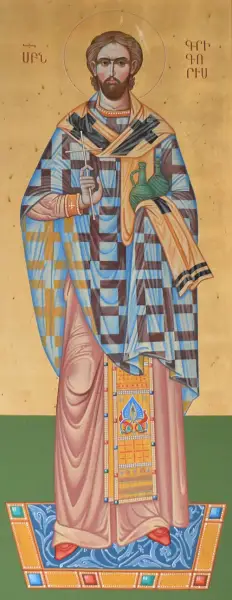
Grigoris has been honored as a saint martyr by the Armenian Apostolic Church since antiquity, without any formal canonization process. His feast is kept on movable dates in the Armenian liturgical year: on the third Saturday before the Nativity of Jesus, and on the third Sunday of the feast of Vardavar — the Transfiguration — together with the other sons and grandsons of Gregory the Illuminator, a liturgical reminder that he is venerated as part of the holy family of the Armenian apostolate. A third observance, on the Monday after the fifth Sunday following the Exaltation of the Cross, commemorates the finding of his relics. His major shrine is the Amaras Monastery, where his tomb is shown and where a modern painting of the saint keeps his memory before pilgrims; the church of St. Grigoris at Nyugdi in Dagestan stands near the traditional field of his martyrdom, itself heir to the medieval chapel that Christians and Muslims of the region honored together. The recovery of his relics by King Vachagan III in 489 is itself commemorated in the tradition as a feast-worthy act of royal piety.
§ Veneration
Legacy and the Scholars' Debate
Grigoris' legacy is entwined with the Christianization of the Caucasus and with the scholarly argument over how it happened. The earliest surviving narrative of his death stands in the Buzandaran of Faustus of Byzantium, and this text anchors his cult, and Movses Kaghankatvatsi's history of the Albanians supplied the connection to Amaras and to Vachagan's translation of the relics. Modern scholarship has not left the tradition untouched: Zaza Aleksidze and Jean-Pierre Mahé concluded from a close examination of the historiographic evidence that Grigoris conducted no preaching mission in Albania and had no hand in that land's conversion, arguing that the Buzandaran styles him not bishop of Albania but Catholicos of the Iberian and Albanian march, and that the legend is a later invention which confined his actual sphere of influence to Gugark. The Armenian scholar Hranush Kharatyan countered that Aleksidze and Mahé misrepresented both Faustus and Khorenatsi. Whatever the resolution, his cult remains fixed at Amaras Monastery, his feasts remain on the Armenian calendar, and the church at his deathplace is still honored by Christians and Muslims on the Caspian frontier.
§ Scholarly debates
Timeline
- 325
Ordained around this time, at fifteen years of age, as patriarch of the Church of Caucasian Albania
§ Legend
- 334
Killed beneath the hooves of Maskut horsemen in the Vatnean Fields as he spread the gospel; dated c. 330 or c. 334
§ Death
- 20 Aug 334
His converts — Sanesan's sons Moses, Daniel, and Elijah, with 387 followers — are martyred by Sanesan on Navasard 9 of that year
§ Death
- 489
King Vachagan III the Pious of Caucasian Albania recovers Grigoris' relics and buries them in a tomb at Amaras Monastery
§ Death
The Record
- Major works
- Church at Amaras, founded on Gregory the Illuminator's orders and later the shrine of Grigoris' relics·Church at Tsri, built to house the relics of Zechariah and Saint Pantaleon
- Canonization
- Pre-congregation; honored as a saint martyr by the Armenian Apostolic Church
Prayer
Bibliography
Show 6 sources
- The Caucasian Albanian palimpsests of Mt. Sinai. Ed. Jost Gippert. Turnhout: Brepols, 2008-2010. pp. xiv. ISBN 978-2-503-53116-8. OCLC 319126785.
- Grousset, René. Histoire de l'Arménie. Payot, Paris, 1973, p. 130.
- P'awstos Byuzand. The Epic Histories Attributed to P'awstos Buzand, English transl. by N. Garsoian. Cambridge, Massachusetts, 1983. IV.50; V.12.
- Nikonorov, Andrei. "Григорис Албанский" [Grigoris of Albania]. Orthodox Encyclopedia.
- Chorbajian, Levon; Donabédian, Patrick; Mutafian, Claude (1994). The Caucasian Knot: The History & Geopolitics of Nagorno-Karabagh. Zed Books. p. 57. ISBN 978-1-85649-288-1.
- Kharatyan, Hranush. "Touching upon issues of Yeghishe the Apostle, Grigoris and the christianization of the Caucasian Aghvank (Albania)". mechitar.org.
Profile text adapted from the Wikipedia article, licensed CC BY-SA 4.0.
Pray with this saint every day
Save St. Grigoris of Albania to your favorites, read the full profile, and get feast-day reminders in the Saints app.
Get the Saints AppFree on the App Store for iPhone and iPad