
1070 – 1127
St. Gualfardo of Verona
Swabian craftsman, pilgrim, and forest hermit
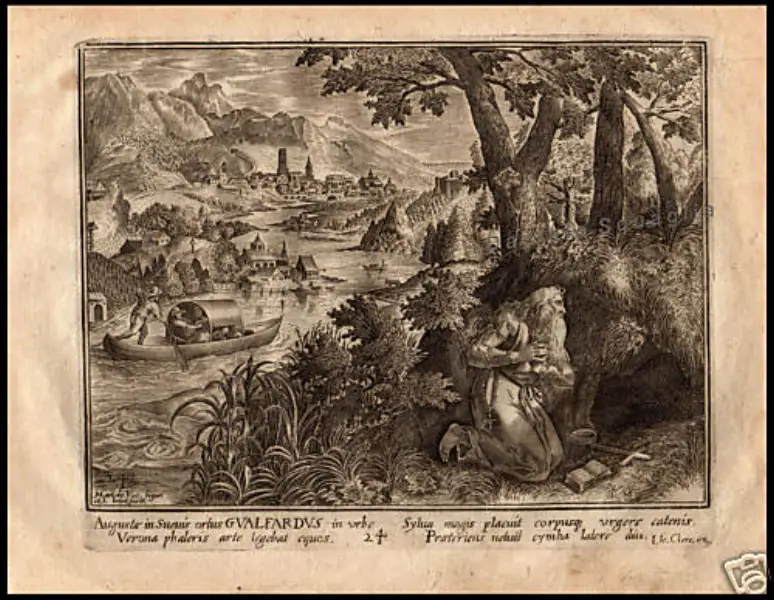
Overview
Gualfardo, remembered in German as Wolfhard, came out of Augsburg, the leading city of medieval Swabia, and spent his adult life around Verona. A master harnessmaker by trade, he came down into Italy in 1096 as a pilgrim travelling with merchant craftsmen, and remained. After working briefly at saddle-making in the city, he withdrew to a thick wood along the Adige, where he lived hidden for some twenty years until hunters found him and led him back to Verona. He kept a workshop beside the abbey of San Salvatore, but when flooding drove him from the city he built himself a cell in the open country near the church of Santa Trinità and stayed there until the end. Word of his holiness spread: until his death the people of Verona came to him seeking miracles, and he received the city-dwellers who brought him food with a hospitality that his love of solitude never closed off. His death came in 1127 at Curte-Regia, in the country outside Verona.
The Complete Life
A Craftsman of Augsburg
Gualfardo first appears to history as a craftsman of Augsburg, the city that stood at the head of Swabia in his day. His German name, Wolfhard, survived alongside the Italian form his journey gave him, and both point to the same working origin: he was no noble and no cleric, but a master of the harnessmaker's trade, a working man whose hands were trained to leather and stitch long before anyone set a word down about his soul. Augsburg in the late eleventh century was a busy commercial center, and a skilled saddler there belonged to a world of workshops, journeymen, and trade routes running south over the Alps toward Italy. It was along just such a road, in 1096, that he left his native city in the company of journeyman merchants, bound on pilgrimage. The German word for such travelers, Wallfahrer, is what medieval Italians heard in his name, turning Wolfhard into Gualfardo. Whatever he intended — a round trip of devotion, or a new life beyond the mountains — the journey proved one-way. Verona, not Augsburg, would keep him.
§ Introduction
Pilgrim on the Road
The pilgrimage of 1096 brought him down to Verona, and there he paused, living for a time with a journeyman of his own trade. His biographer recorded the episode with unusual precision: the blessed Gualfardo stayed but a short while in that place, working at saddles, for a better saddler could hardly be found. The remark preserves something both plain and telling — a respected craftsman, able to support himself anywhere, who nonetheless did not treat the city as his destination. He moved on again, this time out of Verona altogether, into a dense forest along the Adige a short distance from the walls. There the saddler's stall gave way to silence. For roughly twenty years he kept that hidden life, unknown to the city that would one day claim him, until the chance of a hunting party ended it: the hunters who came upon him were astonished, and brought him back to Verona with them. The pattern of his whole adult life is already visible — arrival, withdrawal, and a return he never sought, in which the man who had left Augsburg as a pilgrim became, in spite of himself, a public figure of holiness.
§ Introduction
Solitude That Kept Its Door Open
Back in Verona, Gualfardo set up a shop near the abbey of San Salvatore, resuming the trade he had never really abandoned in the woods. But when flooding struck the city he left it again, building a hermit's cell in the open country near the church of Santa Trinità, and there he remained until his death. The tradition stresses two things about his holiness. First, it was sought out: the Veronese came to him steadily for miracles, treating the forest recluse as a healer whose prayers God answered. Second, his love of solitude never hardened into inhospitality. City dwellers brought him food, and he received them; he made no especial name among travelers as their aid, and claimed no patronage over the roads, but he kept a door — literal or figurative — open to those who climbed out from the city to find him. It is an unusual balance in the history of the hermits: the eremite who does not flee his neighbors, the craftsman whose workshop and whose cell obey the same rule of service, the solitary whose silence was interrupted every week by strangers asking for grace.
§ Introduction
Guild Patron and Written Life
Gualfardo died in 1127 at Curte-Regia, in the Veronese countryside, and his memory took root quickly in the city that had adopted him. The Bollandists judged that a hagiographical vita was put together within a few decades of his passing, most likely as the twelfth century was closing — the book from which nearly everything now known about him flows. The speed of that composition matters: it means the story of the Augsburg pilgrim, the forest along the Adige, and the hunters who found him was written down while people still lived who could have checked it. In the early sixteenth century his cult had an institutional face: the harnessmakers' guild at Verona honored him as its patron saint — their own trade, in which he had been a master. It was a fitting dedication — the guild honored the craftsman among the saints, the one member of their own working order who had climbed into the calendar. His double name, Gualfardo in Italy and Wolfhard in Germany, keeps both halves of his life in view: the Swabian who left, and the Veronese hermit who stayed.
§ Introduction
Timeline
- 1070
Born at Augsburg, then the foremost city of Swabia
§ Introduction
- 1096
Left Augsburg on pilgrimage in the company of journeyman merchants and stopped at Verona
§ Introduction
- 1127
Died at Curte-Regia, near Verona
§ Introduction
- 1500
Honored in Verona as patron saint of the harnessmakers' guild
§ Introduction
The Record
- Patron of
- patron of the harnessmakers' guild at Verona
- Canonization
- Pre-congregation; venerated at Verona and recorded by the early sixteenth century as patron of the city's harnessmakers' guild
Prayer
Bibliography
Show 2 sources
- Vauchez, André (1993). The Laity in the Middle Ages: Religious Beliefs and Devotional Practices. Edited by Daniel E. Bornstein, translated by Margery J. Schneider. Notre Dame: University of Notre Dame Press.
- Butler, Alban (1847). Vies des pères, martyrs et autres principaux saints. Vanderborght.
Profile text adapted from the Wikipedia article, licensed CC BY-SA 4.0.
Pray with this saint every day
Save St. Gualfardo of Verona to your favorites, read the full profile, and get feast-day reminders in the Saints app.
Get the Saints AppFree on the App Store for iPhone and iPad