
c. 1080 – 1158·Feast 6 February
St. Guarinus of Palestrina
Reluctant cardinal and bishop of the poor
Overview
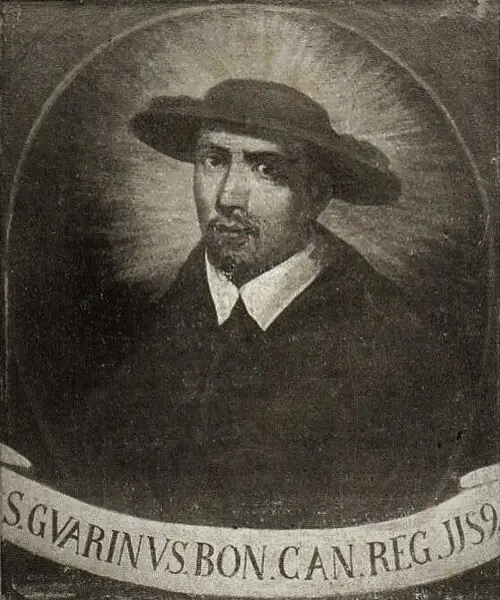
Guarino Foscari, known to history as Guarinus of Palestrina, was an Augustinian canon regular who became a cardinal despite every effort of his own to avoid the dignity. Born into the nobility of Bologna around 1080, he was ordained a priest against his parents' wishes, joined a reforming congregation of canons at Mortara, and gave away his goods to build a hospital before taking up his place there. Twice afterward he fled episcopal office — once escaping election to the see of Pavia by climbing out of a window, and once, in Advent 1144, resisting the summons of Pope Lucius II, who had him arrested, lost him briefly, and then simply appointed him Cardinal-Bishop of Palestrina in December 1144. He sold the fine horses his new rank brought him and gave the money to the poor. Thirteen years as bishop of Palestrina were marked by compassion for its needy and by a careful distance from the violent politics of Rome; he took part in the conclaves that elected Eugene III, Anastasius IV, and Adrian IV. He died on 6 February 1158, and Alexander III canonized him the following year.
The Complete Life
A Noble Son of Bologna
Guarino Foscari was born at Bologna around 1080, a member of the noble Guarini household, his mother coming from the Foscari family. The house gave him every advantage: a thorough education and, the sources note, a genuine fondness for literature, an uncommon ornament in a career that might otherwise have been purely administrative. Religion, however, was not the family's plan for him. When he presented himself for ordination, his parents opposed it — the standing of a noble house in twelfth-century Bologna was not advanced by a son at the altar — and he proceeded despite them. Ordained to the priesthood at twenty-four, he was soon named a canon of the cathedral of Bologna, a post that set him among the clergy of one of Italy's great civic churches. The pattern established itself early and never changed: where his family saw rank to be kept, Guarino saw a call to be answered, and he answered it at whatever cost to their expectations. The same instinct, tested at a far higher price, would govern every choice of the fifty remaining years.
§ Life
Canon Regular at Mortara
In 1104, at about the age his ordination had cost him his parents' approval, Foscari made a decision that completed his break with worldly standing: he joined the Santa Croce Congregation of canons regular at Mortara. The canons regular were clergy living under a rule in community — priests who held goods in common, prayed the office together, and served the churches committed to them. Before leaving Bologna he put the move beyond retreat by giving away everything he owned, directing the whole of it to the building of a hospital. It is the first recorded act of the generosity that would define his reputation: the young canon bought his new life with the price of the old one, and the poor of the place received the proceeds. At Mortara he lived the sort of hidden, orderly religious life he seemed made for — prayer in common, pastoral work, no throne in sight. Had the Church left him there, he would have been remembered, if at all, as a conscientious canon of a Lombard congregation. Instead, the honors of the Church spent the rest of his life hunting him down.
§ Life
Fleeing the Throne
At fifty-nine he was elected to fill the vacancy left in the see of Pavia by its bishop's death, and he answered by climbing out of a window. He hid until another election could be held, and the voters chose someone else. The escape could not be repeated against a pope. In the Advent season of 1144, Lucius II sent for him; again he tried to slip away from higher office, and again the means failed him — the pope had him arrested, and though he broke loose for a short time, the outcome was settled. In December 1144 he was appointed Cardinal-Bishop of Palestrina, one of the suburbicarian sees surrounding Rome. Lucius II, his own relative, bestowed on him the gifts appropriate to his new rank, among them some fine horses; Guarino sold the horses and distributed the money among the poor. Still feeling unworthy of the position, he abandoned his post twice in the years that followed: recalled once from Subiaco by order of Eugene III, and once forced from Ostia by the presence of Saracens, fleeing on to Rome. Through thirteen years as bishop he kept apart from the troubled Roman politics of his era, and as cardinal he voted in the three conclaves that raised Eugene III, Anastasius IV, and Adrian IV to the papal throne.
§ Life
Poverty in High Office
The mark of Guarinus's sanctity, in his own lifetime and in every account since, was a double refusal — refusal of honor and refusal of comfort for himself — joined to an unguarded openhandedness toward the poor. He ran from a bishop's throne through a window and hid until another man was chosen; when a pope's summons cornered him at last, he accepted the see of Palestrina and at once converted its trappings into bread, selling the horses that befitted a cardinal and handing the price to the destitute. Feeling unworthy of the office, he left it twice, and had to be fetched back — once from Subiaco by Eugene III's command, once driven from Ostia by Saracens and fleeing toward Rome. His contemporaries might have read such flights as instability; his canonization within a year of his death shows that the Church read them as they were meant, as a settled conviction that rank existed for the sake of those beneath it. His charity had a definite address: the poor of Palestrina, the town committed to him, whose need he never forgot across thirteen years of office. He is noted above all for that compassion, and the town has never stopped calling him its own.
§ Life
Thirteen Years at His Post
The last stretch of Guarinus's life was quiet, and that quiet is its own testimony. Having fled the Church's honors until they caught him, he spent thirteen years as Cardinal-Bishop of Palestrina in steady work, staying clear of the Roman politics whose turbulence defined the age and ruined so many prelates. His station did bring him to Rome when duty required: he stood among the electing cardinals at three conclaves, helping choose Eugene III, Anastasius IV, and Adrian IV — an unobtrusive record of steadiness across years when the papal throne itself was often contested. He died at Palestrina on 6 February 1158, aged seventy-eight, still the bishop of the town he had tried so hard not to govern. The man who had once escaped a bishopric through a window ended as the settled pastor of a single see, and the see remembered him for it. His death on 6 February fixed the date of his feast, which the Roman Catholic Church keeps on that day; the town whose poor he fed had already decided, well before any formal process, that its bishop was a saint.
§ Life
A Saint Within a Year
Recognition came with remarkable speed. Guarinus died on 6 February 1158; in 1159, hardly a year later, Pope Alexander III enrolled him among the saints of the Roman Catholic Church. The swiftness suggests that the holiness his contemporaries had watched — the flight from high office, the almsgiving, the compassion for Palestrina's destitute — was publicly acknowledged rather than reconstructed by committee. His feast was fixed on the day of his death, 6 February, and that remains the pattern of his cult. The pontiff who canonized him had a decisive first year: Alexander III, elected in 1159, would become one of the great popes of the century, and his early canonization of the reluctant cardinal of Palestrina stands among the acts with which the reformed papacy was consolidating its control of the calendar of saints. Whatever the exact mechanics of the cause — the surviving records are thinner than the saint's reputation — the verdict of 1159 has never been revised. The Church venerates him with the crozier and the cardinal's dress for his emblem, the signs of the office he fled and then filled with distinction.
§ Introduction
The Lost Grave of Palestrina
Guarino was laid to rest in the crypt beneath the cathedral of Sant'Agapito in Palestrina, but his grave did not keep his name safe. In 1473 the town was looted, and those who tended his memory hid the remains to spare them from desecration — hiding them so thoroughly that they have never been found again. A search undertaken in 1754, nearly three centuries later, failed to locate them. The saint thus survives without a tomb: honored in the calendar on 6 February, remembered as the particular patron of Palestrina, and known by his deeds rather than by relics. His story has kept its hold on hagiographers because it states the Gospel of poverty in office so concretely: the canon regular who gave away everything twice, once to build a hospital at Mortara and once to feed the poor of Palestrina; the bishop who climbed out of a window rather than accept a see; the cardinal who sold the fine horses his pope gave him and handed the money to the hungry. In art he wears the dress of the dignity he never wanted. Few lives argue so plainly that authority in the Church exists for those beneath it.
§ Life
Timeline
- 1080
Born at Bologna into the noble Guarini household; his mother was a Foscari
§ Life
- 1104
Joined the Santa Croce Congregation of canons at Mortara, having beforehand given all his goods toward building a hospital
§ Life
- Dec 1144
Appointed Cardinal-Bishop of Palestrina by Pope Lucius II after attempts to evade the office
§ Life
- 6 Feb 1158
Died at Palestrina at the age of seventy-eight
§ Life
- 1159
Canonized by Pope Alexander III
§ Introduction
- 1473
Palestrina was looted and his remains hidden to spare them from desecration
§ Life
- 1754
A search for the long-hidden remains failed to locate them
§ Life
The Record
- Patron of
- Palestrina
- Symbols
- Cardinal's attire·Crozier
- Canonization
- Canonized by Pope Alexander III in 1159
Prayer
Bibliography
Show 5 sources
- Miranda, Salvador. "FOSCARI, Can. Reg. of S. Maria di Reno, Guarino (1080/1084-1158)". The Cardinals of the Holy Roman Church. Florida International University Libraries. OCLC 53276621.
- Bolognini, Daniele. "San Guarino Bishop of Palestrina", Santi Beati.
- Walsh, Michael J., A New Dictionary of Saints: East and West, Liturgical Press, 2007, ISBN 9780814631867.
- Butler, Alban and Burns, Paul. Butler's Lives of the Saints: February, p. 66, A&C Black, 1998, ISBN 9780860122517.
- Burns, Paul, Butler's Lives of the Saints (2000), p. 66, The Liturgical Press, ISBN 0814623883.
Profile text adapted from the Wikipedia article, licensed CC BY-SA 4.0.
Pray with this saint every day
Save St. Guarinus of Palestrina to your favorites, read the full profile, and get feast-day reminders in the Saints app.
Get the Saints AppFree on the App Store for iPhone and iPad